



The Gist
We’re at war with Iran, we’ve fought in Venezuela, and troops have spent this year on a drug-boat campaign at sea.
The Pentagon’s own count says 23 service members are dead and 866 wounded in action in the Iran war alone.
They are coming home to a VA health system that lost about 23,700 staff in a single year by VA’s own numbers, while a Senate witness told Congress that paying disabled veterans makes them sick, and a House bill tried to cut future sleep apnea and tinnitus ratings to pay for other benefits.
In 1944 this country passed the GI Bill, and by VA’s own estimate the extra income taxes alone would cover the cost several times over.
On Veterans Day 2026 we need a new deal for veterans, and the new Congress that takes over in January is the place to start.
I joined the Navy in January 1983 and served until December 1990. I’ve spent more than three decades since then watching how this country treats its veterans.
When we win, or when a tragedy like 9/11 hits, civilians hoist us onto their shoulders and carry us through town, full of gratitude and pride. Washington swears to uphold its sacred duty to us.
Then the operation fades behind other news. The war ends, the crisis passes, a little time goes by, and we find ourselves dropped from their shoulders.
The next time someone in Washington walks toward us, they’re carrying pitchforks and torches.
Veterans Day is Wednesday.
The parades will run. The politicians will post flag photos. Restaurants will hand out free pancakes.
And since February 28, when President Trump launched it, we’ve been at war with Iran. The Pentagon’s own casualty system counts 23 dead and 866 wounded in action, as of November 5, across the two categories it uses for this war, and those numbers have moved more than once, including downward.
Iran isn’t the only one. In January, U.S. forces struck Caracas and captured Venezuela’s president. Iranian drones and missiles have killed U.S. troops at bases from Kuwait to Jordan. In March, thousands more troops were at sea on the drug-boat campaign in the Caribbean. This spring, the President said Cuba is next. On October 23, he floated it again.
Put the war in scale. Every year, war or no war, more than 200,000 service members leave the military. In fiscal 2025, 476,802 veterans started receiving VA disability compensation for the first time, veterans of every era, up from 280,694 four years earlier. That fiscal year ended five months before the first shot in Iran. That’s the load VA was already carrying.
War and defense are expensive. Blood and treasure.
All of them will be veterans, combat or not. We are making new veterans every day, and they’re coming home to a VA health system that is shrinking, and to a Congress that spent this year arguing about whether veterans get too much.
So here’s what I’m asking for this Veterans Day: a new deal for veterans, written into law. Fund VA’s own care first. Stop paying for one veteran’s benefit with another veteran’s rating. Staff up before the next wave comes home. There are eight demands in all, and every one of them comes out of the record below.
We’ve been here before. We know how it ends when we get it right.
We already know how to do this
On June 22, 1944, Franklin Roosevelt signed the Servicemen’s Readjustment Act. The GI Bill.
It nearly didn’t pass. Plenty of people in Washington thought it was too expensive, and plenty thought veterans would take the money and loaf.
It went fine.
In 1947, veterans made up 49 percent of college admissions. By the time the original bill ended in July 1956, 7.8 million of the 16 million World War II veterans had gone through an education or training program, according to VA’s own history.
By 1955, 4.3 million home loans had been granted, worth $33 billion. Veterans bought 20 percent of all the new homes built after the war. That’s the National Archives talking, not me.
And the cost? The education piece paid out $14.5 billion. The Veterans Administration estimated, the Archives notes, that the increase in federal income taxes alone would cover the cost several times over.
Veterans earned that benefit. And the country still came out ahead. It may be the best investment this country ever made in its own people.
It wasn’t fair to everyone. The law was race-neutral on paper. In practice, local banks decided who got the loans and segregated colleges decided who got in. Of the 3,229 GI Bill-guaranteed home, business and farm loans made in Mississippi in 1947, two went to Black veterans, according to historian Ira Katznelson. Economists Sarah Turner and John Bound found the GI Bill raised college attainment for white veterans and for Black veterans born outside the South, but did little for Black veterans limited to the South’s segregated colleges.
A new deal has to do better than the old one.
But the principle held. You take care of the people who raised their right hand, and they build the country back up.
For thirty years, when civilians find out I’m a veteran, the GI Bill comes up. The one they’re picturing is 1944: free college, a house, a fresh start. That bill ended in 1956.
After that, later GI Bills mostly gave back less. The Korea GI Bill stopped paying schools and handed veterans one flat check to cover everything. Vietnam veterans started at $100 a month, about half what World War II veterans got in real dollars. Once the draft ended, troops had to pay in: a pay cut to buy their own benefit. Tuition paid straight to the school didn’t come back until the 2008 Post-9/11 GI Bill, and the first of those benefits started in August 2009.
What we’re doing instead
I went back four years, November 2022 to now, across two administrations.
It started under Biden. In early 2024, VHA ran an internal budget squeeze aimed at hiring and community care. The fiscal 2025 budget request proposed cutting VHA by 9,457 full-time equivalents, the budget’s measure of staffing. Then VA projected a shortfall of nearly $12 billion, later cut to $6.6 billion, and had to go back to Congress. The VA Inspector General blamed outdated budget data.
Outside the administration, the ideas got bigger. The Washington Post editorial board floated means-testing disability pay in 2023. Project 2025’s VA chapter said some service-connected conditions are “tenuously related or wholly unrelated to military service.” The Congressional Budget Office keeps a menu of budget cuts. Means-testing disability pay would save $384 billion over ten years in the latest version.
For the record, Biden’s VA Secretary and the Senate committee’s chairman and top Republican all rejected means-testing out loud. Trump’s VA Secretary, Doug Collins, made his own promise at his confirmation hearing: “we’re not gonna balance budgets on the back of veterans benefits.” Hold him to it.
Then, under Trump, the cuts got bigger. In March 2025, an internal VA memo, first reported by Government Executive, targeted up to 83,000 jobs. By July, Collins said VA would settle for nearly 30,000 through attrition, buyouts and the hiring freeze, and called a mass layoff “off the table.”
VA’s own workforce dashboard shows what that looked like. VHA had 416,667 people on September 30, 2024. A year later it had 392,994. That year opens with Biden’s last four months and runs through Trump’s first eight. That’s 23,673 gone from the health system, including about 1,068 physicians and 3,002 registered nurses.
Then in December 2025, VA cut somewhere between 25,000 and 35,000 open VHA positions, according to Stars and Stripes and Military Times. VA’s spokesman put the number at about 26,400 and said they were mostly COVID-era roles.
Meanwhile VA’s Inspector General counts severe staffing shortages at VA facilities: 2,959 in 2024, 4,434 in 2025, 4,712 in 2026.
Fewer people. More shortages. And more money going out the door to private care: discretionary community care went from $22.6 billion in fiscal 2025 to $34 billion requested for fiscal 2026, and VA asked for $39.7 billion in fiscal 2027.
The Playbook. Starve it. Point at the wreckage. Say it doesn’t work.
The sales pitch
You don’t cut this deep without a story to sell it.
The story got its big stage on October 29, 2025, at a Senate Veterans’ Affairs Committee hearing that followed a Washington Post series on veterans exploiting the disability program. The star witness was Daniel Gade, a retired Army lieutenant colonel. He told the committee:
“For too long you have been told that the best way to care for veterans is to shovel billions of taxpayer dollars into their pockets.”
And:
“By paying veterans to be sick, we create more sick veterans.”
Later in the same hearing, a senator asked him how common outright disability fraud really is. His answer: “outright disability fraud is actually quite rare.” His bigger worry, he said, was lax oversight and exaggerated conditions.
VA’s Inspector General, Cheryl Mason, sat at the same table. She testified that about 3.7 percent of her office’s active fraud investigations involve veterans suspected of fraud in the compensation programs. She also told the committee: “The largest percentage of fraud in VA programs and operations is perpetrated against VA and veterans.” And she said using her office’s evidence “to make it appear like there is mass fraud by veterans, misleads the public and maligns veterans.”
So neither of them described a fraud wave. The witness called outright fraud rare. The IG said dressing it up as mass fraud misleads the public.
They didn’t need it to be real. They needed it to be in the air when the cuts came.
The quiet part
The cuts came.
In January 2026, VA told a House subcommittee it anticipated finalizing the rest of its rating schedule overhaul, including the rules on sleep apnea and tinnitus, “by the end of FY 2026.” In June, VA’s press secretary told Task & Purpose that “no changes are planned or imminent,” and that the 2022 proposal “would need to undergo significant changes prior to being finalized.” The fiscal year ended September 30. Nothing published. But VA’s entry in the federal regulatory agenda still lists the rule at the final rule stage, flagged as a major rule, with final action projected for April 2027.
Congress tried a shortcut. H.R. 9237, the Take Care of America’s Veterans Act, written by the Republican chairmen of both veterans’ committees and backed by the Trump White House, carried a provision, Section 108, that would have written lower sleep apnea and tinnitus ratings into law for future claims, and used the savings to pay for other benefits. The committee’s own summary says the bill is “fully offset by codifying a bipartisan change to VA’s ratings schedule.”
The money was for the Major Richard Star Act, which lets combat-injured military retirees collect both their retired pay and their VA disability pay. They earned that. So did the veteran whose ears have rung since the rifle range. Congress made one pay for the other.
It didn’t stop at ratings. Section 104(b) of the same bill would have raised the funding fee on VA’s streamline refinance, the interest rate reduction refinancing loan, from 0.5 percent to 1.42 percent, and would have doubled the fee to take over someone’s VA loan, to 1 percent. Veterans who draw VA disability compensation would remain exempt, as would a few others the law already waives. Everyone else using those loans would have paid the higher fee. CBO estimated that nearly the same fee increases, in an earlier bill later folded into this one, together with extending other loan fees already on the books, would cut spending by about $4 billion over 2026 to 2036. Veterans’ own mortgages, used as the offset. I laid out every offset in this bill in July.
Doug Collins said we’re not going to balance budgets on the back of veterans benefits. The bill his White House backed balanced its own budget on two of them.
On July 16, Democrats moved to send the bill back to committee. It failed 210 to 211. Then House leadership pulled the bill before a final vote anyway. It’s not law.
That bill is all but dead. Any bill that hasn’t passed when this Congress ends on January 3 dies with it. The only way H.R. 9237 becomes law now is a push in the lame duck, and I don’t expect one. What to watch is whether the new Congress brings Section 108 back under a new bill number, and whether VA finalizes the same cuts on its own in April.
A new deal for veterans
Eight demands. Every one of them comes out of the record above.
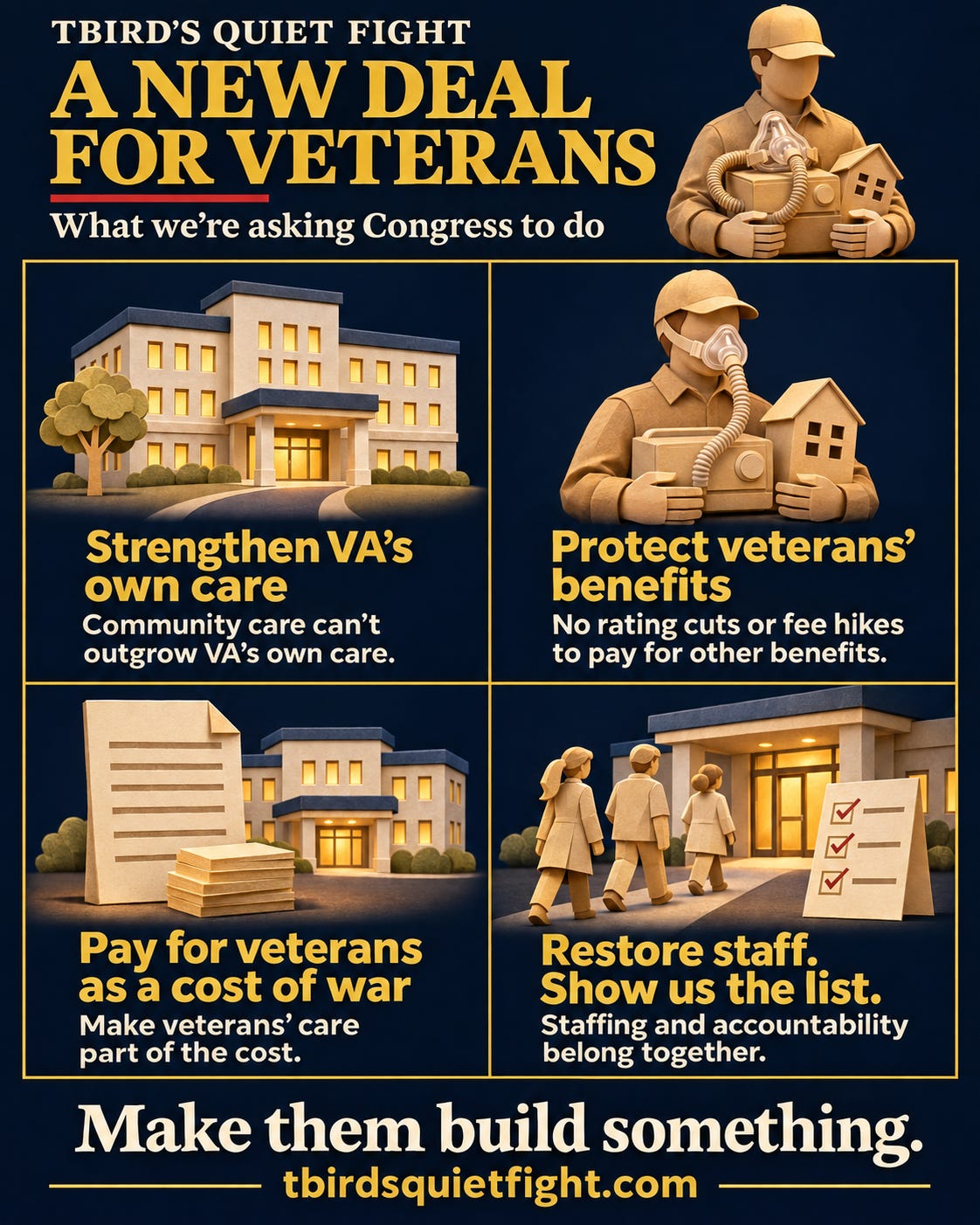
None of them is out of reach. DAV and VFW’s budget for fiscal 2027 asks Congress to grow VA’s own care and fill about 40,000 clinical vacancies. Several of the rest already have a bill or a veterans group behind them.
One rule runs under all eight. A service-connected disability is a service-connected disability. A combat wound, a flight line injury, a burn pit, a training accident, ears that ring from the rifle range. Congress doesn’t get to rank us to make the math work.
1. Community care can’t grow faster than VA’s own care, and its overruns can’t come out of VA’s own care. This isn’t new. In 2017 and 2018, community care ran $1.2 billion and $2.2 billion over VA’s estimates. VA’s answer is that community care is faster and closer. In 2024, VA’s own hand-picked panel of health care leaders, the Red Team, found community care “is often no more timely nor of superior quality to the care offered by the VA,” and warned that rising community care costs “decrease available funds for VHA’s direct care system” unless Congress adds money. Now VA’s fiscal 2027 budget assumes its own staffing will decrease, which it says will “reduce VHA capacity” just as demand for its care grows, and models the gap with more community care. VA’s reason: staff grew during COVID faster than the workload did, which drove up its cost per patient. VA says productivity gains will cover part of the gap. The rest goes out the door to community care. When VA can’t meet the access standards, the answer is to hire, not to ship the money out the door. A veteran who qualifies for community care still gets it. The limit is on the budget, not the veteran.
2. Money set aside stays set aside. The PACT Act created the Toxic Exposures Fund to pay for care, claims and research tied to toxic exposure. In April 2024, the Republican chairman of the House Veterans’ Affairs Committee, Mike Bost, said Biden’s VA was using it as “another budget gimmick.” Two years later, with Trump’s VA running the fund, VA’s Inspector General found this August that VA can’t track the fund to individual episodes of care, which “increases the risk that funds will be used for purposes inconsistent with the law.” The fund itself isn’t the problem. Every dollar gets tracked to the veteran and reported in public, and nobody parks regular VA costs in it to get around the budget caps. That goes for any fund Congress earmarks.
3. Guaranteed, mandatory funding for VA’s rural clinics, and more of them. VA’s Office of Rural Health counts 2.99 million rural veterans enrolled in VA care, out of 9.1 million, and rural veterans sign up at a higher rate than urban ones. VA care is already funded a year ahead, but it still runs through the annual appropriations fight. A rural veteran’s clinic shouldn’t depend on who wins the next budget standoff. And build more of them. Every rural clinic VA doesn’t open is a veteran pushed into community care or a long drive.
4. When we send troops to combat, VA staffs up and starts writing it down. There’s already a bill that tries. The Full Cost of War Act, introduced in January by Reps. Chris Deluzio and Ted Lieu, would require any future war authorization or declaration of war to authorize funding for the veterans’ care and benefits that follow. Authorizing isn’t paying. Fund it. The gap: the Iran war has neither. Congress has voted on war powers again and again and never authorized it. So the trigger has to be deployment, not a vote Congress may never take. Document every exposure and injury while troops are still in uniform, keep a casualty count that doesn’t shrink without explanation, and fund the VA research that turns exposures into recognized conditions. Burn pits taught us what happens when nobody writes it down.
5. No rating cuts or fee hikes as offsets. No Section 108 and no Section 104(b), in any bill, in any Congress. Rating criteria change when the medicine changes, never because a bill needs to pay for something. And a veteran’s home loan is a benefit, not a piggy bank for the rest of the budget. Pass the Star Act and pay for it as a cost of war: out of the Department of War’s own budget, or out of a veterans care trust fund that Congress fills every time it sends troops to fight. Not out of another veteran’s rating. The trust fund isn’t a new idea. Harvard economist Linda Bilmes has pushed one for more than a decade. In 2017, Rep. Beto O’Rourke, two Republicans and another Democrat filed a bill that would have opened a trust fund for every war, including wars fought under the War Powers Resolution with no declaration, paid for with a war tax. It never got a vote.
6. Protect existing ratings, all the way. The House committee says no veteran currently rated for sleep apnea or tinnitus would lose benefits under H.R. 9237, and Section 108 does bar using the new criteria to cut compensation a veteran was already getting. DAV’s national commander says the changes would still reach “any reassessments or reevaluations of existing claims.” Here’s the gap: protecting today’s check isn’t protecting the veteran. The veteran rated for sleep apnea who gets worse and files for an increase gets judged under the new, lower criteria. Write it into law that a veteran already service-connected for a condition keeps the old criteria for every later claim on it.
7. Go after the claim sharks, not the veterans. The witness who sold the fraud story admitted outright fraud is “actually quite rare.” The Inspector General said about 3.7 percent of her office’s active fraud investigations involve veterans suspected of compensation fraud, and that the largest share of fraud in VA programs and operations is committed against VA and veterans. The real predators are the unaccredited companies charging veterans for claims help, and VA has asked Congress to bring back criminal penalties for them. The GUARD VA Benefits Act and this year’s SAFEGUARD Veterans Act would do it. Neither has passed.
8. Restore the staff, and show us the list. Bring VHA back to at least its September 2024 level of 416,667. Publish every position deleted in December 2025, by facility and job title. VA already has to post staffing and vacancies by facility every quarter under the 2018 MISSION Act. Its own Inspector General found in 2019 that VA only partly complied, and in 2021 that VHA “lacks assurance that the figures published in the quarterly staffing and vacancy reports are accurate.” A bipartisan bill filed this June, H.R. 9533, would make the health system’s staffing and vacancy counts monthly, by facility and by occupation, and its hiring and departure counts monthly by occupation. Pass it, so every veteran can see what happened at their own VA.
Who has to do it
The new Congress takes office January 3, 2027. Democrats won both chambers on November 3, according to projections by ABC News and other major outlets. That means new committee chairs and new agendas, and a window.
Until then, the old Congress is still in session, and unlikely isn’t impossible. A lame duck is a good place to hide a provision like Section 108.
So call now, and call again in January.
Make the Call
A phone call takes two minutes. Congressional offices often track constituent calls by issue. When one issue lights up the phones in the same week, staff tend to notice.
Who to call:
Your own U.S. Representative and Senators: they work for you. Find yours here.
Rep. Mike Bost (R-IL), Chairman, House Veterans’ Affairs Committee: (202) 225-5661
Sen. Jerry Moran (R-KS), Chairman, Senate Veterans’ Affairs Committee: (202) 224-6521
Capitol Switchboard (connects to any member): (202) 224-3121
Script 1 (veteran or military family): “Hi, my name is [NAME] and I’m a [veteran / military family member] in [STATE]. I’m calling about veterans’ benefits and VA health care. VA’s own numbers show its health system lost about 23,700 staff in one year, while a House bill tried to pay for other benefits by cutting future sleep apnea and tinnitus ratings and raising fees on veterans’ home loans. I’m asking [MEMBER] to oppose any rating cuts or fee hikes used as offsets, in the lame duck or next year, and to push for a hearing on VA staffing. What is the [Congressman’s / Senator’s] position? Thank you.”
Script 2 (citizen): “Hi, my name is [NAME] and I’m a constituent in [STATE]. We’re at war with Iran and VA’s health system is shrinking. I’m asking [MEMBER] to oppose any cut to veterans’ disability ratings used to pay for other spending, and to support restoring VA staffing. Thank you.”
How offices handle what you send (practices vary by office):
Phone calls get logged in real time by issue and position (for/against). A staffer marks it in their system the moment you hang up. When a member asks “what are people calling about this week,” your call is in that count. A spike on one issue in a short window is hard for staff to miss.
Personal emails (not form letters) get read, categorized, and usually receive a response, but they sit in a queue. Most offices process constituent mail in batches. Your email might not get logged for days. It still counts, but it doesn’t create the same real-time pressure as a ringing phone.
Form emails and petitions (pre-written “click to send” campaigns) get the lowest weight. Offices batch-count them. They know you clicked a button. Better than silence, but a personal call or letter carries more weight.
Letters to the editor in your local paper punch way above their weight. Congressional offices have staff assigned to clip and track local media mentions of their boss. A published letter is public, reaches other voters, and can get picked up by larger outlets.
Op-eds in local or regional papers reach the same staff who track local coverage of their boss.
A good combination: Call first. Follow up with a personal email. Then write a letter to the editor. Each one reaches the office through a different channel.
Tips:
You don’t need to be an expert. You just need to be a constituent.
If you get voicemail, leave the message anyway.
Call during business hours (9 AM to 5 PM Eastern) for the best chance of reaching a staffer.
Be polite, be brief, and state your ask clearly.
If a staffer asks follow-up questions, answer them. It helps them get your concern right.
Go Deeper
Write a Letter to the Editor (10 minutes)
Most local papers accept 150-200 word letters. Mention your representative by name. State your veteran status if applicable. Stick to facts from this article.
Find your local paper’s submission page or email the opinion desk directly. Tips:
Localize it: mention your rep by name and your nearest VA facility
Keep it under 200 words
Say you’re a veteran if you are
Don’t submit the same letter to multiple papers simultaneously
Contact Your VSO
If you’re a member of VFW, DAV, American Legion, VVA, IAVA, or any other Veterans Service Organization, contact your local chapter and ask what their position is on this issue. VSOs have lobbying power. Use it.
Share This Article
Forward it. Post it. Print it. The veterans affected by these decisions often can’t amplify their own stories. You can.
About This Publication
Tbird’s Quiet Fight is independent investigative journalism focused on VA policy, veteran benefits, and government accountability. Published by the founder of HadIt.com, one of the oldest veteran-run VA claims communities online (est. 1997).
Support this work: Subscribe to TQF | Support HadIt.com
For Press and Advocates
Congressional oversight contacts:
House Veterans’ Affairs Committee: (202) 225-3527 | veterans.house.gov
Senate Veterans’ Affairs Committee: (202) 224-9126 | veterans.senate.gov
House VA Oversight & Investigations Subcommittee: veterans.house.gov/issues
Investigative journalists covering VA/veteran policy:
Suzanne Gordon, American Prospect
Jasper Craven, American Prospect
Nikki Wentling, Military Times
Leo Shane III, Military Times
Quil Lawrence, NPR
Veteran advocacy organizations:
Government watchdog resources:
USAspending.gov (track federal contracts and grants)
Paper Trail
Servicemen’s Readjustment Act of 1944, National Archives
VA history of the GI Bill, VA publication, archived
Congressional Research Service, “A Brief History of Veterans’ Education Benefits and Their Value,” RL34549, report
Congressional Research Service, “A Brief Overview of the Post-9/11 Veterans Educational Assistance Act of 2008,” RS22929, July 28, 2008
Ira Katznelson, “When Affirmative Action Was White,” History & Policy policy paper, drawn from his book of the same name (W. W. Norton, 2005), link
Sarah Turner and John Bound, “Closing the Gap or Widening the Divide: The Effects of the G.I. Bill and World War II on the Educational Outcomes of Black Americans,” Journal of Economic History 63, no. 1 (2003): 145-177, NBER working paper
Senate Veterans’ Affairs Committee hearing, Oct. 29, 2025, S. Hrg. 119-189, transcript
VA Workforce Dashboard, Issue 30 (FY2025 year-end, as of Sept. 30, 2025), PDF
VA OIG, severe occupational staffing shortages, FY2025 (25-01135-196) and FY2026 (26-01046-271)
Congressional Record, Senate, March 30, 2023, Tester and Moran on means-testing, S1066
VA release, “VA to reduce staff by nearly 30K by end of FY2025,” July 2025
VA written testimony, Jan. 14, 2026, House VA Disability Assistance subcommittee
CBO budget option, means-testing VA disability compensation, Dec. 12, 2024
Defense Casualty Analysis System, Operation Epic Fury and Overseas Operations casualty pages, OEFU and Overseas Operations
DefenseScoop, Brandi Vincent, on the Jan. 3, 2026 Venezuela raid, coverage
AP, Iranian drone strike killing U.S. soldiers at Port Shuaiba, Kuwait, March 2026
Task & Purpose, Nicholas Slayton, “Two US troops killed, one missing in Iranian attack on Jordan,” citing U.S. Central Command, July 18, 2026
Stars and Stripes, U.S. presence in the Caribbean, March 12, 2026
“Trump says ‘Cuba is next’,” TimesLIVE, March 28, 2026
Associated Press, Meg Kinnard and Josh Boak, “Trump at South Florida rally revives the idea of military intervention in Cuba after Iran,” October 23, 2026
VA FY 2027 Budget Submission, Volume 2, Medical Programs, p. 20 (”Key Drivers of Growth in Projected Resource Requirements”), PDF
Task & Purpose, Patty Nieberg and Jeff Schogol, VA statement on the 2022 rating proposal, June 16, 2026, updated June 17
Unified Agenda, RIN 2900-AQ72, sleep apnea and tinnitus rating rule, reginfo.gov
House Veterans’ Affairs Committee, Take Care of America’s Veterans Act one-pager, PDF
VA Office of Rural Health fact sheet, January 2026, PDF
“The Urgent Need to Address VHA Community Care Spending and Access Strategies,” Red Team Executive Roundtable report, March 30, 2024, copy obtained by Empower Oversight
VA Annual Benefits Report, FY2025, Compensation section, p. 76 (new compensation recipients FY2021 to FY2025), PDF
Congressional Research Service, Military Transition Assistance Program (TAP), R48114, June 27, 2024, report
House Roll Call 249, motion to recommit H.R. 9237, July 16, 2026
H.R. 9237 as introduced, Sec. 104(b), bill text
Military Times, Natalie Oliverio, on the H.R. 9237 home loan fee increases, Sept. 15, 2026
Congressional Budget Office, cost estimate for H.R. 6047, home loan fees, March 12, 2026
DAV, “Veterans Independent Budget seeks to address VA funding shortfalls” (FY2027 Veterans Independent Budget, DAV and VFW), 2026
Roll Call, “Grim echoes of Iraq, Afghanistan in veterans policies” (Linda Bilmes trust fund proposal), July 5, 2013
H.R. 1790 (115th), Veterans Health Care Trust Fund Act, as introduced March 29, 2017
VA, MISSION Act Section 505 staffing and vacancy data, quarterly releases
VA OIG, Staffing and Vacancy Reporting under the MISSION Act of 2018, 19-00266-141, June 25, 2019; Inconsistent Human Resources Practices Inhibit Staffing and Vacancy Transparency, 20-00541-133, June 10, 2021
H.R. 9533 (119th), Veterans Health Administration Personnel Transparency and Accountability Act, as introduced June 29, 2026
VA OIG, review of the $12 billion supplemental request, March 27, 2025
This is journalism and opinion, not legal or claims advice. For a VA claim, talk to a VA-accredited representative.
Last verified: November 9, 2026
I use AI as a research and editing assistant, the same way I’d use a good reference book or a sharp editor. Every word published here is reviewed, verified, and approved by me. The perspective, accuracy, and editorial decisions are mine.
Theresa “Tbird” Aldrich, Navy veteran (VAQ-34, 1983-1990), Investigative Journalist, TbirdsQuietFight.com, Founder of HadIt.com | Advisory Board Member, Veterans Healthcare Policy Institute (VHPI).