


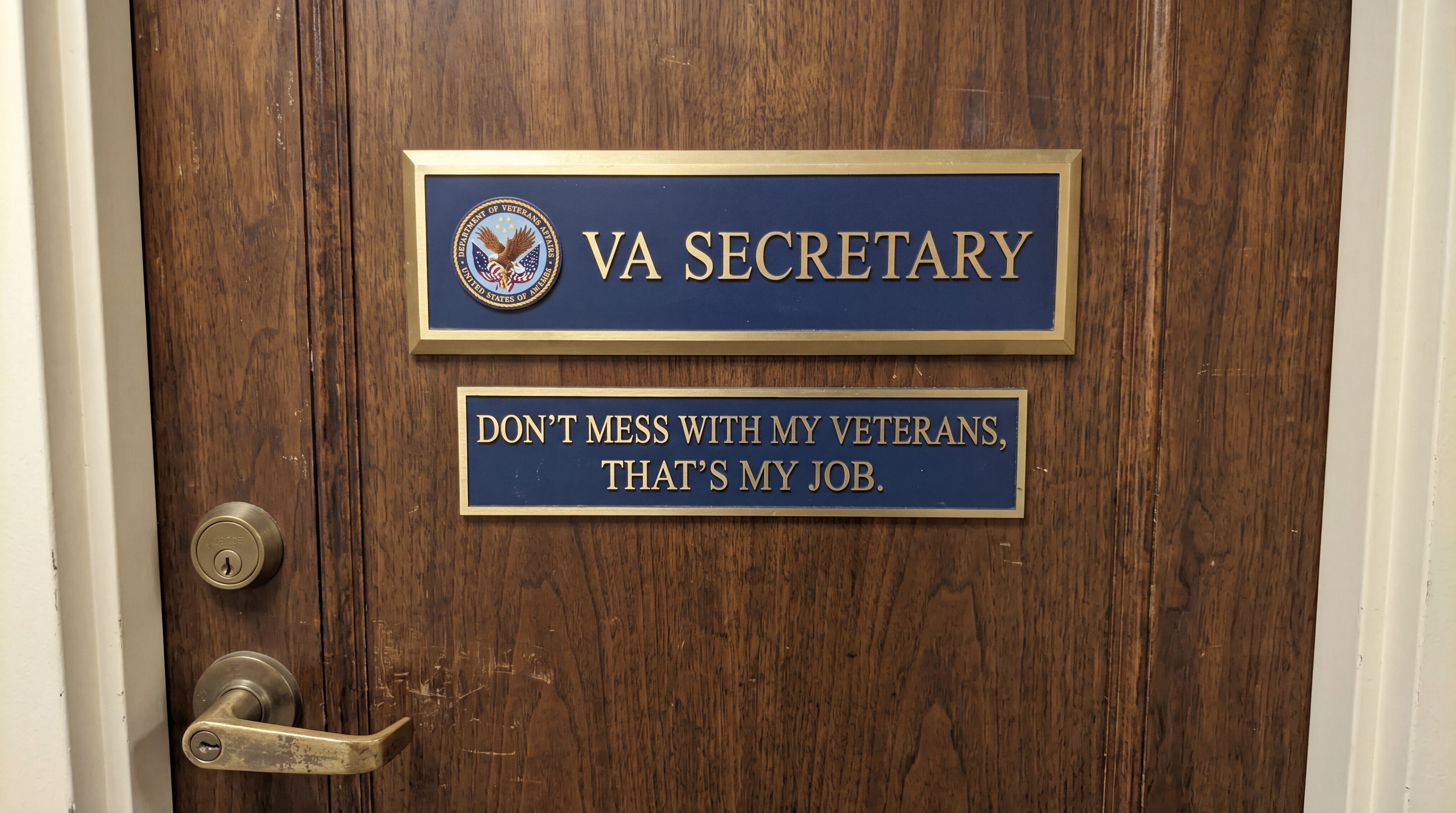
His door. His record. 40,000 VA employees fired anyway. (AI-generated illustration)
The Gist
Doug Collins spent eight years in Congress and never once served on the House Veterans’ Affairs Committee. He voted yes when everyone else did, left before the hard vote came, and was confirmed as VA Secretary 77-23. Then he fired 40,000 VA employees, compared it to Southwest Airlines, stripped male breast cancer from the PACT Act using a gender ideology executive order, and floated a rule penalizing veterans for taking their medication. Veterans weren’t irrelevant to his brand. They were irrelevant to his work.
On March 5, 2025, PBS NewsHour played VA Secretary Doug Collins an audio clip of a fired VA worker: an Air Force veteran, twice promoted, who had received a form termination letter citing “poor performance,” a man who said he had just gotten awards and certificates of achievement from management.
The anchor asked Collins to respond.
Collins said the man was a “probationary employee” in a non-front-facing position. Then:
“It happens all across the country in many jobs that we’re seeing just in the last little bit with Southwest Airlines and others who are announcing large layoffs. These are the kind of things that are hard to do.”
Six days later, Collins expanded on it for Stars and Stripes.
“I hear very little when Southwest Airlines lays off 15% of their workforce. Nobody really mentions the veterans at that point. Nobody mentioned the veterans for that matter at Caterpillar.”
Nobody was comparing veterans to crop machinery. He was.
He said it twice. In two separate interviews. Six days apart.
That is not a gaffe. That is a mission statement.
Who He Said He Was
Collins built his political identity on military service and did not underuse it.
Air Force Reserve chaplain. Iraq war veteran. Twenty-three years in uniform. In his first Senate campaign ad in 2020, looking directly into the camera: “I’m a state trooper’s kid, a husband, a father, an Air Force chaplain and Iraq War veteran.”
The Air Force formally warned Collins’s campaign that October for running ads featuring his uniform without the legally required disclaimer that the military does not endorse him. He ran the ads anyway.
At American Legion conventions. At VFW events. At his confirmation hearing, he told the committee: “We’re not going to balance budgets on the back of veterans benefits.” After his confirmation was announced, the American Legion reported his promise: “The veteran will be first.”
One month into the job, Military.com reporter Patricia Kime wrote a story about a DOGE aide accessing VA computer systems. Collins called it “rumors” and “innuendo.” He called her in for a sit-down, pulled out a printed copy of her article, and read her words back to her.
“That hurts my veterans. That scares my veterans. That scares my employees. Because it’s not true.”
Then he asked her to commit to not doing it again.
The VA’s own press office had confirmed the details in her story.
This is the branding. Keep it in mind.
The Congressional Record
Collins served in the House for eight years, representing Georgia’s 9th District from 2013 to 2021.
He never served on the House Veterans’ Affairs Committee.
Not one term. Not a subcommittee assignment. Not an informal request. Eight years in Congress, and the committee that oversees the people he now runs was not where he put his work.
What he voted for: the Veterans Access, Choice, and Accountability Act of 2014 passed 420-5. The VA Accountability and Whistleblower Protection Act of 2017 passed 368-55. The VA MISSION Act of 2018 passed 347-70. Collins voted yes on all three. So did almost everyone else.
He introduced the Newborn Care Improvement Act in 2014. Then again in 2015. Then again in 2017. It would have doubled the hospital coverage period for babies born at VA facilities from seven days to fourteen. It never received a House vote.
He left Congress in January 2021. The PACT Act, the most significant veterans legislation in a generation, passed in August 2022. He was never tested on it.
Military.com noted on his nomination that Collins “did not play a prominent role on veterans issues during that time and never served on the House Veterans Affairs Committee.” GovTrack, analyzing his major votes: his yes votes “aren’t too revealing about his priorities, since the vast majority of Congress voted for all three as well.”
Veterans weren’t irrelevant to his brand. They were irrelevant to him.
February 4, 2025
The Senate confirmed Douglas A. Collins as the twelfth United States Secretary of Veterans Affairs, 77 to 23. Bipartisan. Comfortable. Twenty-four Democrats voted yes. They had watched him vote with the crowd for eight years, heard his promises at the confirmation hearing, and handed him a $440 billion agency and 484,000 employees.
What He Did With the Keys
The original plan: cut 83,000 employees.
After significant blowback, the revised official target: 30,000.
By the end of fiscal year 2025, the VA had shed more than 40,000 employees. Eighty-eight percent from the Veterans Health Administration. Three thousand registered nurses. One thousand physicians. Seven hundred social workers. The first net loss of VA staff in the department’s history.
The loss of those 1,000 physicians translated to approximately 1.2 million veterans losing their primary VA provider. Mean mental health wait times exceeded 35 days, past the 20-day legal threshold for community care eligibility. A clinic in Ventura, California, lost seven of its twelve mental health providers due to return-to-office mandates and saw wait times hit 134 days. Some facilities capped therapy at eight sessions regardless of what the veteran actually needed.
Collins canceled union contracts for 80% of the VA workforce, roughly 400,000 people. Nearly a quarter of them veterans.
He then gave the Southwest Airlines interview. Then the Caterpillar interview.
The PACT Act He Never Had to Vote For
In 2022, Congress passed the PACT Act. Collins wasn’t there. He had left the year before.
As VA Secretary, he inherited responsibility for implementing it. Here is what he did instead.
Male breast cancer. The PACT Act covers “reproductive cancer of any type.” In June 2024, the Biden VA added male breast cancer to the presumptive list, expediting coverage for veterans who developed a disease that accounts for 11% of VA breast cancer cases despite being 1% in the general population. The medical case was solid: male and female breast tissue responds similarly to toxic exposures and shares nearly identical biological profiles.
Collins signed a memo on September 30, 2025, removing it.
The memo cited no new science. ProPublica obtained it. It cited Trump Executive Order 14168: “Defending Women from Gender Ideology Extremism and Restoring Biological Truth to the Federal Government.”
The VA confirmed the removal. About 100 male veterans are newly diagnosed with breast cancer each year. Each one now has to prove service connection rather than having it presumed.
Rep. Mark Takano, House Veterans’ Affairs Committee Ranking Member, put it plainly: “Cancer does not care about ideology.”
The PACT Act program office. Collins canceled the contract for the VA’s PACT Act Enterprise Program Management Office, the office responsible for screening millions of veterans, processing toxic exposure claims, and running outreach so veterans knew their new benefits existed.
The disability rating rule. In February 2026, the VA issued an interim final rule directing examiners to evaluate veterans based on their “actual level of functional impairment while taking medication or receiving treatment.”
Read that again. A veteran whose PTSD was managed by medication would be rated as less disabled than a veteran with the same underlying condition who was untreated. The rule penalized veterans for following their doctors’ orders.
Over 20,000 public comments flooded in. The VFW and the Disabled American Veterans launched coordinated pressure campaigns. The DAV’s National Commander said no veteran should ever have to worry that taking needed medication could result in a reduction of their benefits.
Collins called it “fake news” on social media. He insisted the VA had always calculated disability this way.
Within 48 hours, he announced enforcement was halted. On February 27, the VA formally rescinded the rule in the Federal Register.
He signed it, called the backlash fake news, and quietly killed it nine days later. He never explained the gap.
What 77 Senators Got Wrong
Seventy-seven senators confirmed Doug Collins as VA Secretary in February 2025. They had watched him vote yes with the crowd for eight years and concluded he was safe.
They had eight years of easy votes and not a single term on the committee that oversees veterans. They chose to read that as caution rather than indifference.
By August 2026, the lawmakers working to pass the Take Care of America’s Veterans Act were meeting without him. CNN reported it plainly: “They don’t trust him anymore.”
This week, Government Executive reported that two VA OIG employees, speaking anonymously for fear of retaliation, allege that VA Inspector General Cheryl Mason has weakened the office’s oversight of the agency. Mason is Collins’s former senior adviser. She was confirmed along party lines in July 2025. The Washington Sun reported in August that she regularly invokes her relationship with Collins, eliminated a type of alert that publicizes major VA problems at his urging, and has edited oversight reports to soften findings related to the staffing shortages Collins’s own cuts produced.
The FY2027 budget Collins submitted proposes a 4% cut to the OIG’s funding. VA’s budget increases by more than 8%.
He didn’t just fire the workforce. He’s working to quiet the people documenting what that did.
The Through-Line
Collins spent eight years in Congress and never once asked to sit on the committee that oversees veterans. He voted yes when it cost nothing to vote yes. He left before the hard vote came.
Then he got the keys.
The 23 years in uniform are real. The chaplaincy was real. The Iraq deployment was real. What’s also real: the memo, the rule, the canceled contracts, the 40,000 who no longer work there, the 1.2 million veterans who no longer have a VA doctor.
The Southwest Airlines comparison wasn’t a slip. He said it once to defend himself. He said it again six days later to make the point.
Veterans weren’t irrelevant to the branding. They were irrelevant to the work.
Take Action
Collins’s decisions affect your care and your benefits. Congress has oversight authority and is currently not exercising it.
Senate Veterans’ Affairs Committee: (202) 224-9126
House Veterans’ Affairs Committee: (202) 225-3527
Tell them: restore the PACT Act program office, demand a full accounting of VA staffing cuts and their impact on veteran care access, restore oversight independence at the VA OIG.
Report waste, fraud, or abuse at the VA: VA OIG Hotline 1-800-488-8244 or oig.va.gov
For press and advocates: ipersist@tbirdsquietfight.com
Last verified: October 21, 2026
I use AI as a research and editing assistant, the same way I’d use a good reference book or a sharp editor. Every word published here is reviewed, verified, and approved by me. The perspective, accuracy, and editorial decisions are mine.
Theresa “Tbird” Aldrich, Navy veteran (VAQ-34, 1983-1990), Investigative Journalist, TbirdsQuietFight.com, Founder of HadIt.com | Advisory Board Member, Veterans Healthcare Policy Institute (VHPI).
This is part of The Ballcap Caucus series. Read the first installment: F#!k You for Your Service: Roger Wicker
Hooyah fuck Doug!!!!