F#@k You for Your Service: H.R. 6047 and the Veterans Congress Robs to Pay Other Veterans
They named it after real veterans. They'll fund it by charging disabled veterans thousands in fees they don't pay now. And they'll call it an expansion.
The Gist
H.R. 6047 increases Aid & Attendance by $10,000/year and enhances DIC COLA (both desperately needed)
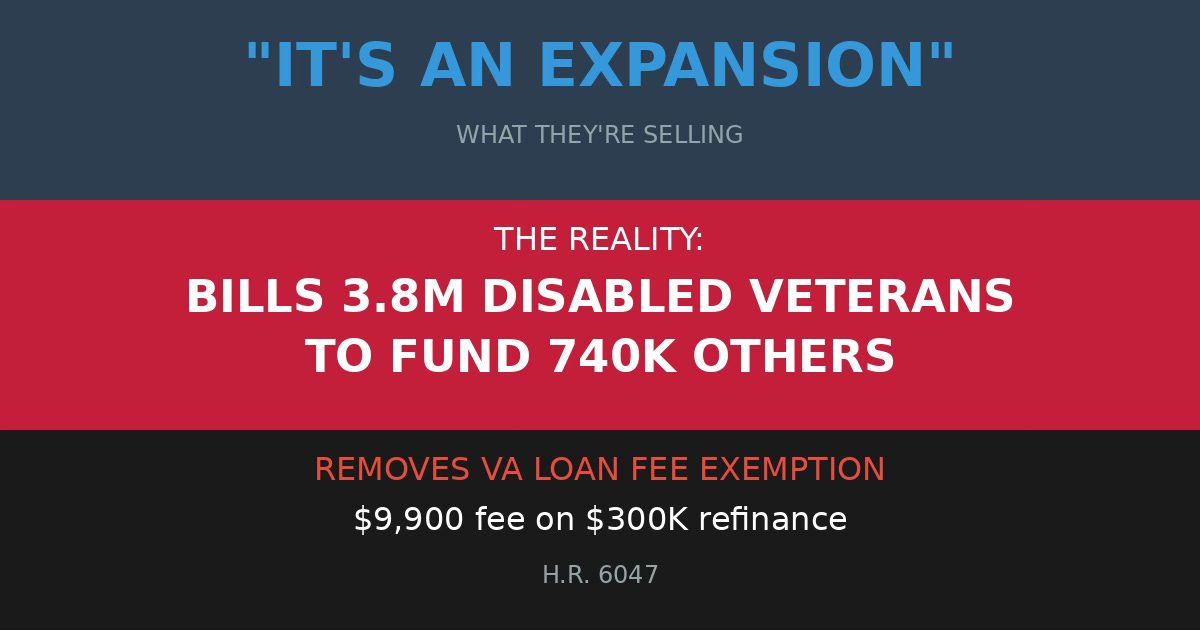
Congress isn’t appropriating new money—they’re billing 3.8 million veterans rated 10-70% to fund it
If you’re rated 10-70% and refinance after August 1, 2026: $9,900 fee on a $300K loan (you pay $0 now)
Total bill cost: $4.5 billion over 10 years (six days of Pentagon spending, 0.1% of the tax cuts Congress just extended)
Fee authority runs 9 years; DIC enhancement runs 5 cycles
Every major VSO opposed the funding mechanism at the December 3rd hearing
Chairman Bost called it “$35/month”—VFW testimony showed it’s $27,000 total over the loan life
The bill is in committee NOW—that’s where you have leverage
This isn’t expansion. It’s making disabled veterans fund other disabled veterans.
“Thank you for your service.”
You hear it everywhere. Airports. Restaurants. Baseball games.
It costs nothing to say. It means nothing. And it damn sure doesn’t pay for anything.
Want to know what it actually looks like when Congress “thanks” veterans?
H.R. 6047. Introduced November 17, 2025. Twelve House members signed on. Beautiful title: “Sharri Briley and Eric Edmundson Veterans Benefits Expansion Act of 2025.”
Named after real veterans. Real advocacy. Real need.
And funded by charging 3.8 million disabled veterans fees they don’t pay now.
That’s the transaction. That’s what “thank you for your service” is worth.
The Setup
The bill does two genuinely good things:
$10,000 more per year for veterans at 100% who need Aid & Attendance—people who can’t bathe, dress, or eat without help. This is meaningful money for veterans with profound disabilities.
Better COLA protection for DIC recipients—surviving spouses already dealing with reduced household income after losing their veteran. When Social Security goes up 3%, their DIC will go up 4%. For five years.
These are good changes. Veterans at this level of disability need more support. Surviving spouses deserve better protection against inflation.
I’m not arguing against either provision.
I’m arguing about what funds them.
The Sleight of Hand
Section 3 strips the VA funding fee exemption from every veteran rated 10-70% who refinances or takes out a subsequent VA loan.
Starting August 1, 2026.
The funding fee is 3.3% for subsequent use.
$300,000 refinance: $9,900 out of pocket
$400,000 loan: $13,200 out of pocket
You were exempt. Now you’re not.
Currently, if you’re service-connected at any percentage, you don’t pay it. Starting next August—if you’re “only” rated 10-70%—you do.
They’re charging disabled veterans thousands of dollars to fund benefits for other disabled veterans.
Because apparently tax cuts are affordable, but properly funding veterans isn’t.
Let’s Talk About Who Pays
3.8 million veterans are rated between 10% and 70%.
Some have significant disabilities. 70% isn’t a paper cut. 60% isn’t “mild.” 50%, 40%—these are serious service-connected conditions affecting daily life and earning capacity.
But they’re not at 100%. So they’re the ATM.
Here’s what burns: this isn’t about fiscal responsibility. This is about Congress avoiding appropriations fights.
It’s easier to make disabled veterans fund other disabled veterans than to actually appropriate enough money for everyone.
The Timeline
August 1, 2026: Start collecting fees from 10-70% veterans
December 1, 2026: Start paying increased benefits
Four months of revenue collection before a dollar goes out.
The fee authority runs through September 30, 2035—nine years.
The enhanced DIC COLA runs for five cycles only.
Nine years of taking. Five years of giving.
The Pattern
This is the third major pay-for scheme I’ve tracked in three years:
2023: Means-testing COLA (failed)
2024: Healthcare premiums based on rating (failed)
2025: This bill (pending)
Same playbook every time:
Frame it as expansion (it’s redistribution)
Use sympathetic names (real veterans, real stories)
Bury the pay-for (Section 3, page 4)
Set different timelines (collect first, pay later)
Make veterans fight each other (instead of Congress funding both)
The Real Question
The question isn’t “Should we help veterans with profound disabilities?”
Of course we should.
The question is: Why isn’t there enough money to help everyone without stripping benefits from other disabled veterans?
Let’s talk about what Congress can afford:
$8 trillion on the wars that disabled these veterans
$4 trillion in extended tax cuts over the next decade
$858 billion for defense contractors this year alone
$80 billion for a new fighter jet program
But $10,000/year for a veteran who can’t dress himself?
That requires taking $9,900 from a veteran with a 70% disability rating every time he refinances his house.
The money exists. It’s always existed. They found $2 trillion for corporate tax cuts in 2017 without a single pay-for. They’ll find another trillion for defense contractors next year without blinking.
But veterans? Veterans get Sophie’s Choice: Which group of disabled people do we help, and which group do we rob to fund it?
This isn’t fiscal responsibility. It’s fiscal cruelty with a flag pin.
They’ll stand for the National Anthem. They’ll wear the flag on their lapels. They’ll pose with veterans at every photo op.
And then they’ll vote to charge you $13,200 to refinance your house so they can pretend they “expanded” benefits without actually appropriating a gd dime.
That’s what “support the troops” means in practice.
That’s the transaction.
What “Thank You for Your Service” Actually Costs
Here’s the math Congress did:
Aid & Attendance increase: ~$3 billion over 10 years
Enhanced DIC COLA: ~$1.5 billion over 10 years
Total cost: $4.5 billion
For context, that’s:
0.5% of what we spend on defense annually
0.1% of the tax cuts Congress just extended
6 days of Pentagon spending
Six. Days.
But instead of appropriating it, they’re making 3.8 million disabled veterans fund it through loan fees over nine years.
Because apparently a disabled veteran refinancing to lower his mortgage payment is a more acceptable revenue source than asking defense contractors to take 0.5% less.
The cruelty is the point. The funding mechanism is the message.
“You’re worth helping—but only if we can make other veterans pay for it.”
The Hearing: Gaslighting in Real Time
The hearing happened two days ago. December 3, 2025.
Chairman Mike Bost brought Sharri Briley and Edgar Edmondson - the people the bill is named after - to testify. Real veterans. Real families. Real sacrifice.
Then he used them as human shields while he lied about what this bill actually does.
The “$35 a Month” Lie
Here’s Bost’s pitch:
“We would require any veteran rated at 70% and below to pay the home loan funding fee on their second home, the rate that all other veterans currently pay. That’s an average of $35 a month.“
Sounds reasonable, right? $35 a month to help catastrophically disabled veterans and surviving spouses?
Here’s what he didn’t say:
The fee is 3.3% of your loan amount. On a $300,000 refinance, that’s $9,900. You can pay it upfront or finance it.
If you finance it? You’re paying interest on that $9,900 for 30 years. Total cost: approximately $27,000.
The VFW put that in their written testimony. DAV put it in theirs. Every VSO who testified did the actual math.
Bost’s “$35 a month” only works if you:
Finance the fee
Keep the mortgage all 30 years (most people don’t)
Ignore the interest you’re paying ON the fee
Pretend equity doesn’t matter
It’s not “$35 a month.” It’s $9,900 out of your home equity the moment you refinance, plus years of interest payments if you finance it.
That’s not spin. That’s a lie.
The “First Home” Sleight of Hand
Bost made sure to emphasize:
“No changes would be made to a veteran’s first home buying experience. This ensures that veterans still have access to the American Dream of owning a home without paying the funding fee on their first use, regardless of their rating.”
Sounds protective, right? Like he’s preserving the benefit where it matters?
Here’s what “first use” actually means:
Refinance your mortgage when rates drop? That’s subsequent use. You pay.
Need a cash-out refi for home repairs? Subsequent use. You pay.
Buy a second home ever? Subsequent use. You pay.
“First home buying experience” means the very first time you use a VA loan. Everything after that - including refinancing the SAME house - counts as subsequent use.
Most veterans refinance at least once. Many refinance multiple times over a 30-year period. That’s how you take advantage of rate drops and build equity.
But now? Every time rates drop and refinancing makes financial sense, you’re looking at a $10,000+ fee you don’t pay today.
That’s not protecting the American Dream. That’s charging you $10K every time you try to save money.
The “Realistic” Gaslighting
Bost said:
“Opening the funding fee is a realistic way to get this done. This bill costs over seven billion dollars, and this is the path forward to get this across the finish line.”
Then:
“Under my leadership, I live in the real world, and I’m focused on getting things done. I’m focused on working with our Republican conference to make it a little easier for families to make ends meet.”
Let’s talk about the “real world”:
This bill costs $4.5 billion over 10 years (not $7 billion)
That’s 0.5% of annual defense spending
That’s six days of Pentagon budget
Congress just extended $4 trillion in tax cuts without a pay-for
But finding $4.5 billion for veterans without making other veterans pay for it? That’s “unrealistic.”
The real world Bost lives in is one where:
Billionaires get tax cuts: no pay-for needed
Defense contractors get $858 billion: no pay-for needed
Veterans get increases: better rob other veterans to fund it
“Realistic” just means “we’re not willing to fight for you.”
The Bipartisan Blame Game
Then Bost went after Democrats:
“I remain concerned by the lack of bipartisanship and rhetoric that continues to come from our friends of the other side of the aisle. My staff and I have spent months trying to understand what the other side of the aisle would need in order to support this good bill. Unfortunately, we have not received a response.”
That’s a lie.
Ranking Member Takano’s response was crystal clear:
“A veteran should never foot the bill for another veteran’s benefits, and that is what this bill is attempting to do. Republicans can find the money to pay for billionaire tax cuts but...need disabled vets to pay for our most vulnerable veterans and survivors?”
That’s not “lack of response.” That’s a very clear response: Fund both groups properly. Don’t make veterans pay for veterans.
But Bost frames that as partisan politics.
The VSO Testimony: Universal Opposition
Every major veteran service organization testified against the funding mechanism.
VFW:
“The VFW opposes reducing the benefits of one group of veterans to expand those of another. Disabled veterans have NEVER paid the funding fee in the history of the program.”
But added: “If the committee changes the funding mechanism for this legislation, the VFW would be proud to lend our support.”
American Legion: Position: “Support with amendments” (support the increases, oppose the funding)
They have TWO resolutions against this:
Resolution No. 314: Opposes VA Home Loan funding fee entirely
Resolution No. 38: Opposes making veterans fund other veterans under Pay-Go rules
They explicitly stated: “The American Legion is reluctant to continue supporting legislation that normalizes funding mechanisms that treat VA benefits as a zero-sum game.”
They proposed an alternative: Expand VA home loan eligibility to dependents (transferability) and use THAT revenue - new users, not existing disabled veterans.
DAV:
“We cannot support the provision of funding fees on disabled veterans. DAV firmly opposes all rules or statutes that require veterans benefit increases to be ‘paid for’ by cuts to other veterans benefits.”
Clear as day: “We believe that ALL Americans should be paying for the benefits and services veterans have earned in defending our freedom.”
The Emotional Manipulation
Bost brought Sharri Briley and Edgar Edmondson to the hearing. Sat them at the witness table. Made sure cameras caught them.
Then:
“The institution of Congress and this Committee is honored to have two great Americans like you both – sitting before us today. As a father, I know the weight that both of you carry each day for your families, and I just want to say thank you.“
It’s a tactic:
Name the bill after sympathetic, deserving people
Bring them to testify
Frame any opposition as disrespecting THEM
When the opposition is actually to robbing OTHER disabled veterans to fund them
Nobody opposes helping Sharri Briley. Nobody opposes helping Edgar Edmondson.
We oppose making a 70% disabled veteran pay $10,000 to refinance his house to fund it.
That’s not the same thing. And Bost knows it.
What Happens Next
The bill is still in committee. It hasn’t been marked up. It hasn’t gone to the floor.
Every major VSO opposes the funding mechanism.
Democrats oppose the funding mechanism.
But Republicans control the committee and the House.
They can push this through on party lines if they want. The question is whether enough Republicans will break ranks when their constituents - veterans rated 10-70% - start calling.
Because here’s what Bost didn’t say in his opening statement:
There are 3.8 million veterans rated 10-70%.
There are 300,000 veterans who would get the A&A increase.
There are 440,000 DIC recipients who would get the enhanced COLA.
The math is clear: they’re charging 3.8 million veterans to fund 740,000 veterans and survivors.
And they’re calling it “realistic.”
Watch It Yourself
Full hearing: YouTube
VSO written testimony:
Read them. Watch the hearing. See for yourself.
Don’t take my word for it. Don’t take Bost’s word for it.
Look at what the organizations that actually represent millions of veterans said under oath.
They all said the same thing: This funding mechanism is wrong.
What You Can Actually Do
This bill is sitting in the House Committee on Veterans’ Affairs right now. That’s where it lives or dies—or gets amended.
Committee members have more power than anyone else to change or kill this. If your representative is on Veterans’ Affairs, your call matters twice as much.
Who to Call
Find your House representative:
Capitol Switchboard: (202) 224-3121
If your rep is on the Veterans’ Affairs Committee, call ASAP.
Republican Side:
Mike Bost (IL-12) - Chairman
Gus Bilirakis (FL-12)
Aumua Amata Coleman Radewagen (AS-At Large)
Mike Carey (OH-15)
Derrick Van Orden (WI-03)
Morgan Luttrell (TX-08)
Keith Self (TX-03)
Juan Ciscomani (AZ-06)
Keith Kellogg (FL-16)
Jen Kiggans (VA-02)
Matt Rosendale (MT-02)
Ronny Jackson (TX-13)
Democratic Side:
Chris Pappas (NH-01) - Ranking Member
Julia Brownley (CA-26)
Mike Levin (CA-49)
Chris Deluzio (PA-17)
Greg Landsman (OH-01)
Morgan McGarvey (KY-03)
Shri Thanedar (MI-13)
Raul Ruiz (CA-25)
Elissa Slotkin (MI-07)
Frank Mrvan (IN-01)
What to Say
Keep it under a minute. Be polite but don’t soften your position.
Sample Script:
“My name is [NAME], I’m a veteran from [CITY], and I’m calling about H.R. 6047.
I support increasing Aid & Attendance and improving DIC COLA. But I oppose Section 3, which removes the VA funding fee exemption from veterans rated 10-70% to pay for it.
This bill costs $4.5 billion—six days of Pentagon spending—but instead of appropriating it, you’re charging disabled veterans up to $13,200 per refinance to fund other disabled veterans.
Congress found $4 trillion for tax cuts without a pay-for. Find $4.5 billion for veterans without making us pay for each other.
I’m asking [Representative Name] to remove Section 3 or vote no. Fund both groups properly.
Thank you.”
Why Your Call Matters
At the committee stage, 10-20 calls on the same issue from the same district gets noticed. 50-100 calls starts changing votes. A few hundred calls forces amendments.
Most bills die in committee. That’s where you have leverage.
Once it hits the floor, momentum makes it harder to stop. But in committee? Your representative is one of 25 votes. Your call is 4% of what they need to hear.
The Reality Check
Will calling stop this bill? Maybe. Maybe not.
But silence guarantees it passes as written. And if it does, you’ll be paying $9,900 every time you refinance for the next nine years while Congress pats itself on the back for “expanding” benefits.
Two minutes on the phone. That’s what standing up for yourself costs.
Make the call.
Current Status: Referred to House Committee on Veterans’ Affairs
Track it: congress.gov, H.R. 6047
What happens next: Committee hearings, markup, potential floor vote
Full detailed breakdown with tables, exact costs, and complete action steps: HadIt.com analysis
Share this widely. Veterans need to know what they’re signing up for before this gets through committee.
Thank you for your service. Now pay up.
You may like my follow-up article Congress Gets a Better Deal After 5 Years Than Most Enlisted Get After 20
A Note on Process
I use Claude (Anthropic) to help research legislation, organize data, and draft initial analysis. Everything gets reviewed, edited, and shaped into my voice before it goes out. The perspective is mine. The research assistance is Claude’s. The mission—holding power accountable and helping veterans navigate the system—stays the same.


So any VA adjudicated SDveteran who over their lifetime overcomes their systemic "veterans earnings penalty" (Angrist) gets to pay extra to help other more disabled vets and widows as they try to save on their own mortgage. Sounds like the kind of for profit scheme that the Department of Justice would investigate upon referral. Thanks for the heads up (or down) TBird.