

F#!k You for Your Service: The Ballcap Caucus
One senator. One objection. 54,000 combat-wounded veterans denied a floor vote. This is the documented record.

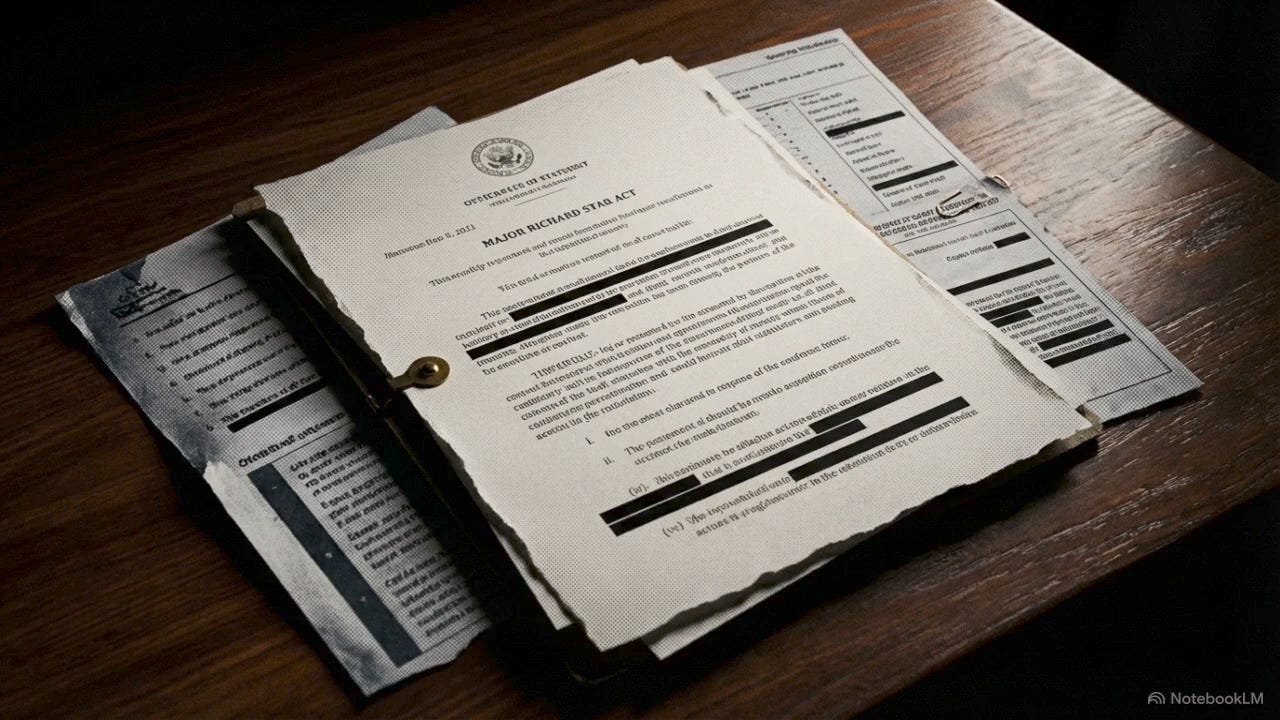
AI-generated image. Created with Google ImageFX.
THE GIST
Five members of Congress wear veterans as a costume. Ballcaps at VFW halls. Flight jackets at air bases. Floor speeches soaked in sacrifice. Their voting records tell a different story.
Sen. Roger Wicker (R-MS) cosponsored the Major Richard Star Act in 2021 — publicly, in a Memorial Day column. In October 2025, as chairman of the Senate Armed Services Committee, he single-handedly killed it on the Senate floor.
He blocked it twice in one day. First the bill. Then a guaranteed single vote.
Three months before the block, he voted to strip funding protections for the PACT Act he’d reluctantly voted for in 2022.
His office later acknowledged “inequities” the bill was designed to fix. Tonya Star, widow of the veteran the bill was named after, died in 2024 — in tears, Blumenthal told the Senate, because another Congress had ended without a vote.
Four more members follow. The pattern holds.
This country has a particular kind of politician.
They show up at VFW halls in ballcaps. They stand at military bases in flight jackets. They say “our heroes” with the practiced ease of people who have said it ten thousand times. Then they go back to Washington and vote.
This is a record of what they voted.
A note on this series
Every subject in The Ballcap Caucus was selected on one criterion: a documented, primary-source contradiction between public statements supporting veterans and specific votes or actions working against them. The five subjects in this series are Republicans. That is not a partisan editorial choice — it reflects who holds the relevant committee chairs, who controls the floor schedule, and who executed the specific procedural blocks documented here. If Democratic members had blocked the Major Richard Star Act, voted to strip PACT Act funding protections, or fired 30,000 VA workers, they would be in this series. The record determines the subject. Not the party.
I. ROGER WICKER
United States Senator, Mississippi
Chairman, Senate Armed Services Committee
Retired Lieutenant Colonel, United States Air Force Reserve
On June 1, 2021, Senator Roger Wicker published his weekly report. It was Memorial Day. He told Mississippi he was a cosponsor of the Major Richard Star Act, which would allow disabled veterans whose combat injuries forced early retirement to receive their full military pension.
He explained what the bill did. Correctly. He understood the injustice it was meant to fix. He wanted public credit for backing it.
Major Richard Star was still alive when Wicker wrote that column. He had lung cancer from burn pit exposure in Iraq and Afghanistan. He had spent what remained of his life lobbying Congress to pass the legislation bearing his name. He died in 2021. He was 51.
His wife Tonya spent the following years walking the same halls. She called Senator Blumenthal’s staff days before her own death in 2024. She was in tears, Blumenthal told the Senate on October 8, 2025, because another Congress had ended without a vote.
Wicker’s senate.gov veterans page reads: “As a retired Air Force Reservist and the first Mississippian to ever serve on the Senate Veterans Affairs Committee, I understand the issues affecting our nation’s veterans. We have a responsibility to take care of those who have sacrificed to protect the freedoms we enjoy as Americans.”
His November 2024 op-ed called VA budget shortfalls the product of “sloppy budgeting” and positioned him as a guardian of veteran funding oversight.
He is, by his own account, the right man to protect veterans. He served. His father served. His son served.
On October 8, 2025, Senator Richard Blumenthal brought the Major Richard Star Act to the Senate floor.
The bill had 76 cosponsors. A filibuster-proof supermajority. If it reached a floor vote, it passed. That was arithmetic, not politics.
Blumenthal asked for unanimous consent to advance S. 1032. Any single senator could stop it by saying two words.
The presiding officer called on the Senator from Mississippi.
Wicker said: “My colleague is asking for an entitlement that does amount to a double benefit, and that we cannot afford... until authors of this proposal identify a way to offset the expense or to make it less expensive, we should not move forward with this legislation. Therefore, I do object.”
The bill died.
Blumenthal came back with a narrower request. Not passage. A guaranteed single vote — scheduled at Majority Leader Thune’s discretion, before the end of the year. Sixty votes required to pass. Half an hour of floor time, whenever leadership wanted it.
Wicker objected again.
Seventy-six senators could not get one vote.
On the same day, the pending business before the Senate included Wicker/Reed amendment No. 3748 — the National Defense Authorization Act for Fiscal Year 2026. The NDAA Wicker was co-authoring. Approaching $900 billion.
He told the Senate he could not find $9 billion for 54,000 combat-wounded veterans over ten years. He was simultaneously managing nearly a trillion dollars in defense spending. The Congressional Record confirms both.
On the floor, Wicker said the Star Act “really belongs in another jurisdiction.”
Senate records show S. 1032 was referred to the Senate Armed Services Committee on March 13, 2025. Wicker chairs the Senate Armed Services Committee. The bill had been in his jurisdiction for seven months when he said it didn’t belong there.
The PACT Act vote is worth examining.
On July 27, 2022, Wicker voted NAY on cloture — Roll Call 272 — blocking the largest expansion of VA healthcare and benefits for toxic-exposed veterans in American history.
Five days later, after veterans and advocates camped on the Capitol steps and the political cost became indefensible, he voted YEA on final passage — Roll Call 280.
His own senate.gov page documented the flip. The headline: “Wicker to Vote for PACT Act.”
When the political pressure became inescapable, he voted yes. The record is documented. The Star Act has not yet made the pressure inescapable.
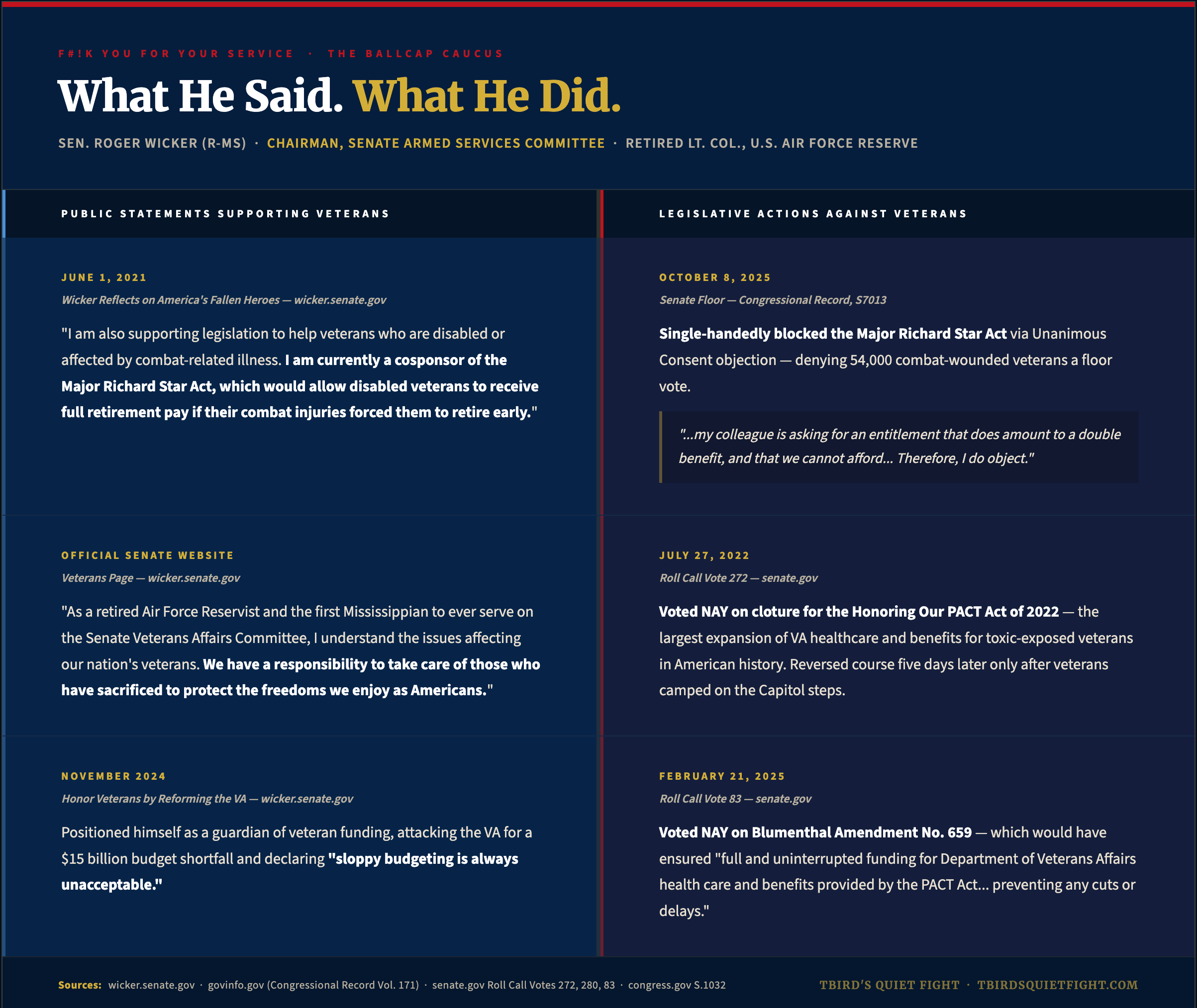
AI-assisted graphic. All data sourced to primary documents. Sources listed in footer of graphic.
On February 21, 2025, Wicker voted NAY on Roll Call 83 — the Blumenthal amendment to protect PACT Act funding.
The amendment would have shielded the Veterans Benefits Administration from the DOGE workforce cuts then gutting the agency. VBA employees process toxic exposure claims. They were being eliminated. The amendment would have stopped it.
Three months before he blocked the Star Act, Wicker voted to leave the law’s implementation unprotected.
He can claim credit for eventually voting for the PACT Act. He voted to starve the workforce responsible for carrying it out.
Veterans organization PassTheAct.org funded billboards in Tupelo and Jackson. His state. His backyard.
One read: “Senator Roger Wicker blocked fair retirement pay for combat wounded veterans. These heroes lose thousands in retirement they’ve earned.”
He made no public statement in response.
His office made a private one.
Four months after the October 8 block, a Wicker spokesperson told Task & Purpose: “He recognizes the inequities some retirees face under the current laws and fully agrees that combat-wounded veterans deserve to be compensated for their service. Senator Wicker will continue working to reach a durable solution.”
The 54,000 veterans waiting for that solution have been waiting since 1941.
Major Richard Star is dead. Tonya Star is dead. The bill is not passed.
Coming in this series: Sen. Ron Johnson (R-WI). Speaker Mike Johnson (R-LA). Sen. Jerry Moran (R-KS). VA Secretary Doug Collins.
TAKE ACTION
The Major Richard Star Act has 77 Senate cosponsors. It has never received a floor vote. One senator blocked it in October 2025. Another blocked it in March 2026. The bill is S. 1032. It is sitting in the Senate Armed Services Committee. The 119th Congress runs through January 2027.
The ask is simple: demand a vote.
If you are a veteran or military family member
Call Senator Wicker’s Washington office: (202) 224-6253
“My name is [name]. I am a [veteran / military spouse / Gold Star family member] calling about the Major Richard Star Act, S. 1032. Senator Wicker blocked this bill in October 2025 and denied 54,000 combat-wounded veterans their earned retirement pay. I am asking the Senator to stop blocking this bill and allow a floor vote immediately. These veterans have waited long enough.”
If you are in Mississippi, call his Tupelo office: (662) 844-5010
Use the same script. Local calls carry more weight.
If you are a citizen — not a veteran
Call Senator Wicker’s Washington office: (202) 224-6253
“My name is [name]. I am a constituent calling about the Major Richard Star Act, S. 1032. This bill would end an unjust pay offset that costs 54,000 combat-wounded veterans an average of $1,200 a month in retirement pay they earned through their service. Senator Wicker blocked it twice. I am asking him to allow a floor vote. This is not a partisan issue. Seventy-seven senators have cosponsored this bill. It deserves a vote.”
Call the Senate Armed Services Committee
Senate Armed Services Committee: (202) 224-3871
“I am calling to ask the Committee to schedule a floor vote on S. 1032, the Major Richard Star Act. This bill has 77 cosponsors and has never received a vote. Please put it on the calendar.”
Call the Senate Veterans’ Affairs Committee
Senate Veterans’ Affairs Committee: (202) 224-9126
“I am calling to express support for the Major Richard Star Act, S. 1032, and to ask the Committee to keep pressing for a floor vote this session.”
Sign the petition
PassTheAct.org is run by combat-wounded veterans directly affected by the offset. Their petition demands a public explanation from Senator Wicker and a floor vote on S. 1032.
Read the bill
S. 1032, Major Richard Star Act, 119th Congress
Share this article
The pressure that moved Wicker on the PACT Act came from veterans showing up on Capitol steps. This series is part of that pressure. Share it on every platform you use. Tag your own senators. Ask them where they stand.
If your senator is not a cosponsor of S. 1032, that is a question worth asking.
SOURCES
Congressional Record, Vol. 171, S7013-7014, October 8, 2025 — Wicker floor objections, verbatim
Wicker, “Wicker Reflects on America’s Fallen Heroes,” wicker.senate.gov, June 1, 2021
Wicker, “Honor Veterans by Reforming the VA,” wicker.senate.gov, November 2024
Wicker, “Wicker to Vote for PACT Act,” wicker.senate.gov, August 2022
U.S. Senate Roll Call Vote 272, 117th Congress, July 27, 2022
U.S. Senate Roll Call Vote 280, 117th Congress, August 2, 2022
U.S. Senate Roll Call Vote 83, 119th Congress, February 21, 2025
S. 1032, Major Richard Star Act, Congress.gov — committee referral March 13, 2025
Senate Veterans’ Affairs Committee, press release, October 2025
Senate Veterans’ Affairs Committee, press release, February 2025
ABOUT TBIRD’S QUIET FIGHT
Tbird’s Quiet Fight is an investigative publication covering veterans policy, VA accountability, and federal programs affecting the military community. Founded by Theresa “Tbird” Aldrich, U.S. Navy veteran (VAQ-34, 1983–1990) and founder of HadIt.com, established January 20, 1997.
I use AI as a research and editing assistant — the same way I’d use a good reference book or a sharp editor. Every word published here is reviewed, verified, and approved by me. The perspective, accuracy, and editorial decisions are mine.
For press and advocates: ipersist@tbirdsquietfight.com