


The Gist
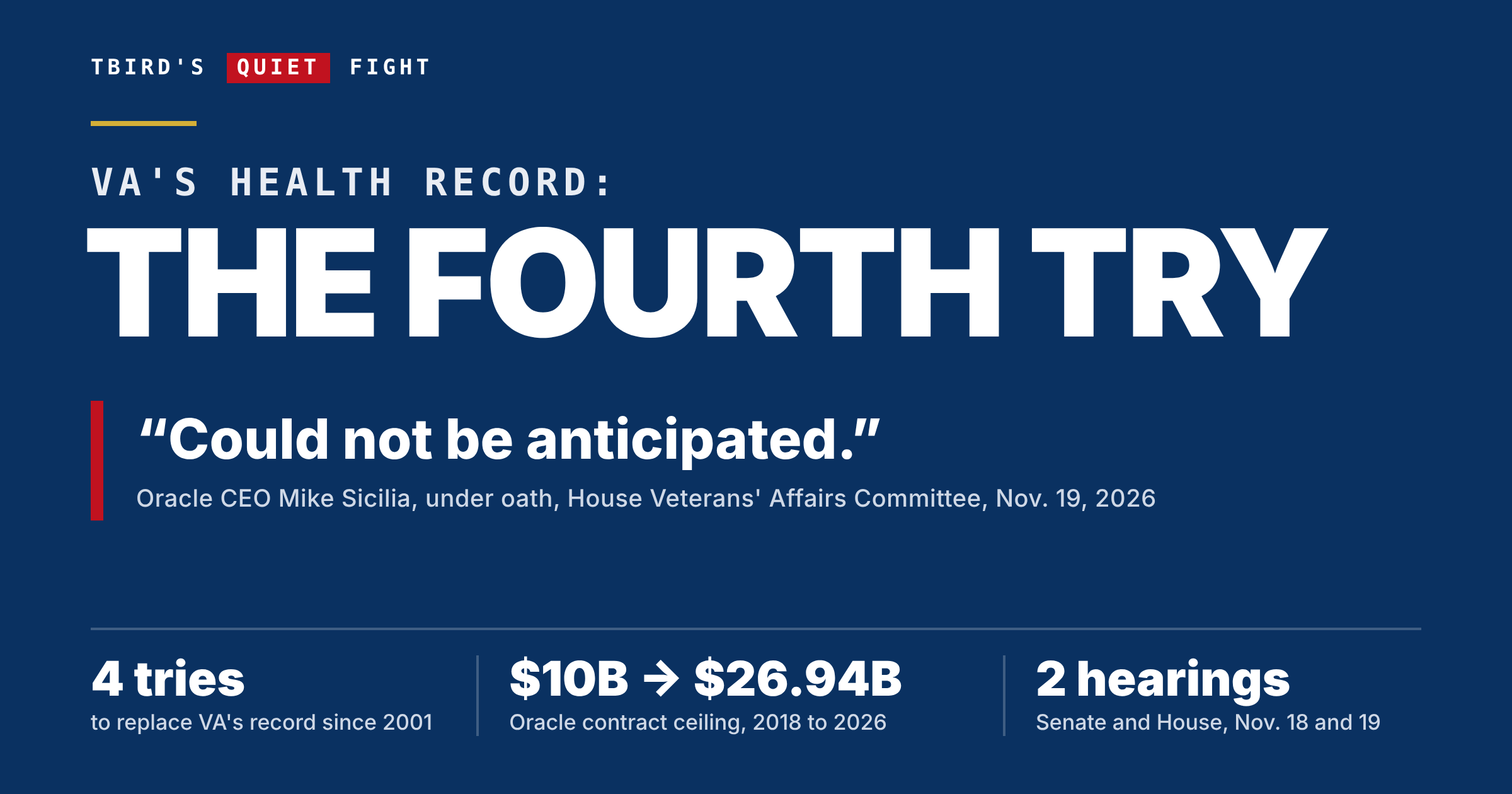
VA is on its fourth try at modernizing its health record since 2001. GAO counts three failures before this one: HealtheVet, iEHR and VistA Evolution.
The money, from the government’s own reports: HealtheVet was projected at about $11 billion. On the next two, VA obligated about $1.1 billion for contracts, fiscal 2011 through 2016. On the current program, VA obligated nearly $16.2 billion from September 2017 through December 2025. Oracle’s contract ceiling is now nearly $27 billion.
On Nov. 18 and 19, Oracle CEO Mike Sicilia told the Senate and then the House Veterans’ Affairs committees that the scope increases and the two-year pause could not have been anticipated. At the House, he was under oath.
In the same House statement, he said the reset “accomplished the standardization and planning that objectively should have been done in 2017.”
GAO wrote in January 2018, four months before Cerner signed, that VA’s first try had set out to eliminate about 130 different systems at its field sites. GAO says the 2018 contract was meant to replace “the 130 instances of VistA.”
VA stopped new deployments in July 2022, the same month Sicilia promised Congress Oracle would deliver within the contract’s current scope and fix problems at its own expense. When VA extended the stop that October, it named the reasons: system performance and issues “that may have patient safety implications.”
At the Senate, VA’s Dr. Neil Evans confirmed that a letter from VA Secretary Doug Collins puts the pause at about $1 billion, inside the new $17 billion. At the House, Oracle said VA paid it during the pause to keep six sites running and hosted, and promised “the exact number.”
Asked how much Oracle absorbed, in dollars, neither Oracle witness gave a figure.
None of this settles who owes what. It raises questions the record doesn’t answer yet.
“Could not have been anticipated”
On Nov. 18, in Dirksen 106, Oracle CEO Mike Sicilia gave the Senate Veterans’ Affairs Committee his reason the ceiling on VA’s health record contract went from $10 billion to nearly $27 billion.
“The sheer amount of scope increases and the two-year pause could not have been anticipated at that time.”
The next morning, House Veterans’ Affairs Chairman Mike Bost (R-Ill.) administered the oath to Sicilia and Oracle Health’s Seema Verma. Then Sicilia said it again.
“The sheer amount of scope increases and the two-year pause could not be anticipated when I made that statement.”
That statement was July 2022, when he first came before Congress and promised Oracle would deliver without exceeding the contracted cost.
His next sentence: “The reset accomplished the standardization and planning that objectively should have been done in 2017, but it also did result in a substantial expansion of the program scope.”
2017. The year VA chose Cerner.
Could not have been anticipated.
That line stopped me. VA has been here before. Three times.
Four tries, 25 years
GAO keeps the count. In September 2026 it put it in one sentence: “After three unsuccessful attempts over two decades, the Department of Veterans Affairs (VA) undertook a fourth effort in 2017.”
The tries, from GAO’s January 2018 history:
HealtheVet, 2001 to 2010. The goal was to standardize VA’s health care system and eliminate “the approximately 130 different systems used by its field locations at that time.” It was scheduled for 2018 at “about $11 billion.” VA terminated it in August 2010. By 2008, VA had reported spending almost $600 million on its projects. For GAO’s January 2018 report, VA said it couldn’t verify any payments to HealtheVet contractors because the contracts fell outside the required records retention period. GAO cited the general rule: six years after final payment.
iEHR, 2011 to 2013. One shared record with the Pentagon. In February 2013 the two secretaries announced they would not continue, after concerns about “meeting deadlines, costing too much, and taking too long to deliver capabilities.”
VistA Evolution, begun December 2013. Modernize the old system instead. GAO said it was still ongoing in January 2018, with VA revising its plans after choosing a fourth effort.
EHRM, 2017 to now. Buy Cerner, the same commercial system the Pentagon bought. Signed in May 2018 with a ceiling of about $10 billion. Oracle bought Cerner in June 2022.
What it cost, in the government’s own numbers. Don’t add these together. They measure different things.
HealtheVet: about $11 billion projected to finish; almost $600 million reported spent through fiscal 2007 (GAO, 2008). What VA paid its contractors, VA told GAO for its 2018 report it couldn’t verify.
iEHR: about $224 million in contract obligations, fiscal 2011 through 2013.
VistA Evolution: about $880 million in contract obligations, fiscal 2014 through 2016.
EHRM, the whole program: nearly $16.2 billion obligated from September 2017 through December 2025, on Oracle’s contract plus program management, IT and more (GAO, Nov. 18, 2026).
Oracle’s contract: a ceiling of nearly $27 billion since August 2026.
EHRM, life cycle: $56.5 billion through 2031 plus sustainment, as GAO adds up VA’s own estimates. GAO says it still hasn’t seen the analysis behind them.
130 systems
Count that again.
In 2001, VA’s first try set out to replace about 130 different systems at its field sites. Seventeen years later, VA signed with Cerner. In testimony to the same Senate committee on Nov. 18, GAO described what that contract was for: “The contract was intended for Cerner to replace the 130 instances of VistA with a standard commercial system across VA over 10 years.”
Oracle’s own October 2026 briefing deck for Congress starts with the same fact. VA “used 130 different versions of VistA.”
Oracle now says VA’s requirements created “a wholly different program.” At the House, Oracle’s Verma walked through the numbers: interfaces from 57 to 165, concurrent users from 85,000 to 195,000, records to migrate from 8 million to 26.1 million. Oracle says those requirements went beyond the original assumptions. Some of that may be fair.
One outside researcher argued the trouble was foreseeable. In April 2023, the month VA announced the reset, Shira Fischer, a physician and policy researcher at RAND, wrote in The Hill that the rollout had been hard for a number of reasons, and “all of these reasons could be, and indeed were, anticipated.” Her list: a system spread across 50 states, a patient population unlike most hospitals’, care VA has to coordinate outside its own walls, and software that, like most commercial health records, is “designed around billing.”
But the 130 systems were the first problem on the list in 2001, and they were written into what the contract was for in 2018. Standardizing them is the work Sicilia now says “objectively should have been done in 2017.” That alone doesn’t settle which later work was inside the original scope. But how does that become something nobody could see coming?
What was on the table in July 2022
The first site, Spokane, went live in October 2020. Oracle bought Cerner in June 2022.
By July 2022, this was public:
On July 14, 2022, VA’s inspector general reported that from go-live through June 2021, the new system “failed to deliver more than 11,000 orders for requested clinical services.” VA’s own clinical reviewers identified 149 adverse events for patients, two of them classified as major harm.
The inspector general wrote that “Oracle Cerner failed to inform VA end-users of the existence of the unknown queue and put the burden on VA to identify and address the problem.” VA’s response, printed with the report, saw it differently. Then-Deputy Secretary Donald Remy called it a “shared failure between VA and Cerner to monitor and manage” the queue. Both views are in that report. Both belong in this one.
VA had stopped new deployments. VA’s words in 2023: the reset “follows an extended pause in deployments that began in July 2022.”
That same month, Sicilia made his promises.
July 20, 2022, to the Senate committee, in his prepared statement: “Oracle is committed to delivering the VA an EHR system that exceeds expectations without exceeding the contracted cost. If there are issues with performance or workflow we commit to fixing those issues at our expense.”
July 27, 2022, to the House, as he quotes himself in his written statement for the Nov. 19 hearing: Oracle intended to deliver “for the amounts contemplated in the current contract under the current scope,” including “fixes or upgrades for things like the unknown queue or referrals.” He drew a line in the same breath: “Of course, if there are big new pieces of functionality not included in the scope, that’s a different discussion.” And if there were significant cost overruns, “as apparently the IDA believes there will be,” Oracle was “prepared to bear those costs and remain within the existing budget envelope.”
He named the unknown queue. He named the outside estimate that predicted overruns. He promised to absorb overruns inside the scope and kept new functionality as a separate conversation. Bost opened the House hearing with the same reading: in 2022, Oracle said it would bear the cost of overruns within the scope of the contract.
On Nov. 19 Sicilia wrote that “deployment delays and growth of implementation requirements resulted in additional costs, which are the subject of the ‘different discussion’ I referenced.” The unknown queue sat on the covered side of that line, by name. Where does the pause sit?
Fair is fair. In July 2022, how long the pause would run wasn’t yet set. But the reasons VA stopped were already in the public record that month.
So what part of it couldn’t be anticipated?
Where does COVID fit?
COVID comes up a lot in this story. Oracle’s own paperwork keeps it separate from the pause.
Sicilia’s written statement: “While COVID had already created delays and while the system had stabilized, a pause was announced in April 2023 that later turned into a two-year ‘reset’ of the program.” Oracle’s cost deck gives COVID its own line: “COVID-related delays and restarts,” about $600 million. Under oath at the House, he put COVID at the start: “the unforeseen COVID pandemic, which created the initial delays.”
Who stopped the rollout? Rep. Derrick Van Orden (R-Wis.) asked whether Oracle did the two-year pause. Sicilia: “The VA directed the pause.” That’s right, and VA said why, in its own words, as the pause went on:
October 2022. An “assess and address” period to correct outstanding issues, “especially those that may have patient safety implications.” Then-Deputy Secretary Donald Remy: “Right now, the Oracle Cerner electronic health record system is not delivering for Veterans or VA health care providers.”
April 2023. The reset. Dr. Neil Evans, then acting head of VA’s health record modernization office: “For the past few years, we’ve tried to fix this plane while flying it.”
On Nov. 18, Sen. Richard Blumenthal (D-Conn.) read from what he described as a letter from Secretary Doug Collins that reached his office the night before, calling the program “nearly dormant for almost two years under the Joseph Biden administration.” He asked Evans whether deployment was paused “because of performance problems and patient safety risks.”
“Yes,” Evans said, “we paused what we called the program reset to basically address the concerns of end users.” The work, he said, was “to work on the stability of the system.”
On Nov. 19, Rep. Maggie Goodlander (D-N.H.) cited figures she attributed to VA’s own safety data: 4,601 cases of harm where the system played a role, 10 of them classified catastrophic, and six deaths where, she said, VA confirmed in 2024 that failures in the system “may well have been a causal factor.” Did he accept VA’s findings?
“I have not been informed by VA of any direct consequence. I’m aware of patient safety reports.”
What was VA paying for?
At the Senate, Blumenthal said the pause “cost a billion dollars in additional costs,” the number in the Collins letter. Evans: “That’s correct.” Is that billion inside the new $17 billion? “Yes.”
At the House, Van Orden asked the other half. “How much money did the VA pay you during that two-year pause?”
Sicilia didn’t have it. Oracle’s Verma: “They were paying us for the sustainment of the six sites... and the hosting.”
“Give me a number. It’s about a billion dollars, right?”
“I’ll give you the exact number.”
Rep. Jack Bergman (R-Mich.) asked whether there were surprise costs nobody had foreseen. Sicilia: “There certainly were surprises, including a two-year pause, in which case costs continued to accumulate, as well as a significant reset in the way the system was configured.”
Sites that were live had to keep running. That’s real work, and a pause isn’t free for anyone.
But here’s the question. Is VA’s $1 billion pause cost the same money VA paid Oracle to keep six sites running and hosted? Part of it? Something else? Nobody at either hearing put the two side by side.
How do both of these fit?
Not all of this is Oracle’s.
The reset also fixed VA’s side: governance, standard workflows, decisions VA made and remade. GAO says so. Oracle says so. VA called the unknown queue a shared failure; the inspector general put the failure to tell users on Oracle Cerner. Sicilia told the House Oracle’s pricing hasn’t increased in eight years, except 2% labor increases under the contract. And nothing I’ve found from VA or Oracle says how much of that $1 billion went to VA’s problems and how much to Oracle’s.
Here’s what I can’t square.
Oracle bought Cerner, contract and defects included. Both days, Sicilia pointed to “inadequate infrastructure from Cerner” that hurt the system’s stability. Oracle promised twice in July 2022 to deliver within the contract’s scope, and in writing to fix “issues with performance or workflow” at its own expense.
At the Senate, in his opening: “I did promise that Oracle would absorb costs and commit to improving the system. Oracle has kept the commitment.”
Later in that hearing, Sen. Patty Murray (D-Wash.) read his July 2022 promise back to him: a system that “exceeds expectations without exceeding the contracted costs.” “Was that a promise that you kept? Yes or no?”
“I believe that what was contemplated at that time is very different than what’s been delivered today,” Sicilia said, “and I believe that we have delivered after the reset on the redesign program.”
“More than tripling the cost of the project kind of feels like a no to me,” Murray said. For the record, the ceiling went from about $10 billion to $26.94 billion, about 2.7 times, and a ceiling is the most VA can order, not what it has spent.
At the House, under oath, Goodlander read back his July 2022 promise to bear significant cost overruns and stay within the existing budget envelope, and asked whether Oracle kept it. “I believe yes,” he said. “I also made a clear statement that unless there was a significant change in scope, which has happened, nobody could have anticipated the scope, the delays, and all of those things.” Then: “I don’t believe that promise was broken.”
So how much did Oracle absorb? Rep. Julia Brownley (D-Calif.) asked for a rough number. Sicilia: “I don’t have the exact numbers in front of me.” Verma listed the work: the pharmacy rebuild, the move to Oracle’s cloud, the health information network. “These are millions of dollars. I don’t have an exact amount for each.”
“I’m asking for a rough estimate.”
“I don’t have a rough estimate in front of me.”
Two committees. Two days. Oracle says it kept its promise to absorb the costs. Asked how much it absorbed, neither Oracle witness had a number. I’d like someone to explain how those fit together.
What comes next
The program is moving again. GAO says VA deployed to all 13 sites it planned for 2026 and plans 26 more in 2027.
VA’s own user survey was pushed from August to November and widened, from the first six sites plus four in Michigan to the first six plus eight in Michigan and Ohio. GAO says it should finish in late November 2026.
The documents. House ranking member Mark Takano (D-Calif.) entered into the hearing record the Nov. 17 Collins letter and emails between Oracle’s sales team and the VA contracting office that handled the increase. Takano said they would be made available on the committee’s hearing repository.
Larry Ellison. The House committee has subpoenaed Oracle’s chairman. Takano said he expects him Dec. 10.
The numbers Oracle owes Congress. Verma promised the exact amount VA paid during the pause. Sicilia said he’d supply what Oracle absorbed.
The Senate committee left its record open one week for written questions. The questions the record leaves open:
Of the $1 billion VA says the pause cost, how much went to Oracle for sustainment and hosting, and how much paid for fixing problems Oracle promised in 2022 to fix at its own expense?
What has Oracle absorbed, in dollars? Sicilia said he’d supply it.
The Collins letter puts the pause at about $1 billion. Oracle’s deck lists “COVID-related delays and restarts” at about $600 million. What periods and costs does each figure cover, and do they overlap?
If the standardization “objectively should have been done in 2017,” what part of the scope growth was actually new?
Four tries. Twenty-five years. The same 130 systems on paper before anyone signed. And Oracle’s CEO, under oath, saying the planning should have been done in 2017.
So how could this not have been anticipated?
Paper Trail
GAO-18-208, VA Health IT Modernization: Historical Perspective on Prior Contracts, Jan. 18, 2018. The four efforts, the 130 systems, HealtheVet’s $11 billion, iEHR and VistA Evolution contract obligations. https://www.gao.gov/products/gao-18-208
GAO-08-805, Veterans Affairs: Health Information System Modernization Far from Complete, June 30, 2008 (HealtheVet spending reported through fiscal 2007). https://www.gao.gov/products/gao-08-805
GAO-26-109393, GAO testimony, Sept. 2, 2026 (”three unsuccessful attempts over two decades”). https://www.gao.gov/products/gao-26-109393
GAO-27-109529, GAO testimony to the Senate Veterans’ Affairs Committee, Nov. 18, 2026 (the 130 instances of VistA; $16.2 billion obligated; ceiling; $56.5 billion; 2026 deployments; user survey). https://www.veterans.senate.gov/services/files/0A0FE42A-A4E5-45EC-BF71-5F73DAF96703
VA OIG 22-01137-204, The New Electronic Health Record’s Unknown Queue Caused Multiple Events of Patient Harm, July 14, 2022. https://www.vaoig.gov/sites/default/files/reports/2022-07/VAOIG-22-01137-204.pdf
Sicilia, Senate Veterans’ Affairs Committee, July 20, 2022 (S. Hrg. 117-636, prepared statement). https://www.govinfo.gov/content/pkg/CHRG-117shrg51647/pdf/CHRG-117shrg51647.pdf
VA news release, Oct. 13, 2022, delay to June 2023. https://www.va.gov/opa/pressrel/pressrelease.cfm?id=5833
Senate Veterans’ Affairs Committee hearing, March 15, 2023 (S. Hrg. 118-150), pp. 22-23. https://www.veterans.senate.gov/services/files/5E216EB2-DB3E-4F39-BE93-AB10CF2EFE97
VA news release, April 21, 2023, the reset. https://www.va.gov/opa/pressrel/pressrelease.cfm?id=5873
Senate Veterans’ Affairs Committee hearing, Nov. 18, 2026, video and witness statements. Sicilia’s opening at about 0:34:30; Murray at 1:01:30; Blumenthal and Evans on the pause at 1:35:14. https://www.veterans.senate.gov/2026/11/va-accountability-and-transparency-examining-the-current-and-future-path-of-va-s-electronic-health-record-modernization-program
House Veterans’ Affairs Committee hearing, Nov. 19, 2026, committee video. Oath at about 0:46:50; Sicilia’s opening at about 0:47:15; Brownley at 0:59:05; Bergman at 1:02:10; Van Orden at 1:32:55; Goodlander at 1:47:00. https://www.youtube.com/watch?v=8FczGV7QXRo Hearing documents: https://docs.house.gov/Committee/Calendar/ByEvent.aspx?EventID=119599
Shira H. Fischer, RAND, “The Problems Facing VA Modernization Are Bigger Than Its Software Systems,” The Hill, April 28, 2023 (republished by RAND). https://www.rand.org/pubs/commentary/2023/04/the-problems-facing-va-modernization-are-bigger-than.html
Oracle briefing deck, “VA EHRM Modernization, Delivery & Cost Transparency,” October 2026, posted by the Senate committee. https://www.veterans.senate.gov/services/files/9E725F67-140A-4974-AB34-EA5DAB3D3904
Sicilia written statement, House Veterans’ Affairs Committee, Nov. 19, 2026. https://docs.house.gov/meetings/VR/VR00/20261119/119599/HHRG-119-VR00-Wstate-SiciliaM-20261119.pdf
Earlier TQF and HadIt coverage: VA’s Electronic Health Record Disaster: Same Problem, Fourth Try, Billions Wasted
Make the Call
A phone call takes two minutes. Congressional offices often track constituent calls by issue. When one issue lights up the phones in the same week, staff tend to notice.
Who to call:
Your own U.S. Representative and Senators: they work for you. Find yours here.
Rep. Mike Bost (R-IL), Chairman, House Veterans’ Affairs Committee: (202) 225-5661
Sen. Jerry Moran (R-KS), Chairman, Senate Veterans’ Affairs Committee: (202) 224-6521
Capitol Switchboard (connects to any member): (202) 224-3121
Script 1: If you’re a veteran or military family member
“Hi, my name is [NAME] and I’m a [veteran / military spouse / family member of a veteran] in [STATE]. I’m calling about VA’s health record program and Oracle’s $27 billion contract ceiling.
This is VA’s fourth try at modernizing its health record since 2001. In 2022 Oracle promised Congress it would stay within the contract and fix problems at its own expense. VA paused the rollout that same year over performance and patient safety problems. Now VA says that pause cost about a billion dollars, and it’s part of the new $17 billion. Oracle told the House it didn’t have a figure for how much it has absorbed.
I’m asking [MEMBER NAME] to demand a written answer on how much of that billion paid for fixing problems Oracle promised to fix at its own expense, and to require an independent cost estimate before any more money goes out.
I’d like to know the [Congressman’s / Senator’s] position on this. Thank you.”
Script 2: If you’re a concerned citizen
“Hi, my name is [NAME] and I’m a constituent in [STATE]. I’m calling about VA’s health record contract with Oracle.
VA has tried to modernize its health record four times since 2001. The contract ceiling has nearly tripled, to about $27 billion, and VA says a billion of that comes from a pause over performance and patient safety problems, after Oracle promised to fix problems like those at its own expense.
I’m asking [MEMBER NAME] to demand a full accounting and an independent cost estimate before any more money is spent.
Thank you for your time.”
How offices handle what you send (practices vary by office):
Phone calls get logged in real time by issue and position (for/against). A staffer marks it in their system the moment you hang up. When a member asks “what are people calling about this week,” your call is in that count. A spike on one issue in a short window is hard for staff to miss.
Personal emails (not form letters) get read, categorized, and usually receive a response, but they sit in a queue. Most offices process constituent mail in batches. Your email might not get logged for days. It still counts, but it doesn’t create the same real-time pressure as a ringing phone.
Form emails and petitions (pre-written “click to send” campaigns) get the lowest weight. Offices batch-count them. They know you clicked a button. Better than silence, but a personal call or letter carries more weight.
Letters to the editor in your local paper punch way above their weight. Congressional offices have staff assigned to clip and track local media mentions of their boss. A published letter is public, reaches other voters, and can get picked up by larger outlets.
Op-eds in local or regional papers reach the same staff who track local coverage of their boss.
A good combination: Call first. Follow up with a personal email. Then write a letter to the editor. Each one reaches the office through a different channel.
Tips:
You don’t need to be an expert. You just need to be a constituent.
If you get voicemail, leave the message anyway.
Call during business hours (9 AM to 5 PM Eastern) for the best chance of reaching a staffer.
Be polite, be brief, and state your ask clearly.
If a staffer asks follow-up questions, answer them. It helps them get your concern right.
Go Deeper
Write a Letter to the Editor (10 minutes)
Most local papers accept 150-200 word letters. Mention your representative by name. State your veteran status if applicable. Stick to facts from this article.
Find your local paper’s submission page or email the opinion desk directly. Tips:
Localize it: mention your rep by name and your nearest VA facility
Keep it under 200 words
Say you’re a veteran if you are
Don’t submit the same letter to multiple papers simultaneously
Contact Your VSO
If you’re a member of VFW, DAV, American Legion, VVA, IAVA, or any other Veterans Service Organization, contact your local chapter and ask what their position is on this issue. VSOs have lobbying power. Use it.
Share This Article
Forward it. Post it. Print it. The veterans affected by these decisions often can’t amplify their own stories. You can.
About This Publication
Tbird’s Quiet Fight is independent investigative journalism focused on VA policy, veteran benefits, and government accountability. Published by the founder of HadIt.com, one of the oldest veteran-run VA claims communities online (est. 1997).
Support this work: Subscribe to TQF | Support HadIt.com
I use AI as a research and editing assistant, the same way I’d use a good reference book or a sharp editor. Every word published here is reviewed, verified, and approved by me. The perspective, accuracy, and editorial decisions are mine.
For Press and Advocates
Congressional oversight contacts:
House Veterans’ Affairs Committee: (202) 225-3527 | veterans.house.gov
Senate Veterans’ Affairs Committee: (202) 224-9126 | veterans.senate.gov
House VA Oversight & Investigations Subcommittee: veterans.house.gov/issues
Investigative journalists covering VA/veteran policy:
Suzanne Gordon, American Prospect
Jasper Craven, American Prospect
Nikki Wentling, Military Times
Leo Shane III, Military Times
Quil Lawrence, NPR
Veteran advocacy organizations:
Government watchdog resources:
USAspending.gov (track federal contracts and grants)
Last verified: November 21, 2026
Theresa “Tbird” Aldrich, Navy veteran (VAQ-34, 1983-1990), Investigative Journalist, TbirdsQuietFight.com, Founder of HadIt.com | Advisory Board Member, Veterans Healthcare Policy Institute (VHPI).