


By Theresa Aldrich and Suzanne Gordon
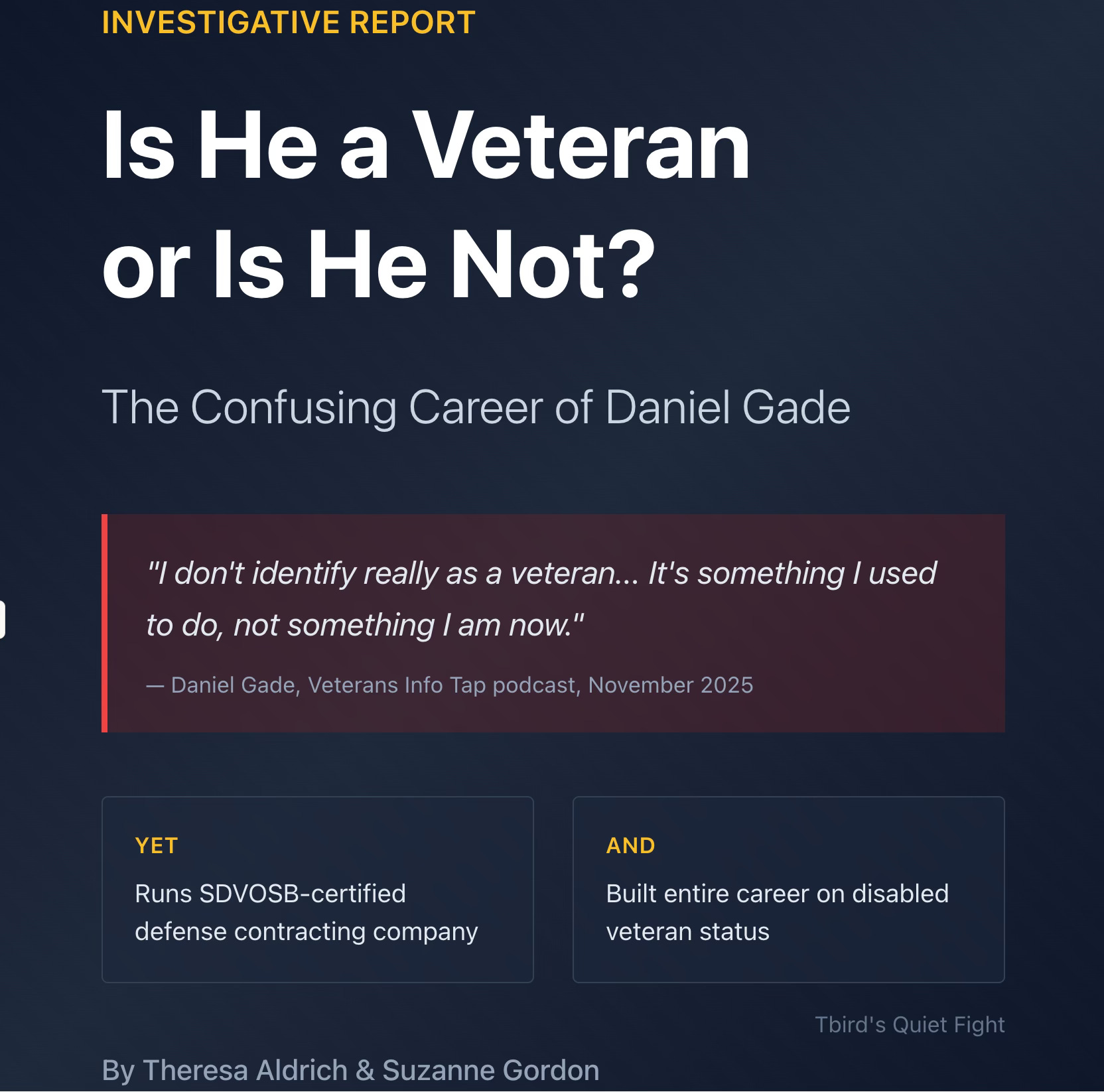
On Wednesday October 29th, Daniel Gade, former Commissioner of the state of Virginia’s Department of Veterans Services, appeared before a hearing of the Senate Committee on Veterans Affairs entitled “Putting Veterans First: Is the Current VA Disability System Keeping its Promises?” The chair of the committee, Senator Jerry Moran (R. KS) introduced Gade as a “service connected, disabled veteran and vocal advocate for changing the current disability system to better serve veterans and support their long-term well-being.”
In the hearing, Gade was included on a panel of veterans’ disability experts which included representatives of The Disabled American Veterans (DAV), Veterans of Foreign Wars (VFW), and Paralyzed Veterans of America (PVA). As Republican senators respectfully questioned Gade, they clearly regarded him as an expert on disability issues. This expertise was grounded on his status as a “war hero,” who had sacrificed for his country by losing a leg in combat. He is, in short, one of the American veterans, as legislators on both sides of the aisle constantly remind one another, to whom the nation owes a sacred debt, which includes the provision of veterans’ healthcare and delivery of other benefits, like compensation for service-connected conditions.
Much of Gade’s post-military career, however, has been spent challenging the very nature of that debt and questioning what we owe our veterans. Indeed, Daniel Gade not only attacks the system from which he has benefited but now insists that he is not even a veteran. Speaking on a recent Veterans Info Tap podcast, Gade contended that “disabled veteran,” makes veterans “embrace their sickest selves and they get stuck in amber a bug on a on prehistoric tree branch… It’s not a positive identity. It’s a negative backward- looking identity.”
“ Just like if you saw me wearing my high school letter jacket,” he continued, “you’d be like, ‘Okay, that’s weird, dude. You’re 50. You shouldn’t be wearing a high school letter jacket.’ True. I shouldn’t. I don’t I don’t identify really as a veteran. Like when they in church when they say, ‘Hey, veterans stand up on Veterans Day.’ I just stay seated.”
“You know why?,” Gade asks his hosts and then tells them, it’s “Because I’m a civilian. I don’t view myself in that …Because it’s something I used to do not something I am now.”
Gade’s repudiation of his veteran status, however, conveniently ignores the fact that he has built his entire career on the government hand-outs he now denigrates and the special regard – and perks – granted to him as an injured veteran.
From the moment Daniel Gade graduated high school he benefited from government largesse. He received a free college education and bachelors’ degree from West Point. When returned, seriously wounded, from his military service in Iraq, he was cared for – at government expense, at the Walter Reed Army Hospital where he recovered from a horrendous war wound that resulted in a total leg, up to the hip, amputation. During his stay at Walter Reed Army Hospital, Gade received a visit from President George W. Bush. The visit – and handshake --was even commemorated in an official White House photo.
Bush later painted Gade’s portrait which appears in Portraits of Courage, Bush’s book honoring wounded warriors. (Note to reader, the book honored disabled veterans). More photos of Gade and Bush appeared when the two went mountain biking together in Palo Duro Canyon, Texas. Bush wrote that watching Gade ride “was unbelievable.” The image of disabled veterans riding on mountain bikes was so irresistible that Fox News dedicated a story to the incident, in which Gade featured prominently – again as a disabled veteran.
“Mr. Bush,” the report said, “is a true mountain biker, and when he wasn’t leading the pack through the 100 degree heat on tortuous single track trails he was helping amputees, such as West Point instructor Major Dan Gade -- whose amputation is so high up that he rides a one pedal bicycle -- make it up the hills.”
The ride then led a man with no prior government experience to be appointed Associate Director of Bush’s Domestic Policy Council.
Next Gade benefited from his veteran/military status by being paid by the government to get Masters and PhD at the University of Georgia. In fact, despite his public opposition to disability benefits, Gade himself receives: • Military retirement pay; VA disability compensation (rating unknown but implied by combat wounds) and Combat-related Special Compensation (CRSC) or Concurrent Retirement and Disability Pay (CRDP). This is a classic example of a double standard: , Gade receives the same benefits he argues other veterans shouldn’t have.
Because of his work on veterans and veteran identity Gade has served as an Advisor to the Conservative Philanthropy Roundtable. In 2015, Speaker John Boehner appointed Gade to the National Council on Disability, an independent federal agency advising Congress and the President on disability policy.
In 2020 he ran for Senate in the state of Virginia. His campaign was based on his disabled veteran status, with campaign literature and appearances that focused on his identity as a wounded, combat veteran. The campaign’s door hangers featured a smiling Gade and in large type identifies him as “COMBAT VETERAN. TRUSTED LEADER. EDUCATED PROFESSOR. NEVER GIVES UP!”
In 2021, Gade and his co-author, Daniel Huang a former Wall Street Journal reporter, published the book Wounding Warriors: How Bad Policy Is Making Veterans Sicker and Poorer. On the cover of a book attacking the VA disability system and the disabled veteran brand, Gade is identified as a wounded combat veteran. This did not stop Gade and Huang from attacking other veterans – those who who lack a “truly static” disability liked his own amputated limb and are thus “diverted from paths of self-sufficiency and shuffled down paths of dependency and dysfunction.” According to Gade the VA, our second-largest federal agency by number of personnel, “robs veterans of their vitality,” privileges “lifetime disability and malaise over recovery in mental and physical health,” and spawns a “culture of entitlement” among veterans and a pernicious “network of enablers.” The VA enabled by Veterans Service Organizations. divert former military personnel “from paths of self-sufficiency” and steer them “down paths of dependency and dysfunction.” As a result, they write, many stay sick, rather than get better, and end up in “a quagmire of despair.”
In January of 2022, the state of Virginia’s newly elected hard-right governor Glenn Youngkin appointed Gadeto the post of Commissioner (i.e. head) of the state of Virginia’s Department of Veterans’ Services. He was described as follows: “He retired from the U.S. Army as a lieutenant colonel in 2017. While serving in Iraq in 2005, he sustained severe injuries that led to the amputation of his right leg. He co-founded The Independence Project to help veterans after his retirement from the army.”
In perhaps one of the greatest of ironies, Gade has become a defense contractor, transforming himself into the CEO of a company called InterFuze, which, according to its website, delivers, “best value solutions for Engineering, Science and Integration; Logistics and Fielding; Site Operations and Infrastructure; Enterprise IT; and Training and Exercise Services.” Its clients include “The Department of Defense, Military Civilian Agencies, and the Intelligence Communities.” In descriptions of the company’s leadership team, Gade’s bio informs us that his “ military career spanned over 25 years, during which he served in various locations, including the United States, Korea, and Iraq. He was wounded twice while serving as a company commander in Ramadi, Iraq. His second wounding was severe, resulting in the amputation of his right leg.” The company is registered as a Service-Disabled-Veteran-Owned-Small-Business, SDVOSB-certified company. Thus Gade has once again used his disabled veteran status to get government contracts that will undoubtedly prove to be quite lucrative.
Daniel Gade purports to have devoted himself to a life of service to others. He claims that government benefits deprive veterans from a life of purpose. In fact, he seems determined to keep other disabled veterans from accessing the benefits and healthcare that could help them find purpose and meaning in their lives.
Daniel Gade styles himself as both advocate and expert on veteran disability issues - shifting between roles as it suits him. But his advocacy extends only to veterans who meet his moral standard: those with visible, “truly static” disabilities like his amputation. Veterans with invisible wounds or veterans whose injuries or diseases don’t meet his standard don’t just fail his test. According to Gade, they’re frauds gaming a broken system.
These views crystallized in 2005 as Gade recovered at Walter Reed, and he’s spent the two decades since trying to prove his point. He connected early with conservative organizations who helped shape his crusade into their own long-standing campaign: cutting veteran benefits while claiming it’s for veterans’ own good. The packaging is slick - wrapped in concern about veteran “vitality” and “self-sufficiency” - but veterans can smell a blue falcon a mile away. And Dr. Gade reeks of it.
His gaslighting is transparent: claiming to care about what’s best for veterans while testifying that the system making their lives possible should be dismantled. He speaks as though representing all veterans, but he’s really the mouthpiece for a conservative movement that’s been gunning for these benefits for years. The difference now is they’ve found a wounded veteran willing to provide cover - one who’s built his entire career on the benefits and disabled veteran status he insists others don’t deserve.
Gade’s tactics are as manipulative as they are transparent. He’s created a perfect closed loop: if you complain about benefit cuts, you’re probably guilty of fraud. He demeans veterans to shame them out of applying for benefits they earned through service. He mocks Veterans Service Organizations - the very groups that help veterans navigate the system - by ridiculing their hats. He claims the VA doesn’t look for fraud because they don’t want to find it, ignoring the rigorous evidence requirements veterans already face. And through it all, he insists he only wants veterans to live their best lives - while actively talking them into surrendering the compensation that makes those lives possible.
Gade got his. He climbed a ladder constructed entirely from government support, special veteran preferences, and disability benefits. Now he wants to pull it up behind him, ensuring other wounded warriors - especially those whose injuries he can’t see or doesn’t approve of - can’t follow. That’s not service to veterans. That’s betrayal, cloaked in a personal morality standard that conveniently excludes everyone but himself.