


The Gist:
On April 25, 2026, an armed man breached the outer perimeter of the Washington Hilton during the White House Correspondents’ Association annual dinner. He was stopped at a magnetometer before reaching the ballroom. Inside that ballroom were the President, the First Lady, and twelve officials in the statutory line of presidential succession, including six of the top seven. The country was sixty days into an undeclared war with Iran whose stated end criterion was a feeling in the President’s bones. There is no public evidence that a designated survivor was identified for the event. There is no federal continuity doctrine that governs the voluntary aggregation of statutory successors at non-official gatherings. There is, however, a 1981 Treasury Department after-action report on the last time a President was attacked at this hotel that warned: “Less favorable circumstances can be easily imagined.” Forty-five years later, those circumstances arrived.
The Sailor on Watch
There is a sailor on watch in the Strait of Hormuz tonight. She does not know when she is coming home. Her ship is in active blockade posture, intercepting Iranian-flagged tankers and screening commercial shipping that has largely refused to risk transit since Iran shut the strait in February. Her chain of command cannot tell her how this ends, because the only person who can tell her, the Commander in Chief, said on Fox News on March 13 that he would know the war was over “when I feel it in my bones.” The American death toll from the war stood at thirteen as of that interview. We do not know how much it will cost the country in blood and treasure, because the administration has declined to ask Congress for a supplemental appropriation to pay for the war and has so far refused to say how much the war will cost.
The sixty-day clock under the War Powers Resolution runs out on May 1. The Trump administration never sought authorization. The Senate has defeated four bipartisan attempts to force a vote, the most recent on April 15 by 52-47, along party lines.
On Saturday night, while that sailor stood her watch, the people who started her war were at a press dinner.
Six of Seven
The Presidential Succession Act of 1947, codified at 3 USC § 19, sets the order. Vice President. Speaker of the House. President pro tempore of the Senate. Then the Senate-confirmed cabinet, beginning with the Secretary of State, in the chronological order their departments were created.
Twelve of the eighteen positions in that line were physically present at the White House Correspondents’ Association annual dinner at the Washington Hilton on April 25, 2026. Six of the top seven.
The names, drawn from named-attendee reporting in the Associated Press, NBC News, CNN, Newsweek, MS NOW, Reuters, Getty, and Fox News red-carpet coverage:
Vice President JD Vance
Speaker of the House Mike Johnson, attending with his wife Kelly
Secretary of State Marco Rubio
Secretary of the Treasury Scott Bessent
Secretary of “War” Pete Hegseth
Acting Attorney General Todd Blanche
Secretary of the Interior Doug Burgum
Secretary of Health and Human Services Robert F. Kennedy Jr.
Secretary of Transportation Sean Duffy
Secretary of Energy Chris Wright
Secretary of Education Linda McMahon
Secretary of Homeland Security Markwayne Mullin
The seventh in the top seven, the one not in the room, was the President pro tempore of the Senate: Charles E. Grassley of Iowa, age 92. The longest-serving Republican senator in American history. The man who, had a fragmentation grenade, an explosive vest, or a vehicle bomb in the Hilton’s underground parking garage taken the dais and the head table on April 25, would have been sworn in as the wartime Commander in Chief of the United States.
He would have been the oldest person ever sworn in as President, by fourteen years.
Joining the line of succession in that ballroom were the Director of National Intelligence, Tulsi Gabbard, in a role from which Trump’s own counterterrorism chief, Joe Kent, resigned in March in protest of the war’s stated intelligence basis. The FBI Director, Kash Patel. The EPA Administrator, Lee Zeldin, whom Trump is reportedly considering nominating to replace Acting AG Blanche. The Office of Management and Budget Director, Russell Vought. The White House Press Secretary, Karoline Leavitt, who in February told the press that Trump had “a feeling, again, based on fact, that Iran was going to strike the United States.” A March 12 ABC News report citing FBI documents on a possible Iranian threat against California prompted Leavitt to post on X: “TO BE CLEAR: No such threat from Iran to our homeland exists, and it never did.” Trump’s separate claim that Iran was building missiles capable of striking the United States is, per CNN, not supported by US intelligence.
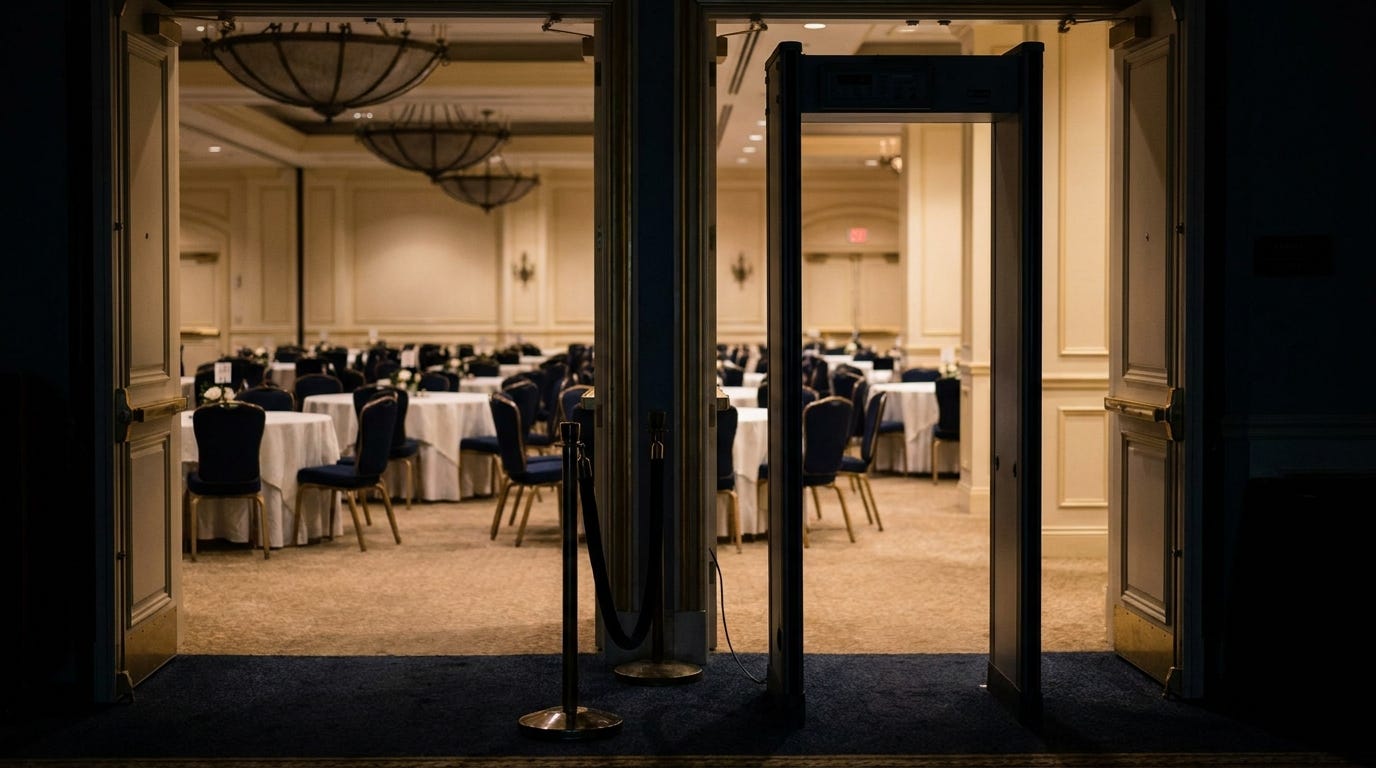
The dinner was sold out. The room held roughly 2,600 people. The lobby of the Washington Hilton, per the Associated Press, “regularly remains open to other guests during the dinner, and security and screening is typically located closer to the ballroom itself.”
The Reason They Were There
This was the first White House Correspondents’ Association dinner Donald Trump had ever attended as a sitting President of the United States. He skipped 2017. He skipped 2018. He skipped 2019. The 2020 dinner was canceled. He skipped 2025. For nearly a decade, he had treated the dinner as an enemy gathering and made his refusal to attend a public statement.
So why, in the middle of a war, did he come?
He told us himself, three hours after his evacuation, in the White House briefing room. He had come to deliver a speech he had been saving up for a long time. From his own remarks, on camera, after he was rushed off the stage:
“I am ready, willing, and able, and I was all set to really rip it. And I said to my people, This would be the most inappropriate speech ever made, if I said, So I have to save it. I don’t know if I could ever be as rough as I was gonna be tonight. I think I’m gonna be probably very nice. I’d be very boring the next time.”
He came to a press dinner during active wartime, after a decade of public boycott, to deliver what he himself described as “the most inappropriate speech ever made.” That was the purpose for which the line of succession was aggregated. That was the reason the war Cabinet, the men and women whose decisions are killing American servicemembers in undeclared combat, sat in one ballroom on the night of April 25.
To watch Trump rip the press.
That is the gravity of the room. The Secretary of “War,” the Secretary of State, the Treasury Secretary running the sanctions architecture against Iran, the Energy Secretary responsible for the Strategic Petroleum Reserve and the supply consequences of the Strait closure, the Director of National Intelligence whose own analysts have publicly contradicted the war’s stated rationale, the Vice President who has called the War Powers Resolution “fundamentally a fake and unconstitutional law,” all in one room. None of them, apparently, said this is unwise. None of them said one of us should be elsewhere. None of them said, with a war on, the country needs us alive more than the President needs us in his audience.
Or if any of them said it, the President did not listen. And they came anyway.
Among them was the Acting Attorney General. Todd Blanche, who served as Trump’s personal defense attorney through the 2024 New York hush money trial and the federal classified documents case, was elevated to acting head of the Justice Department on April 2, when Trump fired Pam Bondi over what news reports described as her insufficiently aggressive prosecution of Trump’s political opponents. He was on day twenty-three of his appointment when he sat in the Hilton ballroom. The Justice Department has not publicly specified whether Blanche serves under 28 USC § 508 or the Federal Vacancies Reform Act, and declined to answer Roll Call’s questions about which legal mechanism authorizes his service.
The Hotel
The Washington Hilton is the same hotel where John Hinckley Jr. shot Ronald Reagan, Special Agent Tim McCarthy, Officer Thomas Delahanty, and Press Secretary James Brady on March 30, 1981.
Three months after that shooting, on July 2, 1981, the General Counsel of the Treasury Department circulated a draft after-action report to Edwin Meese III, then Counsellor to the President. The report, ordered by Treasury Secretary Donald Regan, evaluated “the adequacy of procedures, facilities, and personnel for ascertaining the existence and assessing the seriousness of threats to the President, protecting the President in his public activities, and responding promptly and effectively to this and similar incidents.” The unredacted draft is held at the Ronald Reagan Presidential Library.
It found that the Secret Service performed admirably under circumstances that were highly favorable to survival: a single attacker, quickly apprehended, mid-afternoon, weekday, small-caliber weapon, the President at the door of his limousine close to a fully equipped trauma hospital, the wound non-mortal.
And then it offered, in its own words, this warning:
“Less favorable circumstances can be easily imagined.”
The Treasury Department put that sentence in writing in 1981. It identified procedural deficiencies and called for “the establishment of new protective procedures.” Forty-five years later, the lobby of the Washington Hilton still remains open to other guests during the WHCA dinner. The screening still sits at the door of the ballroom, not at the perimeter of the building. A 31-year-old tutor with a shotgun, a handgun, and four knives walked in.
The Doctrine That Wasn’t
The federal government has a written, classified, multi-tiered policy framework for the continuity of constitutional government in the face of catastrophic events. It is named, dated, and accessible. Presidential Policy Directive 40, signed July 15, 2016, is the controlling National Continuity Policy. It is operationalized by the Federal Continuity Directives, FCD-1 and FCD-2, both updated August 12, 2024. Together they govern how federal agencies preserve essential functions and command authority during a wide spectrum of mass-casualty scenarios.
The directives are exhaustive on facilities. They mandate geographic dispersion of continuity locations. They require that “Heads of Category I and II HQ organizations” identify orders of succession that include “at least one individual who is geographically dispersed from the Organization Head and other individuals within the order of succession.” They define Emergency Relocation Groups and Devolution Emergency Relocation Groups. They specify primary, secondary, and tertiary continuity sites on separate power and telecommunication grids.
They are, in their entirety, silent on the aggregation of the actual statutory successors at non-official gatherings.
The doctrine assumes that bureaucratic continuity is the question. The doctrine does not address the assembly of the human beings the bureaucracy is meant to continue. There is no provision in PPD-40, FCD-1, FCD-2, or any unclassified successor directive that says: officials at the top of the constitutional chain of presidential succession should not all be at the same private dinner during an active war.
That gap is not an oversight. It is a chosen silence. The federal continuity policy framework was rebuilt twice in the post-9/11 era, once in 2007 under Bush and again in 2016 under Obama, with full knowledge that decapitation events targeting the senior civilian leadership were the foundational threat the framework existed to address. And neither version included a binding provision against the kind of aggregation that occurred at the Washington Hilton on April 25, 2026.
The doctrine has a hole in it. The hole has the exact shape of a press dinner.
The Designated Survivor That Wasn’t
There is a customary safeguard that fills the doctrinal hole on a small number of occasions every year. It is called the designated survivor. The Cold War-era practice, used publicly since 1984, removes one person in the line of succession from the room during the State of the Union and presidential inaugurations and places them in a secure, undisclosed location with continuity communications and a protective detail. According to the Congressional Research Service, the practice is not codified in any federal statute, in the Code of Federal Regulations, or in the Constitution. It is, in CRS’s own words, an “executive custom.”
The custom is applied because everyone with operational responsibility for it understands that gathering the constitutional command authority in one room is a bet the country cannot afford to lose. The custom exists precisely because the law did not anticipate this need.
There is no public evidence that a designated survivor was identified for the April 25, 2026 White House Correspondents’ Association dinner.
White House daily schedules do not mention one. Pool reports do not mention one. The press briefing on April 26 did not mention one. The Acting Attorney General, the Acting White House Chief of Staff, the Secretary of “War,” the Vice President, all of whom appeared in the Brady Briefing Room flanking the President in the hours after the incident, were either in the ballroom or in the secure holding area inside the Hilton when the shots were fired. Whoever the designated survivor would have been, if there was one, has not surfaced in any reporting available to the public as of this writing.
This is the question: was the customary safeguard applied or not?
If it was applied and the designated survivor remains unnamed because the White House has chosen not to disclose, that itself is publishable as a refusal of transparency about the most consequential continuity decision the executive branch makes. If it was not applied, then on the night six of the seven top successors were in the same ballroom in the middle of a war, the customary safeguard that has stood since 1984 simply was not used.
Either way, the question demands an answer the White House has not provided.
The Eighteen-Month Warning
On October 17, 2024, the Department of Homeland Security published the final report of the bipartisan Independent Review Panel on the Butler, Pennsylvania assassination attempt against then-candidate Donald Trump. The four panelists were Mark Filip, former Deputy Attorney General; David Mitchell, longtime law enforcement officer; Janet Napolitano, former Secretary of Homeland Security; and Frances Townsend, former Homeland Security Advisor.
The report’s findings, in the panel’s own words:
“The Secret Service does not perform at the elite levels needed to discharge its critical mission... The Secret Service has become bureaucratic, complacent, and static even though risks have multiplied and technology has evolved... The Secret Service as an agency requires fundamental reform to carry out its mission. Without that reform, the Independent Review Panel believes another Butler can and will happen again.”
The panel set deadlines. Butler-specific reforms were to be implemented no later than March 31, 2025. Broader reforms were to be implemented by the end of 2025.
On July 13, 2025, on the one-year anniversary of the Butler shooting, the Senate Homeland Security and Governmental Affairs Committee released its own final report under Chairman Rand Paul. The committee found that the Butler attempt was the result of a “cascade of preventable failures.” It found that “lack of structured communication was likely the greatest contributor to the failures” of July 13, 2024. It found that the former Secret Service Director, Kimberly Cheatle, had given false testimony to Congress about whether resource requests for the Butler rally had been denied. They had been.
And the Senate report documented this: as of one year after Butler, the Secret Service had implemented twenty-one of the forty-six recommendations from independent and congressional oversight bodies. Six employees had been disciplined with suspensions ranging from ten to forty-two days without pay. Twenty-five recommendations remained pending.
Twenty-five recommendations remained pending the night Cole Tomas Allen breached the perimeter at the Hilton.
The current Secret Service Director, Sean Curran, in his post-incident statement on April 25, called the response a demonstration that “our multi-layered protection works.”
The Independent Review Panel had a phrase for the precise scenario that played out on April 25, 2026, eighteen months before it played out. Their phrase was “another Butler.” It arrived.
What Is Owed
Ask any servicemember on watch tonight whether they signed up to fight and bleed and possibly die in an undeclared war whose end criterion is a feeling in the President’s bones. They cannot answer you in the way you want them to, because the oath they swore was to the Constitution, not to the man who currently sits in the office. So they stand watch. They run intercepts in the Strait. They sleep in shifts on bases that have already been hit by Iranian retaliation. They wait. They are good at waiting because we asked them to be good at it. They will continue to be good at it, because that is what the country has asked of them, and they will keep their end of the bargain even when the country has not kept its end.
Here is what the country owes them in return.
It owes them a Commander in Chief who acts like the country is at war when the country is at war. It owes them a Cabinet that does not aggregate at a press dinner during their war. It owes them an Acting Attorney General who is not the President’s former personal defense attorney serving on day twenty-three of his appointment, in a position the Justice Department will not publicly explain the legal basis for. It owes them a constitutional chain of succession that is not all in one ballroom on one night to hear the President insult the journalists who cover them. It owes them a Secret Service that has implemented the reforms an independent panel and the United States Senate told it to implement.
It owes them a republic that takes its own continuity seriously enough to keep one of its statutory successors out of the room. Even one. Even on a slow night. Even when there is no specific threat. Especially when there is.
None of that was true on the night of April 25, 2026. The President came to a press dinner he had boycotted for a decade in order to deliver a speech he himself described as “the most inappropriate speech ever made.” His Cabinet came with him. The Speaker of the House came with his wife. The line of succession sat in one room. The White House has not said whether a designated survivor was named. The hotel lobby remained open to other guests. A 31-year-old tutor walked in.
If he had been carrying what a more capable person, or a coordinated cell, or the next person trying this would carry, instead of a shotgun and a handgun and four knives, the country would have woken up on April 26 with Charles E. Grassley of Iowa, ninety-two years old, sworn in as the wartime Commander in Chief of the United States in the seventh week of an undeclared war whose previous Commander in Chief had said it would end when he felt it in his bones.
The Acting Attorney General, who was at the dinner, called the night a success story. The Director of the Secret Service called it a demonstration that “our multi-layered protection works.” The President used it to argue for building a new ballroom at the White House.
The sailor in the Strait of Hormuz tonight does not know any of this. She is on watch.
What You Can Do
This is a continuity-of-government failure. It is also a transparency failure, and Congress has the tools to address both.
Call or write your Senator and Representative. The Capitol switchboard is (202) 224-3121. Ask for your senator or representative by name. The questions to ask:
Was a designated survivor identified for the April 25, 2026 White House Correspondents’ Association dinner? If so, who? If not, why not?
Will the Senate Homeland Security and Governmental Affairs Committee hold an oversight hearing on the continuity-of-government posture during the April 25 incident, including the absence of any binding doctrine governing the aggregation of statutory successors at non-official events?
Will the House Oversight and Accountability Committee request the Justice Department’s Office of Legal Counsel memorandum authorizing Todd Blanche’s service as Acting Attorney General, including the legal basis under either 28 USC § 508 or the Federal Vacancies Reform Act?
What is the implementation status of the twenty-five remaining recommendations from the post-Butler oversight reports as of April 25, 2026?
Specific committees worth calling directly:
Senate Homeland Security and Governmental Affairs Committee: (202) 224-4751
House Oversight and Accountability Committee: (202) 225-5074
House Judiciary Committee: (202) 225-3951
Senate Judiciary Committee: (202) 224-5225
If you are a journalist or researcher, the agencies holding the operational records are:
The White House Military Office, for any continuity-of-government policy applicable to non-official events.
The United States Secret Service Office of Protective Operations, for the operational security plan, advance site survey, and threat assessment generated for the April 25, 2026 dinner.
The Department of Justice Office of Legal Counsel, for the legal authorization memorandum on Acting Attorney General Blanche.
The Department of Homeland Security FEMA National Continuity Programs office, for any internal policy memoranda or interagency working group records on principal aggregation risk.
FOIA requests cost the news media nothing for the first one hundred pages of duplication and no search or review fees, under 5 USC § 552(a)(4)(A)(iii). Public-interest fee waivers are available on request.
About This Publication
Tbird’s Quiet Fight is independent investigative journalism focused on VA policy, veteran benefits, and government accountability. Published by the founder of HadIt.com, one of the oldest veteran-run VA claims communities online (est. 1997).
Tips and sources: ipersist@tbirdsquietfight.com (encrypted options available on request)
Support this work: Subscribe to TQF | Support HadIt.com
For Press and Advocates
Story tips or collaboration: Tbird (TQF / HadIt.com): ipersist@tbirdsquietfight.com
Congressional oversight contacts (continuity and Secret Service jurisdiction):
Senate Homeland Security and Governmental Affairs Committee: (202) 224-4751 | hsgac.senate.gov
House Oversight and Accountability Committee: (202) 225-5074 | oversight.house.gov
House Judiciary Committee: (202) 225-3951 | judiciary.house.gov
Senate Judiciary Committee: (202) 224-5225 | judiciary.senate.gov
Government watchdog resources:
Theresa Aldrich “Tbird,” Navy veteran (VAQ-34, 1983 to 1990), Investigative Journalist, TbirdsQuietFight.com, founder of HadIt.com. Advisory Board Member, Veterans Healthcare Policy Institute.
I use AI as a research and editing assistant, the same way I’d use a good reference book or a sharp editor.
Last verified: April 26, 2026.