The Efficiency Theater: Reading Between the Lines of VA's VHA Reorganization
The Gist
VA Secretary Collins testified that VHA reorganization will eliminate “duplicative bureaucracy” and improve care—using the exact playbook from 2014’s Choice Act and 2018’s MISSION Act. His statistics are mostly accurate but misleadingly framed: backlog reductions began under Biden, the homeless housing record was achieved before Trump took office, and the oversight reports he cites never recommended eliminating regional management layers. Watch what happens over the next 18-24 months when VISN positions quietly disappear.
When officials lead with “this is NOT a reduction in force,” that’s usually your first clue.
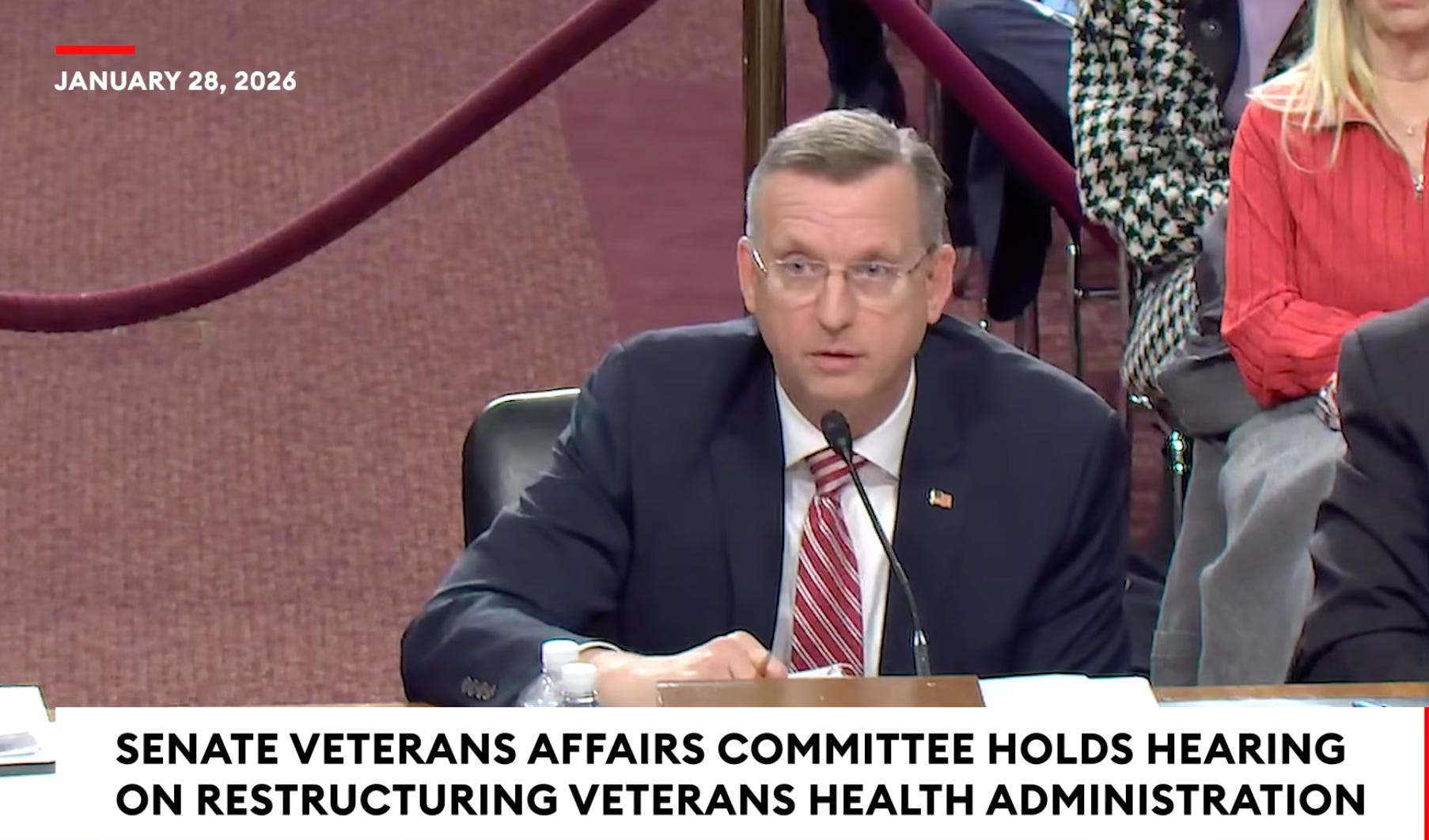
On January 28, 2026, VA Secretary Douglas Collins testified before the Senate Veterans Affairs Committee about VHA’s planned reorganization. His opening line? “Let me start by addressing some misleading and inaccurate descriptions we have heard about this effort. This is not a reduction in force (RIF), and this is not an effort to diminish direct care for Veterans.”
If you’ve been around VA long enough, you recognize this playbook. It’s the same one used before every major restructuring attempt for the past two decades. The script never changes—only the date on the letterhead.
The Numbers Game
Collins came armed with statistics designed to demonstrate that the Trump administration has transformed VA in barely a year:
Backlog reduction: “nearly 60% since January 20, 2025”
CHAMPVA backlog: Eliminated
New facilities: “25 new health care facilities”
Homeless veterans housed: “nearly 52,000...the highest total in 7 years”
Here’s what the numbers actually show:
The Backlog Story
The backlog claim is technically accurate. The backlog dropped from 264,717 on January 20, 2025, to 112,353 by November 2025—a 57.6% reduction that Collins rounds to “nearly 60%.”
But zoom out: The backlog peaked at 417,855 in January 2024 and fell to 134,009 by September 2025—a 67.9% reduction. Most of that drop happened before Trump’s inauguration. The automation systems, staffing increases, and process improvements driving current success were implemented throughout 2024.
Collins is taking credit for crossing the finish line of a race someone else ran.
The Homeless Housing Achievement
Collins claims credit for “permanently housing nearly 52,000 homeless Veterans in fiscal year 2025, the highest total in 7 years.”
One problem: Fiscal Year 2025 ended on September 30, 2025—nearly four months before Trump took office on January 20, 2026.
This is a Biden-era achievement being repackaged as Trump administration success.
The Missing Details
Collins mentions “opening 25 new health care facilities.” VA press releases say “25 new health care clinics.” That word swap matters—facilities suggests full medical centers; clinics means outpatient sites.
Research could not find a list of these locations. No facilities confirmed by name. No opening dates verified. Just a number floating in press releases, unchallenged and unverifiable.
The Citation Shuffle
Collins justifies reorganization by citing reports from GAO and VA’s Office of Inspector General spanning 2016-2024. He’s correct that these reports exist and contain critical language about VHA structure.
But here’s what he doesn’t mention:
The 2016 GAO report (GAO-16-803) that Collins quotes was produced during the Choice Act era—the last major push toward privatization. It criticized VHA’s structure but was part of a broader effort to route veterans to community care.
The Commission on Care report from 2016 was packed with privatization advocates. Their “governance recommendations” aligned with efforts to dismantle direct VA care.
The 2019 GAO reports (GAO-19-462) documented problems with VISN oversight, but recommended strengthening accountability—not eliminating oversight layers.
The 2024 OIG statement that Collins quotes—”weaknesses in VA’s governance and oversight have affected many aspects of program performance and operations”—came from a semiannual report discussing specific program failures (personnel suitability, financial management systems). The OIG was criticizing how VA manages individual programs, not recommending wholesale elimination of regional oversight.
None of these reports specifically recommended eliminating VISN leadership positions. Collins is using decade-old criticism to justify a predetermined restructuring plan.
What They’re Actually Proposing
Strip away the rhetoric, and here’s the reorganization:
VHA Central Office: Sets policy, handles financial management, oversight, compliance
VISNs + New Operations Center: Take policy direction from Central, develop operational standards
Local facilities: Get “greater decision-making authority”
Translation: They’re eliminating the middle management layer that currently provides regional oversight, quality control, and accountability.
Collins promises this creates “clear lines of authority.” But removing oversight doesn’t create accountability—it creates decentralized failure points that are harder to track and slower to fix.
The Pattern You Should Recognize
This exact pattern played out with:
2014 Veterans Choice Act: Cited VA’s “access crisis” to push community care expansion
2018 VA MISSION Act: Used same efficiency language to consolidate community care programs
2025-2026 VHA Reorganization: Using same reports and same rhetoric
Each time, the script is identical:
Cite years-old oversight reports
Promise “no reduction in force”
Claim “eliminating bureaucracy”
Talk about “empowering local directors”
Avoid specifics about which positions disappear
What to Watch For
The reorganization announcement says changes will occur “over the next 18-24 months.” That’s your window to track what actually happens versus what’s promised.
Key indicators:
Vacancy rates at regional offices: If VISN positions aren’t filled after people leave, that’s a soft RIF
Wait times and quality metrics: Local facilities with less oversight may see quality variation
Community care spending: Watch whether “efficiency” dollars flow to private contractors
Accountability gaps: Who investigates systemic problems when regional oversight disappears?
The Questions Nobody’s Answering
Collins’ testimony didn’t address:
Current staffing levels: What are VISN vacancy rates now?
Specific positions affected: Which “duplicative” roles are being eliminated?
Success metrics: How will VA measure whether this reorganization improves care?
Timeline details: When do specific changes occur, and how will they be monitored?
Cost analysis: Does removing oversight layers actually save money or shift costs elsewhere?
What This Means for Your Care
In the short term: probably nothing. Front-line clinical staff at your local VA aren’t affected by this reorganization. Your doctor, your nurse, your benefits counselor—they’re still there.
In the medium term: watch for variations in service quality between facilities. Regional oversight exists to catch problems early and ensure consistent standards. Without it, facility-level failures may take longer to identify and fix.
In the long term: this restructuring makes VA’s direct care system more vulnerable to further privatization efforts. Eliminating regional management layers removes institutional knowledge and oversight capacity that would be difficult to rebuild.
What You Can Do
Track the changes: Bookmark this article and check back in 6 months. Are VISN positions being filled? Are wait times staying steady? Is community care spending increasing?
Ask your VSO: When you hear about “efficiency improvements,” ask which specific positions are being eliminated and how oversight will be maintained.
Document your experience: If you notice changes in care coordination or quality at your local VA, report it. The pattern only becomes visible when veterans share what’s actually happening on the ground.
Share this analysis: Veterans need to understand the playbook before the moves are made. Forward this to veterans in your network who need to see the pattern.
The Bottom Line
Collins wrapped his testimony in the language of efficiency and accountability. He cited legitimate criticisms from oversight reports. He presented impressive statistics.
But the pattern is unmistakable: Use accurate numbers, cherry-pick old reports, avoid specifics about job losses, promise better care with less bureaucracy.
It’s the same playbook from 2014’s Choice Act and 2018’s MISSION Act—just updated for 2026.
The real test isn’t Collins’ testimony. It’s what happens over the next 18-24 months when VISN positions quietly go unfilled, when regional oversight disappears, when accountability gaps appear.
By then, the press conference will be over. The testimony will be archived. And veterans will be left navigating whatever system remains.
Place your bets on how long before they say “unforeseen challenges.”
Tbird’s Take: I’ve watched VA restructuring attempts for 29 years. Every single one follows this script: cite old oversight reports, promise efficiency, avoid specifics about job cuts, claim “this time is different.”
It never is.
The question isn’t whether Collins’ statistics are accurate—most are, with creative framing. The question is whether removing regional oversight actually improves care or simply makes systemic failures harder to detect and fix.
History suggests the latter.
Sources: Secretary Collins’ testimony (January 28, 2026), VA press releases, GAO reports GAO-16-803 (2016), GAO-19-462 (2019), VA OIG Semiannual Report Issue 90 (March 2024), VBA Monday Morning Workload Reports


