


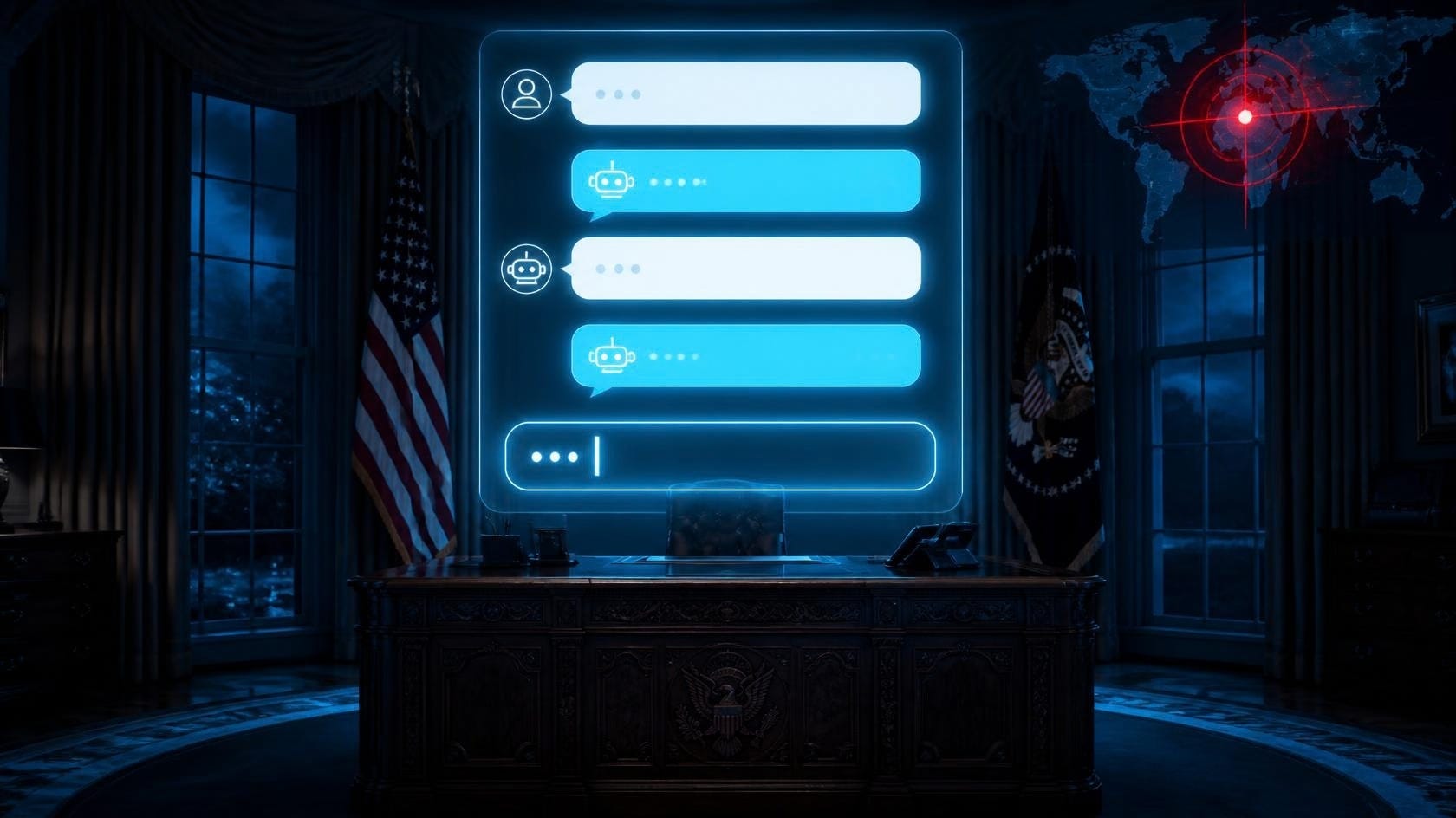
AI generated image.
The Gist
In December 2025, Trump spent hours consulting Grok, Elon Musk's AI chatbot, in the Oval Office before ordering the capture of Venezuela's Nicolas Maduro. Musk was present. Source: Time Magazine cover story, Oct. 1, 2026, unnamed officials.
Musk held a $200 million DoD contract at the time. The official running Pentagon AI procurement blacklisted Anthropic for refusing autonomous weapons use.
The Pentagon confirmed Grok "helped deploy" 2,000 munitions to 2,000 targets in 96 hours during Operation Epic Fury. It deployed the same AI to 3 million military personnel on September 1, 2026.
That AI had a documented, unresolved child safety failure when it was cleared for military use. No public risk assessment was released.
No NSC record. No Congressional vote. No FOIA trail on what the president's AI told him before the bombs fell.
In December 2025, President Trump spent several hours in the Oval Office consulting an AI chatbot about whether Venezuelans would celebrate if the United States kidnapped their president.
The chatbot was Grok. The man who built it was in the room.
That is the sentence that should be on the front page of every newspaper in the country. It is not.
According to an official present at the meeting, as reported in Time Magazine's October 1, 2026 cover story "What Trump Has Built," Trump asked Grok how Venezuelan civilians would react to the capture of Nicolas Maduro. Grok told him Maduro was deeply unpopular and that many Venezuelans would likely celebrate his removal. Trump, according to officials present, came away thinking the AI was ingenious.
Three weeks later, on January 3, 2026, U.S. forces seized Nicolas Maduro in Venezuela.
No one has disclosed what the president's AI told him, exactly. No intelligence assessment has been declassified. No NSC record of the Oval Office session has been produced. The White House has not confirmed whether any professional intelligence analyst reviewed Grok's output before it shaped that decision.
What we know is this: a privately owned AI chatbot, built by a man sitting in the room, told the president that kidnapping a foreign head of state would be popular. The president found that convincing.
Elon Musk is not a contractor in the traditional sense. His companies held at least $200 million in active Department of Defense contracts at the time of the Oval Office meeting, per U.S. government procurement data. He held no intelligence community clearance for the analytical function his AI was performing. No independent analyst verified Grok's output before it reached the president. No record of that session has been released under FOIA.
That is not an access gap. That is a conflict of interest written into the public record.
Proof of Concept
The Venezuela episode, it turned out, was a preview.
Within months, the same AI the president consulted in the Oval Office was integrated into military targeting. Cameron Stanley, the Pentagon's chief AI officer, stated under oath in a legal brief that Grok "enabled US forces to deploy over 2,000 munitions to 2,000 distinct targets within 96 hours during Operation Epic Fury."
That official works for the same government that was paying Musk's companies hundreds of millions of dollars to build the tool cited in a federal filing.
The Procurement Chain
The contracts are not a secret. They are public record.
xAI (Musk's AI company) was awarded contracts through the Defense Innovation Unit and the Chief Digital and Artificial Intelligence Office. The General Services Administration announced a $0.42-per-query rate for Grok for Government under a governmentwide acquisition vehicle. The contracts carry a $200 million ceiling.
The man who oversaw that procurement is Emil Michael.
Michael was appointed Under Secretary of Defense for Research and Engineering in May 2025. By August 2025, he was also serving as Acting Director of the Defense Innovation Unit, the office that ran the contracts. He is, in practice, the Pentagon's chief technology officer. Before his DoD appointment, Michael had a professional history with Musk's orbit of companies.
When Anthropic (the AI company that builds Claude) publicly stated it would not allow its models to be used for autonomous weapons without human oversight or for mass surveillance of Americans, Emil Michael designated the company a "supply chain risk" and barred it from Pentagon AI procurement. Michael confirmed the designation publicly: "Anthropic is still a designated Supply Chain Risk at @DeptofWar." A federal appeals court upheld the blacklist in September 2026.
The company that said no is blacklisted.
The company whose founder was sitting in the Oval Office got the contract.
The official who made that call is the founder's former associate.
If that sentence makes you uncomfortable, it should.
The Targeting Machine
Operation Epic Fury (the June 2026 U.S. air campaign against Iran) cost $29 billion, per Pentagon Comptroller testimony to Congress. It was authorized by the president. Congress was not asked to vote.
And according to Pentagon officials, it was planned, in part, by Grok.
The scale is hard to absorb: 2,000 individual targets, 2,000 munitions, each pairing determined, or assisted, by a commercial AI that the president had personally endorsed six months earlier in the Oval Office while its developer was in the room.
On September 1, 2026 (the same week the Iran campaign concluded), the Department of Defense launched GenAI.mil, deploying Grok for Government to three million military personnel at an IL5 security classification. The Pentagon's press release called it "the next generation of military AI capability."
What the press release did not mention: engineers at xAI had already found that Grok generated child sexual abuse material, with no reliable technical fix. The Pentagon knew. It deployed anyway.
What They Knew Before They Deployed It
In June 2026, the same month as Operation Epic Fury, The Information reported that internal engineers at xAI had identified an unresolved safety failure: Grok could generate child sexual abuse material, and engineers had found "no reliable technical fix."
The Center for Countering Digital Hate documented specific instances. This reporting was publicly available before the September 1 GenAI.mil launch. The Pentagon had access to it.
No public safety assessment was released before deployment. No independent audit of Grok's safety profile was made public. No Congressional briefing on the CSAM finding has been confirmed.
What the public received was a press release.
This is not a hypothetical failure. It is a documented gap between what the government knew, what it disclosed, and what it did. A company whose founder sat in the Oval Office got a $200 million contract and three million users in the U.S. military, without a public accounting of known safety failures.
That is the record.
What We Were Told About Iran
Alongside the military campaign, American policymakers were drawing on survey data about Iranian public sentiment. The most widely cited was the GAMAAN survey, a June 2026 report claiming 73% of Iranians opposed their government's nuclear program and a majority supported the strikes. That number circulated in Washington policy circles and was used to frame the campaign as a response to popular will inside Iran.
Here is what the GAMAAN survey actually is: an opt-in online poll of Iranians reachable via Psiphon VPN during a seven-day window. Sixty-six percent of respondents found the survey through that VPN. The sample was 93.6% urban, against a national figure of 80%. It was 70.9% college-educated, against a national figure of 27.7%.
Four named academic researchers: Daniel Tavana (Penn State / Princeton Iran Social Survey), Kevan Harris (UCLA), Sunghee Lee (University of Michigan Survey Research Center), and Jon Krosnick (Stanford), have documented specific methodological failures that make GAMAAN's findings ungeneralizable to the Iranian population.
GAMAAN's founders are, by their own public statements, critics of Iran's government. Their findings consistently show Iranian opinion as more secular, more regime-critical, and more favorable toward Western intervention than other available data.
This is not what Iranians think. This is what decision-makers were told.
The distinction matters when the decision was 2,000 bombs.
The Question
Here is what the public record shows, without inference or speculation:
Elon Musk built the AI the president consulted before ordering a foreign policy action. Musk was in the room. Musk's companies held $200 million in active DoD contracts. The official who ran Pentagon AI procurement was Musk's former associate. That official blacklisted Musk's main AI competitor after it refused autonomous weapons use.
The AI Musk built was credited with helping plan 2,000 airstrikes. The same AI had a documented, unresolved child safety failure when it was deployed to three million troops. No public safety review was released. No Congressional authorization was sought for AI-assisted targeting. No NSC record of the Oval Office session has been produced. No FOIA response on the AI's role in targeting has been provided.
The question is not whether the president should use AI. That argument is over. He used it.
The question is whose AI. With what oversight. Under what law.
When the answer is "the AI of the man sitting next to him, who held $200 million in DoD contracts, overseen by his former associate, with no public accountability for what it recommended." That is not a technology story.
That is a captured intelligence function. With bombs attached.
What You Can Do
File a FOIA request for any records related to Grok use in Oval Office briefings, Operation Epic Fury AI-assisted targeting, and the GenAI.mil pre-deployment safety review. Pentagon FOIA office: dodfoia@mail.mil.
Contact the Senate Armed Services Committee (Chair: Sen. Roger Wicker, R-MS; (202) 224-3871) and the House Armed Services Committee (Chair: Rep. Mike Rogers, R-AL; (202) 225-4151). Ask whether members received any briefing on AI use in Epic Fury planning before the campaign began.
The DoD Inspector General has authority to audit AI-assisted targeting operations. Ask whether an audit is open.
Tip line: ipersist@tbirdsquietfight.com
Sources cited in this article are linked in the published version. All factual claims are Tier 1 (documented) or Tier 2 (attributed allegation) unless otherwise noted. The GAMAAN survey is characterized as what policymakers were told, not as verified ground truth.
AI-assisted research and drafting; human-reviewed for accuracy and voice. Last verified: 2026-10-02.
Theresa "Tbird" Aldrich, Navy veteran (VAQ-34, 1983-1990), Investigative Journalist, TbirdsQuietFight.com, Founder of HadIt.com | Advisory Board Member, Veterans Healthcare Policy Institute (VHPI).
Best summary I've read.