Three Moves. One Direction.
AI-generated image. Research and analysis: Tbird's Quiet Fight · tbirdsquietfight.com
THE GIST
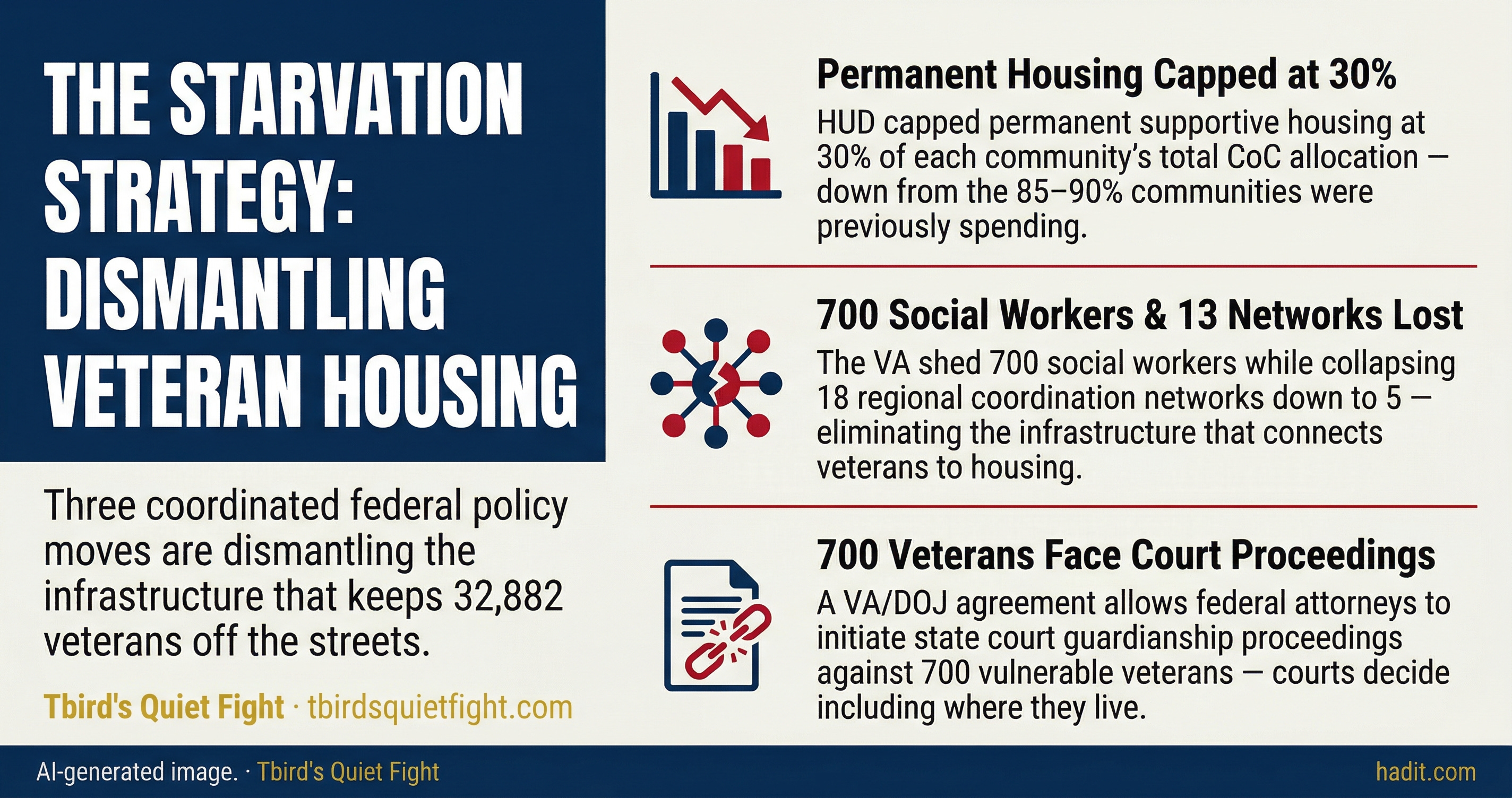
HUD just gutted the main federal program that keeps homeless veterans housed — capping permanent housing funds at 30% of each community’s total CoC allocation, down from the 85–90% communities were previously spending on permanent housing
The VA simultaneously lost 700 social workers — the people who connect homeless veterans to those housing programs — and is now collapsing 18 regional networks down to 5, eliminating the coordination infrastructure those workers depend on
A new VA/DOJ agreement gives federal attorneys the power to initiate court proceedings that can strip decision-making authority from approximately 700 veterans in VA facilities — VA confirms some are homeless or at risk
The vouchers that were supposed to be the safety net now come with ideological compliance strings attached
A federal court has temporarily blocked the HUD funding shift. But “temporary” is doing a lot of work right now.
The VA isn’t failing homeless veterans by accident.
Three separate federal policy moves — enacted months apart, buried in bureaucratic language, never connected in a single headline — are now converging on the same population. Each one, on its own, looks like reshuffling. Together, they form something uglier.
Move one: HUD Secretary Scott Turner released the FY25 Continuum of Care Notice of Funding Opportunity — the annual grant that funds most of the housing infrastructure keeping veterans off the street. The new rules cap permanent supportive housing at 30% of a CoC’s previous allocation. Most communities were spending 85 to 90 percent of those funds on permanent housing. That gap doesn’t disappear. Veterans do.
The policy isn’t subtle about its origins. Project 2025 explicitly called for HUD to end all Housing First grants, labeling the model a “far-left idea.” HUD is delivering.
A federal court issued a preliminary injunction on December 23rd ordering HUD to preserve the status quo and process eligible renewals. The injunction is holding — for now.
Months before the injunction, in July 2025, HUD had already issued a separate notice announcing roughly 3,400 new HUD-VASH vouchers — the program that’s supposed to be the individual veteran’s lifeline to stable housing. The $34 million announced sounds significant. It isn’t. The 2025 continuing resolution provided $15 million in total new appropriations for the program — but only $5 million of that reached veterans as new vouchers. The other $10 million was designated for administrative fees. The remaining $29 million in the notice is prior-year carryover — money already allocated in previous budgets, not new commitment. And buried in Section 16 of that voucher notice, HUD attached a list of Trump executive orders that now govern every organization receiving those vouchers — including one that restricts benefits to people based on immigration status, and one that terminates DEI programs. Veteran housing vouchers now come with ideological compliance strings. That’s new.
An estimated 115,000 non-citizen veterans live in the United States. They served. They wore the uniform. Military service provides an expedited path to citizenship — but not an automatic one. The process requires applications, certifications, background checks, and USCIS processing — a multi-step sequence that can be disrupted by overseas service, administrative backlogs, or policy changes. Whether the immigration restriction now embedded in HUD-VASH voucher notices can be used to deny housing assistance to a veteran still waiting on citizenship paperwork is a question nobody at HUD or VA has answered publicly. Someone should ask.
Move two: The VA has shed approximately 40,000 employees over the past year, including nearly 700 social workers. Those aren’t administrative positions. Social workers are the people who find the veteran sleeping under an overpass and walk them through the HUD-VASH application. They’re the ones who know which CoC has a slot open and which case manager to call. You don’t automate that. You just lose it.
And the regional coordination structure those workers depended on is being dismantled at the same time. The VA is collapsing 18 Veterans Integrated Service Networks down to 5 — the largest restructuring of VA healthcare in 30 years. At the February 2026 House Veterans’ Affairs Committee hearing, Rep. Debbie Wasserman Schultz cited a net cost of $312 million over five years — a figure that already accounts for VA’s projected savings. Regional networks are where complex case management happens. Homeless veterans don’t have simple cases. Shrinking 18 networks to 5 means the people still standing lose the coordination infrastructure they need to do their jobs.
Move three: In March 2026, the VA and DOJ signed a memorandum of understanding allowing VA attorneys to initiate state court guardianship and conservatorship proceedings against veterans in VA facilities who lack medical decision-making capacity and have no legal surrogate. Approximately 700 veterans are in scope. VA attorneys don’t determine the outcome — state courts do. But once a court appoints a guardian, that guardian makes decisions for the veteran.
Including where they live.
VA press secretary Peter Kasperowicz confirmed that some of the targeted veterans are homeless or at risk of homelessness — and CNN reported roughly half of the 700 targeted veterans are homeless. Kasperowicz pushed back on the framing, saying the key characteristic is not homelessness but lack of capacity to make medical decisions. Carl Blake, CEO of Paralyzed Veterans of America, warned the agreement could lead to “unnecessary institutionalization” and permanently restrict a veteran’s access to community-based supports.
What the Sequence Actually Means
Billion-dollar permanent housing infrastructure gets defunded. The voucher program meant to replace it gets starved of new money and loaded with compliance requirements. Seven hundred social workers disappear. The regional networks that coordinated their work get collapsed. Legal guardianship creates a transfer mechanism for the most vulnerable patients in VA facilities.
HUD is explicitly redirecting CoC funding toward transitional housing. Federal dollars follow veterans wherever they go. The question worth asking is who runs the transitional housing that fills the vacuum — and who profits when permanent housing disappears.
This is what a starvation strategy looks like in practice. You don’t announce that you’re dismantling the system. You just make the system fail — then point at the failure as proof that the government can’t do the job.
The 2024 HUD Point-in-Time count found 32,882 veterans experiencing homelessness. That number came after years of hard-won progress. Watch what happens to it next year.
TAKE ACTION
The ask: Contact your representatives. Demand they protect the December 23rd federal court injunction blocking HUD’s CoC funding reversal and restore permanent supportive housing funding.
If you’re a veteran:
“I’m a veteran and a constituent. I’m calling about the federal court injunction blocking HUD’s Continuum of Care funding reversal. That injunction is the only thing standing between thousands of homeless veterans and the street. I’m asking [Representative’s name] to publicly support restoring CoC permanent housing funding and protecting the court order. Can you tell me the representative’s position on this?”
If you’re a citizen:
“I’m a constituent calling about federal housing policy. A court has temporarily blocked HUD’s attempt to gut the Continuum of Care program that houses homeless veterans. I’m asking [Representative’s name] to go on record supporting the court order and opposing any HUD policy that moves veterans out of permanent housing and into temporary shelters. What is the representative’s position?”
House Veterans’ Affairs Committee — Minority Staff 202-225-9756 Rep. Mark Takano, Ranking Member (CA-39)
Find your representative: house.gov/representatives/find-your-representative
Find your senators: senate.gov/senators/senators-contact.htm
Sources
All primary source documents used in this article are available for public review in the HUD CoC Source Notebook on NotebookLM. Ask it questions directly.
Download the briefing slides (PDF) →
HUD FY25 CoC Notice of Funding Opportunity: hud.gov/news/hud-no-25-132
HUD Notice PIH 2025-21 — HUD-VASH Vouchers: hud.gov
Project 2025 — Chapter 15, Department of Housing and Urban Development (pp. 503–516)
USICH FY2024 Annual Homelessness Report: usich.gov
VA/DOJ MOU Press Release: news.va.gov
CNN — VA/DOJ Guardianship Agreement (March 20, 2026): cnn.com
Military Times — VA Legal Guardianship (March 18, 2026): militarytimes.com
Rep. Takano HVAC Remarks (Feb 11, 2026): democrats-veterans.house.gov
VA Workforce Report — GovExec (Jan 2026): govexec.com
VA Rolls Out Risky Consolidation Scheme — The American Prospect (March 2, 2026): prospect.org
CRS Report — Foreign Nationals in the U.S. Armed Forces: congress.gov
About Tbird’s Quiet Fight
Tbird’s Quiet Fight is an independent investigative publication covering VA policy, veteran benefits, and the forces working to dismantle the system veterans earned. Written by Theresa “Tbird” Aldrich — Navy veteran, founder of HadIt.com, and 29-year veteran advocate.
For more on the VA privatization pattern behind these moves, read:
For press and advocates: ipersist@tbirdsquietfight.com
I use AI as a research and editing assistant—the same way I’d use a good reference book or a sharp editor. Every word published here is reviewed, verified, and approved by me. The perspective, accuracy, and editorial decisions are mine.