


The Gist
VA raised veterans’ ratings to 100% more than 625,000 times in three years. Its own budget names what’s pushing ratings up: the PACT Act, rule changes, record claims processing, and more conditions per claim. Fraud isn’t on the list.
The number landed in the middle of a two-year campaign to paint veterans as gaming the system.
The policy that campaign points to is already written. Section 108 of H.R. 9237 would cut sleep apnea and tinnitus ratings for claims filed after it becomes law. The bill survived a House floor challenge by one vote.
VA’s own version of the same cut is now classified as a major rule. VA projects final action in April 2027 and estimates $25.5 billion in savings over ten years.
Both bar using the changes to cut compensation already being paid. They target new claims.
By the numbers
625,000+ increases to a 100% rating, fiscal years 2023 through 2025
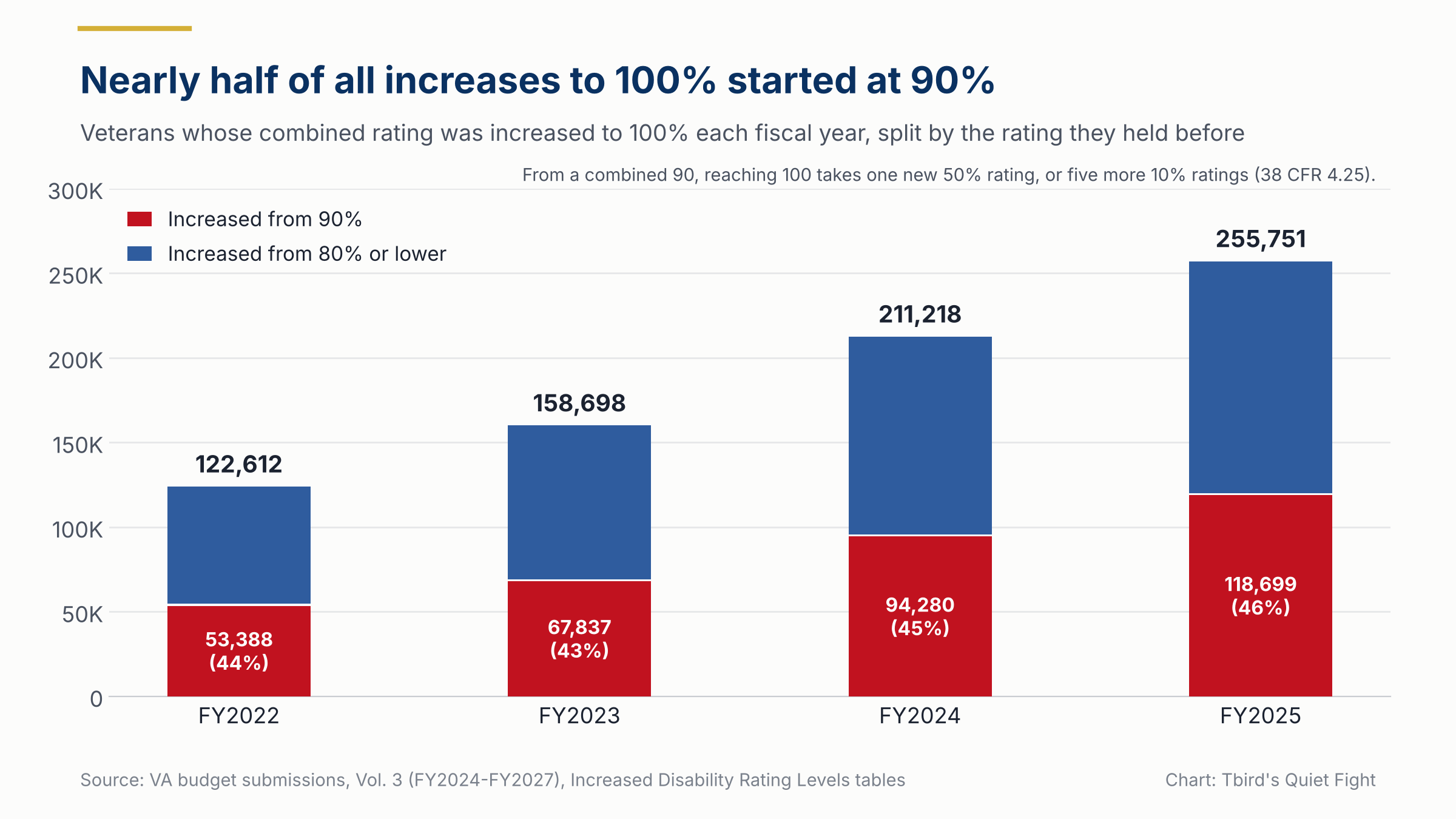
46% of 2025’s increases came from veterans already rated 90%
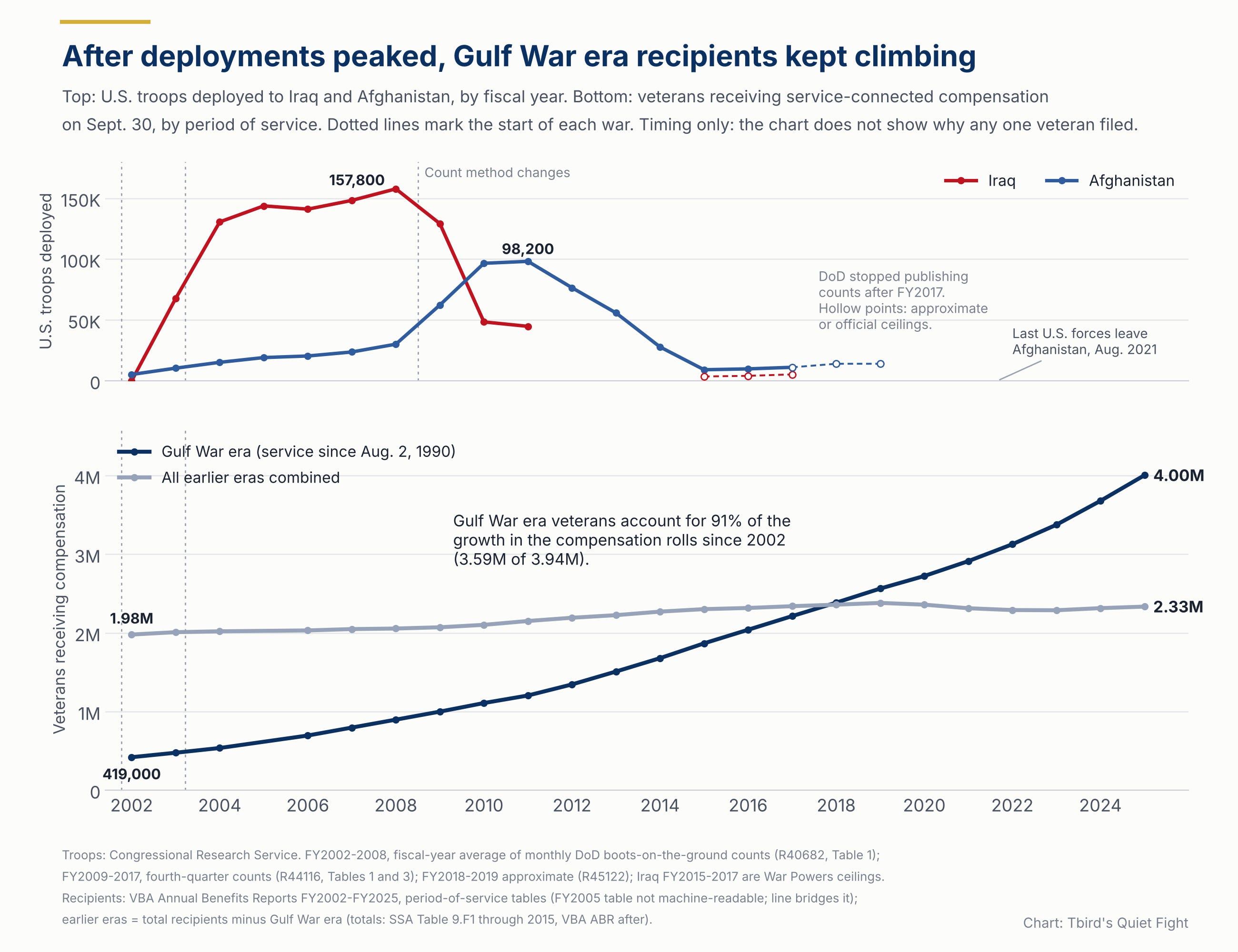
91% of the growth in the compensation rolls since 2002 is Gulf War era veterans
210-211, the July vote that kept the bill carrying Section 108 alive
$25.5 billion, VA’s own ten-year savings estimate for its sleep apnea and tinnitus rule
The number
On Oct. 22, Military.com pulled a figure out of VA’s budget books: VA raised veterans’ ratings to 100% more than 625,000 times in three years.
Military.com called them upgrades. VA’s own table calls them increased ratings, and that’s the right word. A rating goes up because a disability got worse, or because a new one showed up years later, the way Agent Orange did. When a civilian’s disability gets worse, nobody says congratulations on the upgrade.
Those are increases counted year by year. A veteran already at 100% can’t be raised to 100% again, so the total is probably close to the number of veterans. VA’s table doesn’t say.
I don’t think Military.com set out to write a hit piece. But I’ve been watching VA numbers since 1997. I know what happens to a number like that. It gets clipped, stripped of its footnotes, and passed around until it means whatever the person holding it needs. Right now a crowd needs it to mean one thing: veterans are gaming the system.
They’ve been building that case since at least November 2024. What they lacked was one headline-sized figure. Now they have it.
So VA’s own explanation goes on the record first.
What VA says drove it
In its latest budget request to Congress, VA reports the average disability rating rose to 65.6% in 2025, the biggest one-year jump in more than 30 years. Then it lists why: the PACT Act, regulatory updates, more completed claims, and more issues per claim.
That’s VA’s list, not mine. It explains rising ratings; it doesn’t break down the 625,000, and it doesn’t measure fraud one way or the other. But anyone calling this inflation has to argue with the agency that writes the checks before they get to argue with veterans.
Nearly half of those increases went to veterans already rated 90%, about 281,000 over three years. That’s the last step on the scale, and the hardest one to take. Yes, the yearly count more than doubled, from about 123,000 in 2022 to about 256,000 in 2025. Hold onto the 90% part. It explains more than any think-tank chart.
The cut is already written
This is where a budget statistic turns into a threat.
In June, House Veterans’ Affairs Committee Chairman Mike Bost (R-IL) introduced the Take Care of America’s Veterans Act, H.R. 9237. Senate committee Chairman Jerry Moran (R-KS) filed the Senate version the same day.
Section 108 orders VA to rewrite how it rates two of the most common claims:
Sleep apnea: 0% with no symptoms. 10% if treatment only partly works. 50% only if treatment fails or other conditions rule it out. 100% only with organ damage.
Tinnitus: no separate rating, except 10% when it comes with service-connected hearing loss rated at zero.
Who it hits: claims filed after it becomes law. The changes can’t be used to cut compensation already being paid.
Read that last line twice. If you’re rated for sleep apnea or tinnitus today, this bill can’t be used to cut that rating. It’s aimed at new claims: the 22-year-old who comes home next year with a CPAP machine and ringing ears, and the veteran already on the rolls who files for sleep apnea next year.
House leaders sent the bill to the floor under a closed rule, so no floor amendments. On July 16, Rep. Chris Deluzio (D-PA) moved to send the whole bill back to committee. The motion failed 210-211. Leaders then postponed further action. As of Oct. 27, there has been no passage vote.
One vote. That’s the margin.
The money. DAV says a VA analysis puts the savings at $57 billion over ten years. The Senate committee majority’s own summary says $38 billion, with half redirected to other veterans’ benefits, according to Newsweek. VA’s own regulatory agenda puts the savings from its version of the change at $25.5 billion over ten years. Three estimates, three sources, no CBO score. Either way, future claimants’ sleep apnea and tinnitus ratings help pay for the rest of the bill. Newsweek reported that Sen. Richard Blumenthal (D-CT) tried to swap that offset for unspent Pentagon money. He lost.
Newsweek reported the American Legion, Wounded Warrior Project and the Elizabeth Dole Foundation backing the bill in July, and the White House backing it in September. DAV, VFW, IAVA and PVA opposed its funding offsets.
One correction to the opposition’s own messaging, because the other side will make it if I don’t: DAV has said the change would reach existing claims. The bill text bars using these changes to cut compensation in effect the day before enactment. This fight is about new claims, not existing ratings.
The rule track. Section 108 isn’t the only road. VA proposed substantially the same changes in 2022 and revised them in 2024. The spring 2025 regulatory agenda listed that rule as not major, with final action projected for December 2025. This year’s agenda lists it as economically significant and major, with $25.5 billion in projected savings over ten years, and projects final action in April 2027. Agencies don’t reclassify a rule as major by accident.
A VA spokesman told Newsweek in September that no changes are “planned or imminent.” As of Oct. 27, the rule isn’t at the White House budget office for final review. It’s pending, not final. It isn’t dead, either.
For veterans. If you’re rated today, both the bill and VA’s proposed rule bar using these changes to cut your existing compensation for these conditions. A new claim filed after the change, including one from a veteran already on the rolls, would fall under the new rules. If you’re serving now, or recently out and haven’t filed, this is about you.
This is journalism, not legal advice. If you have a claim pending or planned, talk to a VA-accredited representative.
The law moved first
In August 2022, President Biden signed the PACT Act. Among much else, it made hypertension presumptive for veterans exposed to Agent Orange.
The law set hypertension’s general start date for October 2026. VA didn’t wait. On signing day, Secretary Denis McDonough announced all 23 new presumptives were effective immediately, and VA started processing claims in January 2023. Vietnam veterans got paid for hypertension years ahead of the date Congress wrote down.
VA’s own budget says the Vietnam-era caseload, which had been shrinking, started growing again in 2023 because of it.
That was a policy choice to pay old men sooner. You can argue with it. You can’t call it fraud.
It wasn’t the first. Since 1991, Congress and VA have opened compensation to Agent Orange diseases, Gulf War illness, Camp Lejeune water, Blue Water Navy sailors and burn pits. Each change brought in veterans who had been shut out.
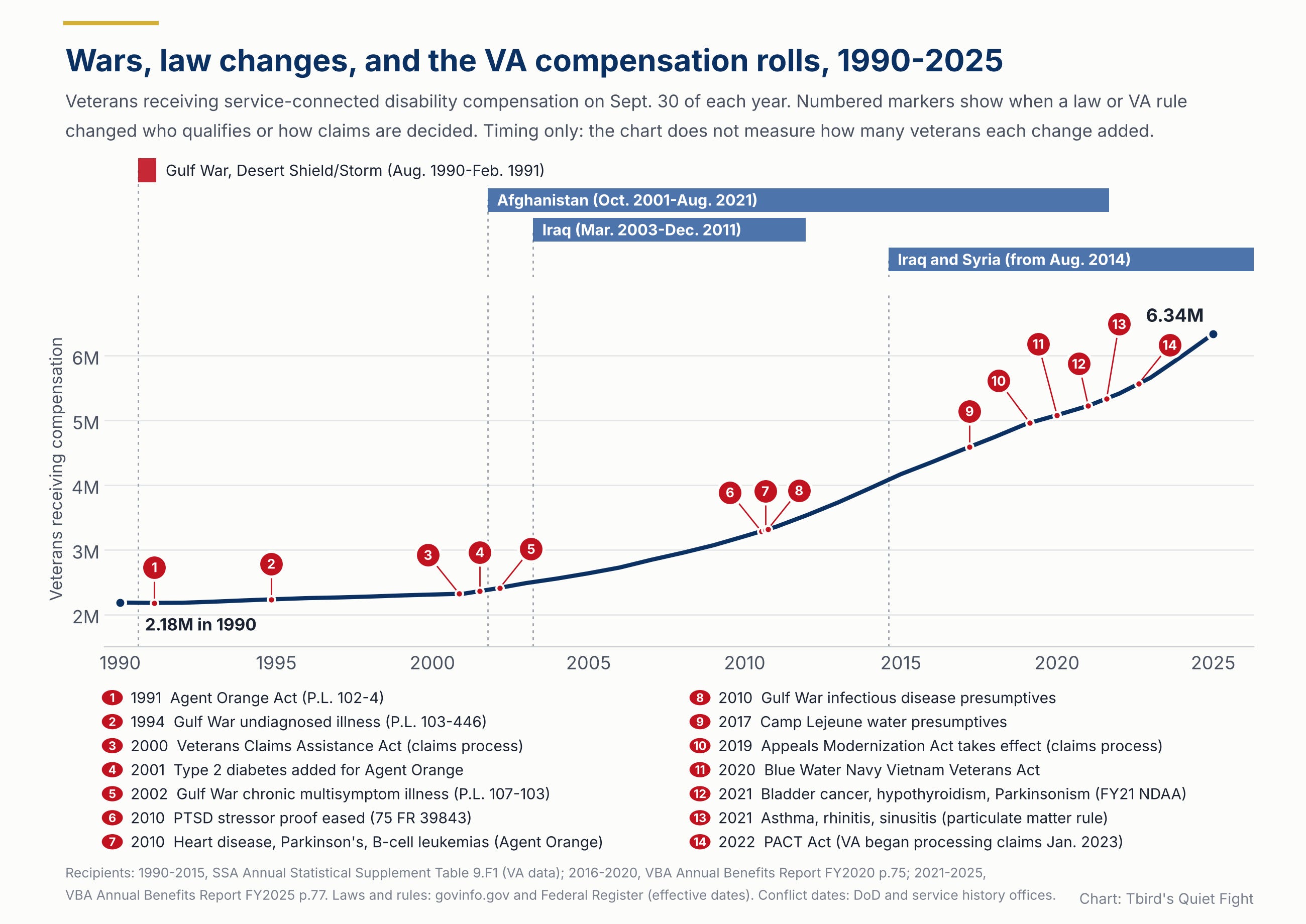
And VA got faster. It completed more than 2.3 million rating claims in 2025, and its total claims output set a record. More decisions means more awards, and more increases among them. VA lists that as a factor itself.
Why 90 turns into 100
VA doesn’t add ratings. It combines them, and each new rating counts only against the part of you not already rated disabled. Then the result rounds to the nearest 10. That’s why the last 10% is the hardest. Take a veteran whose ratings combine to exactly 90. Add a new 10% condition and the math lands at 91. Still 90%. Getting to 95, which rounds to 100, takes one new 50% rating, or five more 10% ratings stacked one after another. (A rating shown as 90% can sit anywhere from 85 to 94 underneath, so the bar runs from one more 10% to one new 70%.)
Now look at who’s filing. Post-9/11 veterans on compensation average nearly 10 service-connected conditions each. World War II veterans average about two and a half.
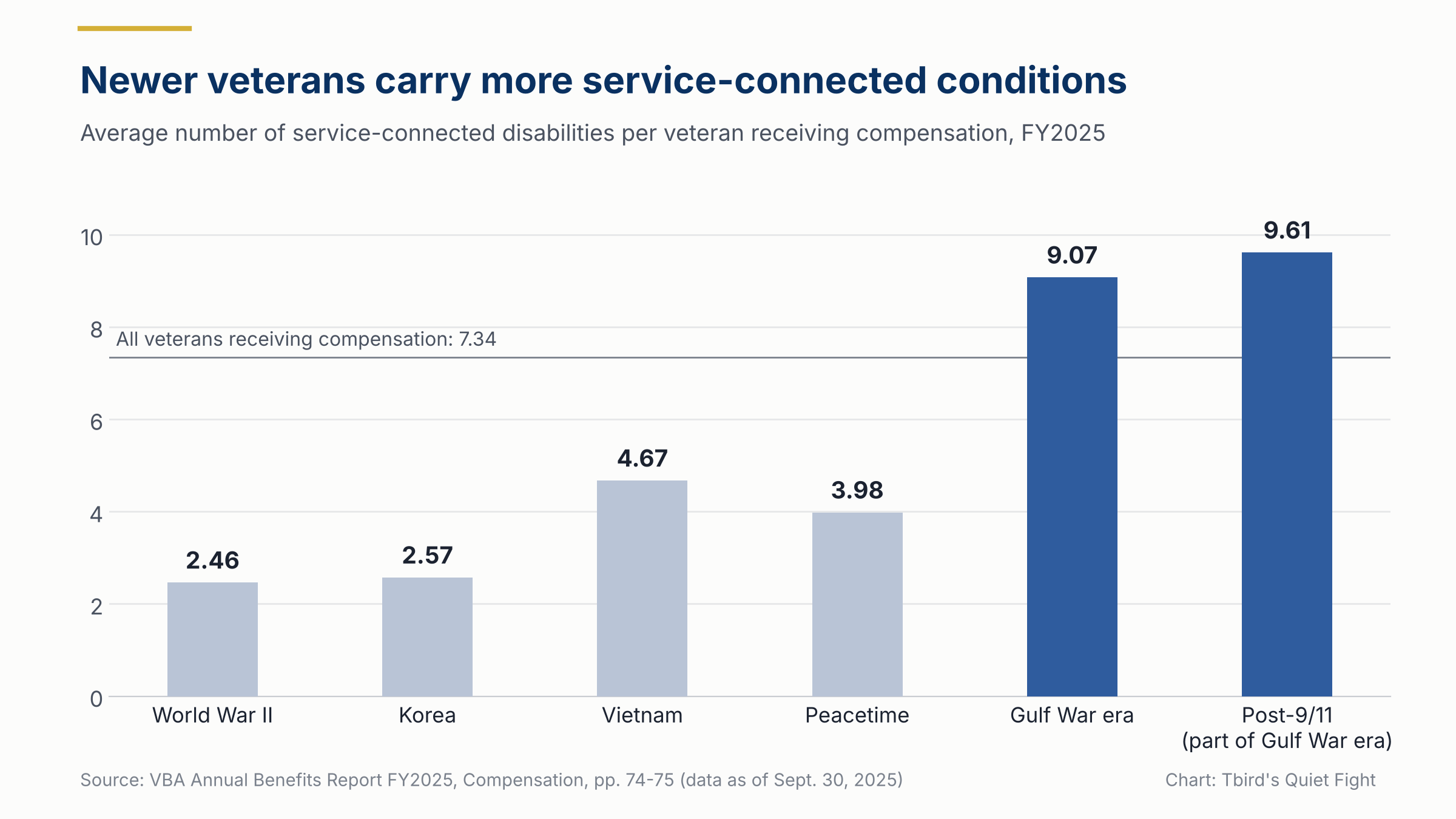
Age and presumptive rules play a part. So do twenty years of war. Stack enough conditions under a formula built to squeeze, and the 90s cross the line. About 119,000 did in 2025 alone.
“An incentive not to get better”
In November 2024, The Economist ran “American veterans now receive absurdly generous benefits.” It quoted Stanford economist Mark Duggan: “Once you qualify you have an incentive not to get better.”
That’s the slacker argument in one sentence. VA’s own records answer it.
The growth belongs to the generation that fought. Since 2002, the compensation rolls grew by about 3.9 million veterans. Nine in ten were Gulf War era, meaning anyone who has served since August 1990. Their numbers rose every year through the surges and kept rising as the troops came home. Many veterans file after they get out, and the injuries come home with them.
The 100% group is getting younger. The average age of veterans rated 100% fell from about 57 to 55 since 2022, while the group grew by two-thirds. Part of that is older veterans dying off the rolls, so I won’t push it further. But this isn’t retirees running out the clock.
100% isn’t a lifetime lock. Unless VA rates it permanent and total, a 100% rating can be reexamined and reduced. The Economist told readers 100% brings about $4,000 a month for life, “with no conditions attached.” That $4,000 is close to VA’s average 100% payment with dependents. “No conditions” is wrong for every veteran whose rating isn’t permanent.
When VA does cut, the process breaks a third of the time. CBO noted in 2023 that ratings are rarely reduced. True. In August, VA’s Inspector General estimated that in 2024, VA made at least one error in about a third of its cases proposing or finalizing a cut to a veteran’s compensation. The errors included failing to give veterans the notice the law requires before a cut.
I’ve heard it from civilians for years: our benefits are too generous, the checks are too big. I give the same answer every time. If you envy the deal, the recruiter’s office is open. Raise your right hand.
The knees, the ears and the nightmares come standard.
The menu
The Economist pointed readers to CBO’s options for cutting compensation. They’re real, and priced. Means-testing disability pay would save $384 billion over ten years. Taxing it would raise $235 billion. Others would trim pay after retirement age or stop paying low ratings. Unlike Section 108, several would reach veterans already on the rolls.
CBO publishes options. It doesn’t endorse them. But when The Economist points readers to that menu, a Senate witness floats his own version, and a governing blueprint calls for savings from future claimants, somebody’s planning to order.
“There is no massive fraud going on”
In October 2025, the Washington Post ran an investigation into how some veterans exploit VA’s $193 billion disability program and its lax controls. More pieces followed, including one built around the “honor system.”
Three weeks later, the Senate Veterans’ Affairs Committee held a hearing. VA Inspector General Cheryl Mason testified that about 3.7% of her office’s active fraud cases involve veterans suspected of compensation fraud. Using OIG evidence to suggest mass fraud by veterans, she said, “misleads the public and maligns veterans.” Asked directly, she answered: “There is no massive fraud going on.”
Then Sen. Jim Banks (R-IN) read the Post’s worst examples aloud and asked another witness, Daniel Gade, how common outright fraud really is. Gade’s answer, under oath: “outright disability fraud is actually quite rare, as Ms. Mason pointed out earlier. A bigger problem is the problem of lax oversight and easily exaggerated conditions and no follow-up.”
Read that again. Asked point-blank, the witness most eager to cut benefits said fraud is rare. His charge was exaggeration. That’s the slacker frame, and it’s harder to fight than a fraud charge, because there’s no case file to disprove it.
He filled it in. The system, he said, “robs veterans of purpose and dignity” and “traps veterans in a disability identity.” He wanted compensation stripped from “conditions caused by genetics, aging, or lifestyle,” and named sleep apnea. He floated ending compensation for ratings of 60% and below, while saying “I am not making this proposal necessarily.” And he blamed “the avalanche of claims” on “non-profits and pay-to-play claims companies” that, he said, “encourage veterans to selectively exaggerate or falsify symptoms.”
Non-profits. He didn’t say which. In claims work, the best-known nonprofits are the VSOs, which help veterans file for free.
The control problems on the record belong to VA:
Unchecked forms. For claims VA finished in 2022, OIG estimated VA accepted 97% of the disability questionnaires veterans brought from outside doctors, and about two-thirds of those claims carried at least one fraud-risk indicator. A VA analyst had forwarded just 10 questionnaires to VA’s field operations office over possible fraud. That office reviewed three. Risk indicators aren’t fraud, and OIG didn’t find those payments improper. It found that, at the time, VA wasn’t looking. Mason told the hearing those forms are a problem “both publicly and internally.”
VA’s own errors. In Philadelphia, one senior claims employee authorized thousands of decisions in the first half of 2024, often without opening the files. OIG estimated 84% had at least one error.
VA’s automation. In July, Rep. Tom Barrett (R-MI) pledged “strong guardrails where no veteran benefit claim is fully decided by A.I. or Automation.” Two months earlier, OIG had reported that some survivors’ death benefit claims were already processed from beginning to end by automation, and at least 8,000 decisions or letters left out findings in the survivor’s favor.
One more for the “honor system” crowd: fiscal 2025 was the first year VA folded disability compensation into its formal improper-payment estimates. When The Economist called these benefits absurdly generous, that estimate didn’t exist yet.
What the documents have in common
Project 2025’s VA chapter, written by Brooks D. Tucker, says the quiet part in print. It calls for faster rating-schedule rewrites to “target significant cost savings from revising disability rating awards for future claimants,” and describes compensated conditions as “tenuously related or wholly unrelated to military service.” It says existing awards should be preserved, fully or partially.
Line the documents up:
Project 2025: savings from future claimants.
Section 108: claims filed after enactment.
VA’s proposed rule: no impact on veterans already rated for tinnitus.
Same feature in all three. VA’s proposal came first, in 2022, so this isn’t proof anyone coordinated. The effect is the same either way. Cutting veterans already on the rolls is politically expensive. Cutting the ones who haven’t filed yet is cheap, because most of them don’t know it’s coming, and the people who’d fight for them are being called the problem.
Watch who picks up the 625,000 number next, and what they use it to sell. The next claimant is the target.
The medication note still in VA’s pending rule
VA’s proposed mental health rating rule would raise spending overall. VA estimates it adds $62.1 billion over ten years, and it sets a 10% minimum rating for mental disorders. But it also carries a note: rate only the symptoms left after medication.
In Ingram v. Collins, the veterans court said VA can’t do that unless the rating criteria say so. In February, VA tried to override Ingram with an interim rule that took effect without public comment, estimating the ruling could require it to redo more than 350,000 pending claims. Ten days later, VA pulled it. In March, the Federal Circuit dismissed VA’s appeal.
The mental health rule would write that same principle into the rating schedule for mental disorders through the front door. VA projected final action in August 2026. That date passed with nothing published. Watch it.
What I’m watching
H.R. 9237. Postponed, not dead. A passage vote can come any week the House is in.
The sleep apnea and tinnitus rule. Major; VA projects final action in April 2027. A neurological rating rule moved onto the same fast track this year.
A toxic exposure rule now at OMB (RIN 2900-AR75), under review since April. I haven’t read it yet, and I won’t write about it until I have.
S. 4140, Sen. Blumenthal’s bill named for Carlton Ingram. Hearing held in April; not passed.
If you want to know where your own representative and senators stand on Section 108, find them here and ask.
The numbers in VA’s budget are real. The reasons are on the record. The people telling you it’s fraud haven’t read the record, or they have and are counting on you not to.
Paper Trail
VA budget and benefits data
VA FY2027 Budget Submission, Volume 3: Benefits and Burial Programs (April 2026). Contributing factors p.166; increased rating levels table p.168; hypertension and Vietnam caseload p.165; caseload growth and claims volume p.159; IU p.169.
VA FY2026 Budget Submission, Volume 3 (May 2025). Average 100% payment with dependents p.160.
VBA Annual Benefits Report FY2025, Compensation. Conditions per veteran pp.73-75, 109; rolls by rating p.77; GWOT p.90; hypertension p.108.
Legislation
H.R. 9237, Take Care of America’s Veterans Act. Section 108; actions through July 16, 2026.
S. 4744. Senate Calendar No. 433.
House Roll Call 249, July 16, 2026. Motion to recommit, failed 210-211.
Public Law 117-168, PACT Act. Hypertension general date, sec. 404(d)(2).
S. 4140, Carlton H. Ingram Veterans’ Benefits Protection Act.
Rules
AQ72 proposed rule, 87 FR 8474 (sleep apnea, tinnitus) and supplemental proposal, 89 FR 74162 (Sept. 2024).
AQ82 proposed rule, 87 FR 8498 (mental disorders, medication note) and AQ82 in the 2026 Unified Agenda ($62.1 billion ten-year estimate).
Ingram interim final rule, 91 FR 7118 and rescission, 91 FR 9712.
OIRA rules under EO 12866 review. Checked October 27, 2026.
CBO
Options for Reducing the Deficit: 2025 to 2034 (December 2024).
Income of Working-Age Veterans Receiving Disability Compensation (December 2023). “Veterans’ ratings are rarely revised downward” (p. 4).
Hearing and blueprint
Senate Veterans’ Affairs Committee hearing, October 29, 2025, S. Hrg. 119-189. Mason and Gade testimony.
Project 2025, Mandate for Leadership, Chapter 20 (Brooks D. Tucker). pp.649-650.
VA Inspector General
25-01011-154 (August 31, 2026), adverse actions (reductions).
24-03608-203 (September 29, 2025), Philadelphia senior claims employee.
25-00153-47 (April 30, 2026), automated survivors’ death claims.
23-01690-31 (January 4, 2024), public disability benefits questionnaires.
25-04241-151 (July 16, 2026), VA’s FY2025 improper payments compliance.
House hearing
News coverage (linked, not reproduced)
Military.com, October 22, 2026 (Adam Gramegna).
Washington Post investigation, October 2025 and “honor system” follow-up.
Newsweek on H.R. 9237: July 16, 2026 (Suzanne Blake) and September 1, 2026 (Sam Stevenson).
Chart data
VBA Annual Benefits Reports, FY2002-FY2025, period-of-service and rating tables.
SSA Annual Statistical Supplement, Table 9.F1, VA compensation recipients 1990-2015.
Congressional Research Service troop levels: R44116 and R40682 (2009; not in Congress.gov’s public CRS collection, text via EveryCRSReport).
About This Publication
Tbird’s Quiet Fight is independent investigative journalism focused on VA policy, veteran benefits, and government accountability. Published by the founder of HadIt.com, one of the oldest veteran-run VA claims communities online (est. 1997).
Tips and sources: ipersist@tbirdsquietfight.com (encrypted options available on request)
Support this work: Subscribe to TQF | Support HadIt.com
I use AI as a research and editing assistant, the same way I’d use a good reference book or a sharp editor. Every word published here is reviewed, verified, and approved by me. The perspective, accuracy, and editorial decisions are mine.
Last verified: October 27, 2026
Theresa “Tbird” Aldrich, Navy veteran (VAQ-34, 1983-1990), Investigative Journalist, TbirdsQuietFight.com, Founder of HadIt.com | Advisory Board Member, Veterans Healthcare Policy Institute (VHPI).