


The Gist
Every time a story runs about cuts at the Veterans Health Administration, someone answers: “I love my VA.” Most of the time they’re right about their doctor.
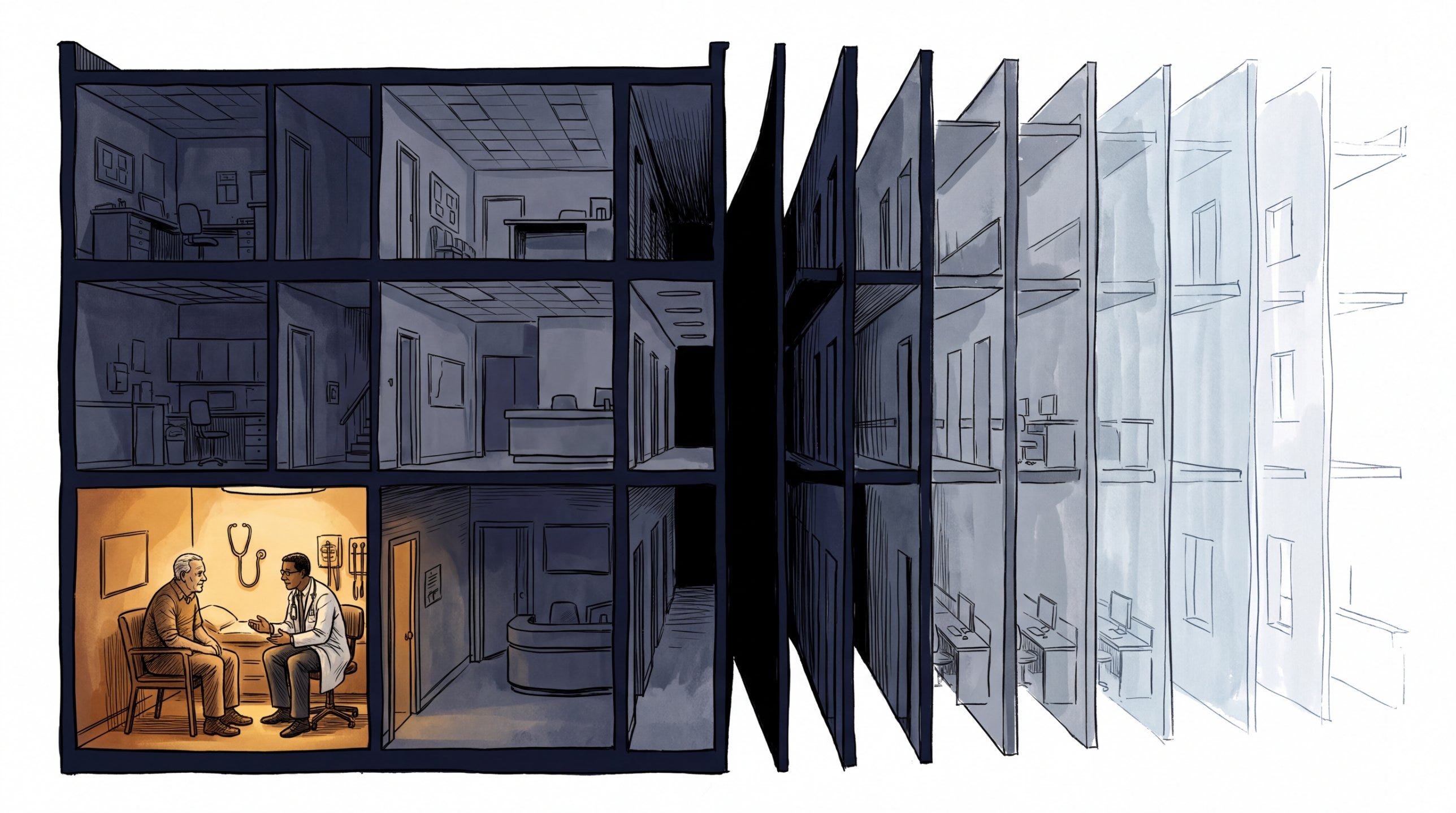
Privatization doesn’t need to close your clinic. It works one thin slice at a time, from the back of the building, where patients don’t look.
The slices are on the record: a temporary program made permanent, VA’s own target of nearly 30,000 fewer employees in 2025, 25,000 vacant positions marked for elimination, and a 2027 budget request that grows community care funding at six times the rate of VA’s main account for in-house care.
By VA’s own count, 41.8% of the appointments veterans booked through VA in fiscal 2025 were with outside providers.
Liking your doctor answers a different question. The question here is what the building around your doctor looks like in five years.
Every time I post a story about cuts at the VA, the comments fill up with the same answer.
I love my VA. My doctor is great. Best care I’ve ever had.
I believe you. Keep that doctor.
Now look at the building they work in.
Nobody’s going to bulldoze the VA. Too many veterans like it, and they vote. So it doesn’t get bulldozed. It gets sliced.
What salami slicing means
The phrase comes out of Cold War Hungary. In 1952, TIME quoted Communist Party boss Mátyás Rákosi describing how his party swallowed a coalition government: “demanding a little more each day, like cutting up a salami, thin slice after thin slice.”
That’s the whole tactic. You never take the whole sausage. You take a slice. Each one is thin enough that fighting it looks petty, and each one shows up with a good reason attached. By the time anybody notices, the end of the salami is all that’s left.
It doesn’t take a villain with a master plan. It takes a direction, and enough people looking at one slice at a time.
The slices, on the record
Every item here links to the document. Check me.
2014: Temporary. After the wait-list scandal, Congress created the Choice program. If you were an eligible veteran living more than 40 miles from the nearest VA medical facility, or VA couldn’t see you within its wait-time goals, you could choose an outside doctor, with VA’s authorization, and VA paid. The program was written to end after three years or when the money ran out, whichever came first.
2018: Permanent. The VA MISSION Act made outside care a standing program. Under the current access standards, if VA can’t schedule you within a 30-minute average drive or 20 days for primary or mental health care, or 60 minutes or 28 days for a specialist, you can choose community care instead, once VA authorizes it. The day count starts when you ask for the appointment, unless you agree to a later date after talking it over with your VA provider.
2025: The staff. VA went from about 484,000 employees on January 1 to 467,000 on June 1, and said it expected nearly 30,000 fewer by the end of the fiscal year. In December, VA officials said they planned to eliminate 25,000 vacant positions in the health administration.
Nobody gets fired when you cut a job nobody’s in. VA’s press secretary told Military Times the cuts “will have zero impact on veteran care.” Maybe. But an empty job can mean fewer appointments inside. And when VA can’t meet the access standards, the veteran who needed that job filled can take a VA-authorized appointment outside instead.
Fiscal 2025: The share. “In fiscal year 2025, 41.8% of all health care appointments Veterans booked with VA were in the community.” Those are VA’s own words, from its chief financial officer’s Senate testimony in February.
2027: The money. In VA’s 2027 budget request, Medical Services, the main account for care inside VA, grows 2.8%. Medical Community Care grows 17%. The same request proposes splitting VA health money into two new accounts: Direct Care and Community Care.
Next: The law. The Veterans’ ACCESS Act would write the access standards into statute. It cleared the House and Senate veterans committees in July 2025. As of November 5, 2026, neither the full House nor the full Senate had voted on it.
Six slices. Not one of them needed a bulldozer.
Why you can’t see it from the waiting room
Salami slicing works from the back of the building.
Your doctor is still there. The front desk is still there. The parking lot is still a knife fight at 0700.
What changes is behind the wall. The desk down the hall that nobody refilled. The position that came off the books. The appointment that can’t land inside 28 days, so you’re offered a referral to somebody in town instead.
That referral might be fine. Some community care is good care. For a rural veteran three hours from the nearest VA hospital, Choice was a lifeline.
That’s why it works. Every slice comes with a good reason.
What VA says
VA Secretary Doug Collins told the Senate Veterans’ Affairs Committee in May 2025 that the department “will not be cutting benefits and health care, only improving them,” according to NBC News. A release from Senate Veterans’ Affairs Committee Chairman Jerry Moran says the new community care contracts don’t change who is eligible.
Meanwhile, DAV’s presentation of the 2027 Independent Budget, which DAV writes with the VFW, lists over-reliance on community care “due to insufficient internal capacity” under VA’s capacity crisis.
That’s from a budget DAV, the VFW and partner VSOs have handed Congress for nearly 40 years.
If you love your VA, defend it
Loving your VA and watching it get sliced aren’t opposites. Salami slicing only works while the part you can see still looks fine. Every happy patient is proof the front door does.
So the next time you see a story about VHA cuts, don’t stop at “my doctor is great.” Ask the follow-up:
If nothing’s being cut, why is VA asking Congress to grow community care funding six times faster than its main account for care inside VA?
Ask your Representative and both Senators. Find them here. Ask at your VSO post. Ask at the next VA town hall.
And keep your doctor. They’re the part worth saving.
Last verified: November 5, 2026
I use AI as a research and editing assistant, the same way I’d use a good reference book or a sharp editor. Every word published here is reviewed, verified, and approved by me. The perspective, accuracy, and editorial decisions are mine. The illustration at the top was made with Google Flow, an AI tool.
Theresa “Tbird” Aldrich, Navy veteran (VAQ-34, 1983-1990), Investigative Journalist, TbirdsQuietFight.com, Founder of HadIt.com | Advisory Board Member, Veterans Healthcare Policy Institute (VHPI).