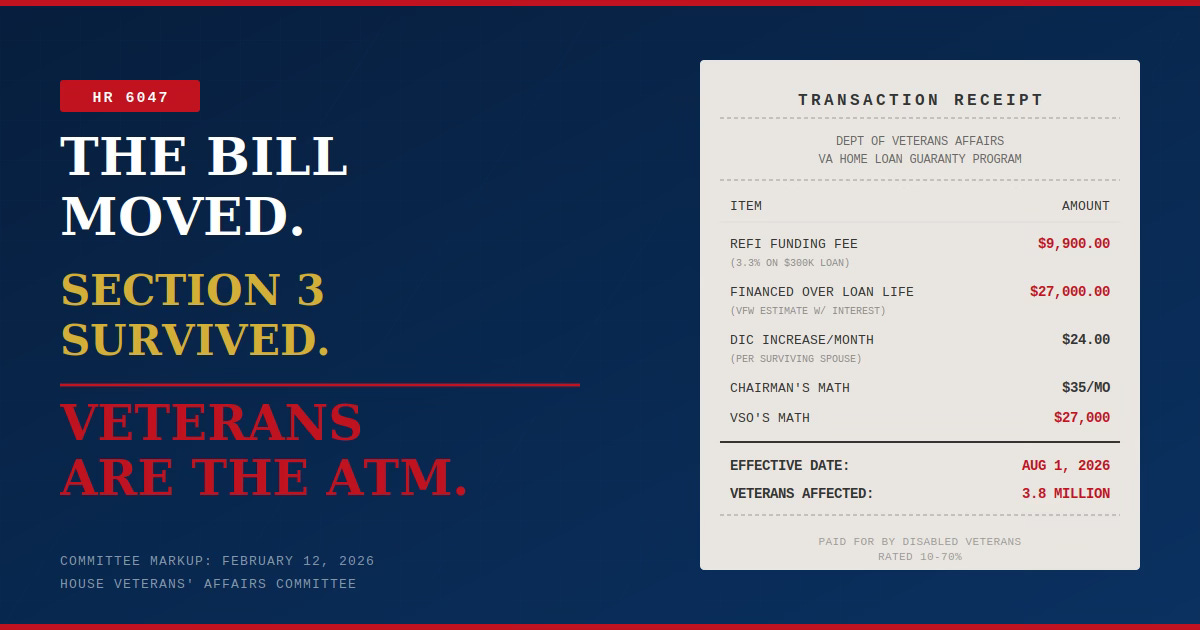
HR 6047 Update: The Bill Moved. Section 3 Survived. Veterans Are the ATM.
The Gist
HR 6047 cleared the House Veterans’ Affairs Committee on February 12, 2026, on a near party-line vote. The funding mechanism that charges disabled veterans rated 10–70% a fee on VA loan refinances? Still in there. The bill now heads to the full House. There is no Senate version. August 1, 2026 is the effective date. The clock is ticking.
Two months of silence. That’s what we got after the December 3rd hearing where every major VSO opposed Section 3’s funding mechanism and Sharri Briley and Edgar Edmundson testified with tears in their eyes about what these benefits mean to their families.
Then, on February 12th, the House Veterans’ Affairs Committee marked up HR 6047 and reported it out. Five bills moved that day. This was the headliner.
The vote split almost perfectly along party lines. Ten of eleven Democrats voted no. Not because they oppose helping catastrophically disabled veterans or Gold Star families — every single member of that committee supports increasing DIC and SMC. They voted no because Section 3 is still in the bill.
Section 3 is the part that makes you the bank.
What Didn’t Change
The funding mechanism survived markup without amendment. Here’s what that means, same as it did in December:
If you’re rated 10–70% and refinance your VA home loan or take a subsequent loan, you pay a funding fee you’re currently exempt from. That exemption has been in place for the 80-year history of the VA home loan program.
According to Democrats on the committee, the bill would nearly triple the fee veteran homeowners pay to refinance and double the fee for a buyer to assume a VA loan at their existing interest rate.
Chairman Bost still calls it “$35 a month.” The VFW’s math from December still says $27,000 over the life of a loan.
The authority runs from August 1, 2026 through September 30, 2035. Nine years of disabled veterans funding other veterans’ benefits.
What Happened at the Markup
It got ugly.
Rep. Kelly Morrison (D-MN) proposed redirecting ICE funding from the Department of Homeland Security to cover the cost instead of charging disabled veterans. That amendment failed.
Ranking Member Takano put it plainly: the committee couldn’t support HR 6047 because Republicans chose to fund it by taxing veterans. He also pointed out that Democrats advocated for increases larger than Barrett’s proposed $24 a month for DIC. Twenty-four dollars. That’s the “historic” increase for surviving spouses.
Chairman Bost fired back. He told Democrats to drive to Arlington National Cemetery if they needed a reminder of why they serve on the committee. That line got headlines. What it didn’t do is fix Section 3.
Rep. Van Orden (R-WI), a retired SEAL, told Democrats they must have walked into the wrong committee room when they brought up ICE funding. He said the committee’s job is to take care of veterans.
He’s right about that part. Which is exactly why you don’t make veterans pay for it.
The VSO Split
This is where it gets complicated.
Over 20 veteran service organizations signed on in support of the bill. PVA called the markup an “important step forward” while urging speed.
But the VFW, DAV, and American Legion all opposed the funding mechanism at the December hearing. That tension hasn’t gone away — it’s just been overshadowed by the political theater of the markup vote.
The VSO support letters are for the benefits expansion. Not for Section 3. That distinction matters, and it’s getting lost in the press releases.
What Happens Next
The bill is now eligible for a full House floor vote. Chairman Bost has signaled he wants to move fast.
There is no Senate companion bill. If this passes the House, it still needs Senate action, a companion or amendment, and reconciliation. That’s a long road.
But here’s what worries me: the August 1, 2026 effective date. That’s five and a half months away. If this bill gains momentum and gets attached to a must-pass vehicle — an NDAA provision, a VA funding bill, anything moving fast — Section 3 could become law before most veterans know it happened.
That’s not a conspiracy theory. That’s how Congress works. Bills that stall on their own get folded into larger packages all the time.
The Real Problem Nobody’s Fixing
This entire fight exists because Congress won’t appropriate money for veteran benefits. Every dollar spent on DIC and SMC increases could come from general appropriations. Congress has the power to fund this without touching a single veteran’s wallet.
The estimated cost is $5–10 billion over ten years, depending on whose math you use. For context, the FY2026 Military Construction and VA Appropriations bill that passed the House last year totaled $453 billion. The ICE budget Democrats tried to tap has $30 billion in it.
But Congress chose to make 3.8 million disabled veterans the funding source instead. Both parties bear responsibility for not finding a better way, but only one party wrote Section 3.
What You Can Do
The bill is heading to the House floor. That means your representative — not just committee members — will vote on it.
Call your representative. Capitol Switchboard: (202) 224-3121
Tell them: “I support increasing DIC and SMC benefits. I oppose Section 3 of HR 6047, which charges disabled veterans a funding fee to pay for it. Find another funding source.”
Find your representative: house.gov/representatives
If you’re rated 10–70% and have used or plan to use a VA home loan, this bill directly affects you starting August 1, 2026.
Previously: F*** You for Your Service: HR 6047 and the Bill That Makes Veterans Fund Each Other
Last verified: February 14, 2026. Bill status confirmed via Congress.gov, House Veterans’ Affairs Committee press releases, and Stars and Stripes reporting.
I use AI as a research and editing assistant—the same way I’d use a good reference book or a sharp editor. Every word published here is reviewed, verified, and approved by me. The perspective, accuracy, and editorial decisions are mine.


