


The Gist
On Nov. 20, President Trump signed an executive order on federal contractors and Congress. Every federal contractor must now notify the White House and its contracting agency of any congressional request about its work or communications with the government, and follow their instructions on withholding anything they decide is covered by executive privilege. Contractors that don’t comply risk termination, suspension or debarment. Oracle is VA’s health record contractor. In August, VA raised the ceiling on that contract by $16.94 billion, to nearly $27 billion. Committee staff asked VA for documents in August. In October, the top Democrats on both veterans committees asked VA for the emails between VA and Oracle behind that increase, and who approved it. VA still hadn’t delivered the August documents. Now Oracle has to check with VA and the White House before it hands over its own. The order names no company, and nothing public shows it has been used on Oracle yet. It also can’t reach what Congress already holds, and Oracle’s chairman, Larry Ellison, is still due under subpoena Dec. 10.
My first instinct was to look toward Washington for chimney smoke. If I listened hard enough, I figured I’d hear the shredders.
Then I read the order. It’s quieter than that.
Nobody has to burn anything. They just have to check with the folks whose emails Congress wants.
Riddle me this. If Congress wanted your emails and you got to decide which ones it saw, would you hand over everything?
What the order says
The order, “Protecting the Executive’s Privileges and Enhancing Efficiencies in Federal Contracting,” went up on the White House website late Friday, Nov. 20. The White House page labels it Executive Order 14438. The Federal Register already gave that number to an Oct. 22 order on housing costs. As of Monday morning, the contractor order hadn’t been published in the Federal Register.
The operative part is one sentence. Every federal contractor must immediately:
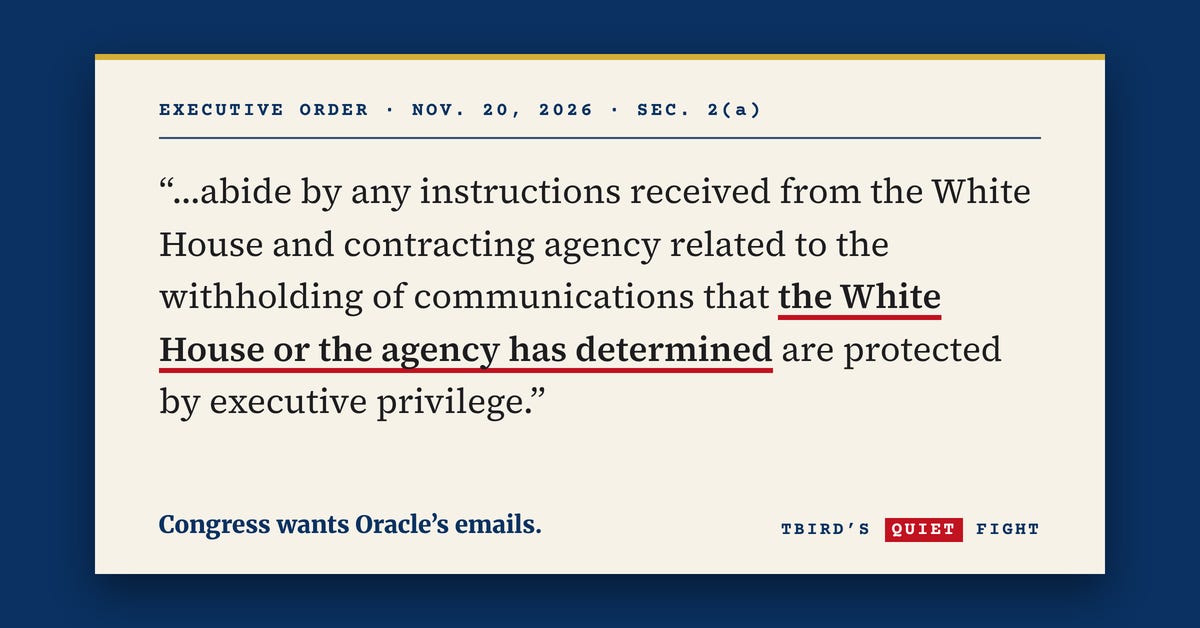
“notify the White House and the contracting agencies of any pending or future congressional request respecting the contractors’ communications or work with the executive branch; and abide by any instructions received from the White House and contracting agency related to the withholding of communications that the White House or the agency has determined are protected by executive privilege.”
In plain English: if Congress asks a contractor about its work for the government, or about its communications with the government, the contractor has to tell the White House and the agency that hired it. That covers requests already pending, not just new ones. Then, if the White House or that agency decides some of those communications are covered by executive privilege and says to hold them back, the contractor has to hold them back. (So VA can make that call itself. The White House still hears about every request, and the order tells agencies to coordinate privilege calls with it.)
Subcontractors too. Agencies are told to coordinate with the White House “on appropriate responses to such congressional requests, including the application or assertion of any relevant privileges.”
The order also lays out the administration’s theory. Congress, it says, cannot obtain privileged information, “including information shared between Federal employees and Federal contractors, before the executive branch has an opportunity to assert relevant privileges.”
That’s a position, not a ruling. I found no court ruling on this order. Reuters reported it could face legal challenges, especially if contractors are told to withhold information Congress has subpoenaed.
The stick: if a contractor doesn’t comply, agencies “shall consider” termination, cancellation, suspension or debarment.
The order names no company. It says “certain congressional leaders have threatened to intrude” on executive prerogatives, including by “harassing private companies that contract with the Federal Government.” It came the same week White House Counsel Will Scharf told agencies, Reuters reported, that their employees need White House approval before agreeing to testify before Congress.
That directive covered agency employees. This order covers the companies.
What Congress wants from Oracle
On Aug. 18, VA’s Technology Acquisition Center awarded Oracle Health Government Services a contract modification worth $16,941,387,684.28. The ceiling on VA’s health record contract went from about $10 billion to nearly $27 billion.
Congress wanted to know how.
On Aug. 27, House committee staff asked VA for documents. By Oct. 6, they still didn’t have them. That day, House ranking member Mark Takano (D-Calif.) and Senate ranking member Richard Blumenthal (D-Conn.) wrote VA Secretary Doug Collins. Item three on their list:
“All communications, including emails, text messages, and memoranda, between VA and Oracle related to the contract increase.”
Question one: “Who approved the ceiling increase and under whose direction?”
Deadline, Oct. 30. I haven’t found a public record that names who approved it. On Nov. 19, Takano entered a Collins letter dated Nov. 17 into the hearing record and said it didn’t answer his October request.
Bloomberg Government reported that the increase came after less than two months of negotiations that “occurred heavily over email.” VA’s spokesman told Bloomberg the ceiling was negotiated “through a series of virtual and in-person meetings.”
Either way, the paper trail behind “who approved $17 billion” sits in at least two places. VA’s files. And Oracle’s.
Congress has been asking VA for documents since August, and for the emails by name since October. It has asked Oracle too. In September, Senate VA Committee Democrats and independents wrote Ellison and Oracle CEO Mike Sicilia demanding the company’s documents and communications on the increase, Stars and Stripes reported. On Nov. 19, House committee Democrats asked Oracle “to produce all documents and communications with White House and VA officials about its work at VA.”
The next night, the president signed the order.
Under it, before Oracle answers that request, it notifies the White House and VA. Then it follows their instructions on what to hold back.
VA and the White House are the other end of those emails.
Some of it already got out
Not all of it is still out there to fight over.
At the Nov. 19 hearing, Takano entered into the record Oracle’s written responses to the committee and email communications between Oracle’s sales team and the contracting team at VA’s Technology Acquisition Center, the office that handled the increase. He told viewers to look for them on the committee’s document repository. The release doesn’t say who supplied the emails, VA or Oracle.
As of this morning, they weren’t there. The hearing page on docs.house.gov was last updated Nov. 19 at 1:36 p.m. That’s not proof of anything. Committees post on their own schedule.
The order tells contractors and agencies what to do. Nothing in it reaches records Congress already holds.
How much of the paper trail is in that set? I don’t know. Watch the repository.
Dec. 10
Larry Ellison’s subpoena is real. I’ve read it. Testify at a hearing, 360 Cannon, Dec. 10, 10:15 a.m.
It’s also narrow. The subpoena form has a box for “to produce the things identified on the attached schedule.” That box isn’t checked. Ellison is compelled to show up and talk. This subpoena doesn’t compel a single page. The documents are being sought by letter, from the minority. A letter from the minority doesn’t compel anyone. That’s how it was before Friday, too.
That changes in January. Democrats take the House, and FedScoop reports Takano is expected to chair the committee. Under the committee’s current rules, the chair can issue a subpoena once a majority of members voting authorizes it, with a majority present. The next Congress writes its own rules. A Democratic majority could supply those votes. That’s where this order is waiting.
Then there’s Ellison himself.
In August, the Justice Department’s Office of Legal Counsel told the White House that executive privilege can cover the president’s communications with private advisers, as long as they relate to official presidential decisionmaking, involve or reflect communications with the president or his direct advisers, and are confidential. On Nov. 14, Bloomberg Government reported that Scharf believes company executives who’ve had contact with the president may be covered.
After the hearing, Takano said he is “still unconvinced that Larry Ellison’s relationship with the president has not tipped the scales in Oracle’s favor.” Will anything he says Dec. 10 about talking to Trump come with a privilege instruction attached?
This isn’t hypothetical. In February, the Wall Street Journal reported that Director of National Intelligence Tulsi Gabbard’s office told Democratic intelligence committee staff it couldn’t hand over the full report behind a whistleblower complaint, citing executive privilege. The Journal reported that the intelligence concerns two foreign nationals talking about Jared Kushner, who has no formal government role. The top Democrats on the intelligence committees, Sen. Mark Warner (D-Va.) and Rep. Jim Himes (D-Conn.), wrote that without the underlying report they couldn’t confirm that account. Glenn Gerstell, the NSA’s former general counsel, told the Journal the privilege is harder to justify when the conversation is between third parties outside the White House. He said he wasn’t familiar with the intelligence itself. In October, AP reported the administration was withholding records from Rep. Joyce Beatty on claims of privileged presidential communications, including 19 text messages between the Kennedy Center’s CEO and the president’s executive assistant.
Oracle says there’s nothing there. Sicilia’s written statement for the House: “Neither Oracle’s founder, Larry Ellison, nor I participated in or sought to influence the negotiations related to the EHRM contract extension.” Under oath, he said: “I’ve never talked with anybody in the White House about the VA contract.” Asked whether he’d asked Ellison about conversations with the president or the White House about the contract, Sicilia said: “I have not directly.” He said Oracle ran an internal investigation and answered the committee in writing. Pressed, he said it again: “I did not ask him directly.” Then: “I can assure you that Mr. Ellison was not involved in any VA negotiations.”
Fair is fair. If Oracle’s account holds, Ellison stayed out of the negotiations.
That’s a denial about Ellison. It isn’t a denial that Oracle has emails with VA about this contract. Ask Oracle for those emails now, and VA and the White House hear about the request first, help shape the answer, and can tell Oracle what to hold back as privileged.
What the order doesn’t touch
What Congress already has. Covered above.
The subpoena. Ellison is still due Dec. 10.
People who work for contractors, with limits. Federal law, 41 U.S.C. 4712, says an employee of a contractor or subcontractor “may not be discharged, demoted, or otherwise discriminated against as a reprisal” for disclosing to “A Member of Congress or a representative of a committee of Congress” information the employee reasonably believes shows “gross mismanagement of a Federal contract,” “a gross waste of Federal funds,” or “a substantial and specific danger to public health or safety,” among other things.
The limits matter. The ban on reprisal holds even when an executive branch official asks for it, “unless the request takes the form of a non-discretionary directive and is within the authority of the executive branch official making the request.” The law creates no new right “to disclose classified information.” And it carves out the intelligence community.
The order doesn’t mention that law. It says it will be carried out “consistent with applicable law.”
This is journalism, not legal advice. If you work for a federal contractor and are weighing whether to go to Congress, talk to a whistleblower attorney first, not a news article.
The questions
The order is three days old. Here’s what the record doesn’t answer yet.
The order tells each agency to “promptly inform all contractors and subcontractors” of these obligations. Has VA sent Oracle that notice? Who signed it?
Has Oracle notified the White House about the House Democrats’ Nov. 19 request, the Senate Democrats’ September letter, or Ellison’s subpoena?
Has anyone at VA or the White House told Oracle to withhold anything?
The order lets “the agency” decide what’s privileged. Who at VA is that? The Secretary, the general counsel, the contracting officer?
Who at VA approved the $16.94 billion increase? Takano and Blumenthal asked in writing on Oct. 6.
When will the committee post the Oracle-VA emails entered Nov. 19?
When does the Office of Management and Budget issue the compliance guidance the order calls for?
Congress asked who signed off on $17 billion.
The answer is in somebody’s files.
As of Friday night, the White House gets a say before Congress sees it.
Paper Trail
Executive order, Protecting the Executive’s Privileges and Enhancing Efficiencies in Federal Contracting, Nov. 20, 2026 (labeled 14438 on the White House page; not yet published in the Federal Register). https://www.whitehouse.gov/presidential-actions/2026/11/protecting-the-executives-privileges-and-enhancing-efficiencies-in-federal-contracting/
White House fact sheet, Nov. 20, 2026. https://www.whitehouse.gov/fact-sheets/2026/11/fact-sheet-president-donald-j-trump-protects-the-executives-privileges-and-enhances-efficiencies-in-federal-contracting/
SAM.gov award notice, VA EHRM IDIQ 36C10B18D5000, Modification P00008, award date Aug. 18, 2026. https://sam.gov/workspace/contract/opp/85bba2cc888d42d8bbe8e6a48058c1cc/view
Takano-Blumenthal letter to Secretary Collins, Oct. 6, 2026. https://democrats-veterans.house.gov/download/ehrm-modification-rms-hvac-svac-takano-blumenthal-ltr-to-secva?download=1
House Veterans’ Affairs Committee Democrats, “Ranking Member Takano After Oracle Hearing: No Answers on $17.5 Billion, and Ellison is Next,” Nov. 19, 2026. https://democrats-veterans.house.gov/news/press-releases/ranking-member-takano-after-oracle-hearing-no-answers-on-175-billion-and-ellison-is-next
Ellison subpoena, issued Sept. 14, 2026. https://democrats-veterans.house.gov/imo/media/doc/ellison_subpoena.pdf
House Veterans’ Affairs Committee hearing, Nov. 19, 2026, video and documents. Sicilia on the White House at about 0:55:30; on Ellison and the internal investigation at about 2:13:50; Takano entering the record at about 2:18:30. www.youtube.com/watch?v=8FczGV7QXRo and https://docs.house.gov/Committee/Calendar/ByEvent.aspx?EventID=119599
Sicilia written statement, House Veterans’ Affairs Committee, Nov. 19, 2026. https://docs.house.gov/meetings/VR/VR00/20261119/119599/HHRG-119-VR00-Wstate-SiciliaM-20261119.pdf
DOJ Office of Legal Counsel, Applicability of Executive Privilege to Presidential Communications with Private Advisers, Aug. 10, 2026. https://www.justice.gov/olc/media/1457271/dl
Wall Street Journal, Dustin Volz, “Spy Agency Blocks Congress From Seeing Gabbard Whistleblower Intelligence,” Feb. 25, 2026. https://www.wsj.com/politics/national-security/spy-agency-blocks-congress-from-seeing-gabbard-whistleblower-intelligence-1baea148
Warner-Himes letter to DNI Gabbard, Feb. 24, 2026. https://www.warner.senate.gov/public/_cache/files/8/3/836f0c01-f86f-426a-974f-dab79fc77b2d/3372B11CEA921CDE0840A871504C65524D34B180DC4A720A79E5C9317C74D43A.2.24.26-wb-letter-to-dni-gabbard.pdf
Associated Press, Michael Kunzelman, Kennedy Center records lawsuit, Oct. 25, 2026. https://www.wpxi.com/news/politics/judge-asked-compel/ILWKVGAZOI25BKWHXNOFGHN2IM/
41 U.S.C. 4712, contractor employee whistleblower protections. https://www.law.cornell.edu/uscode/text/41/4712
Reuters via CNBC, Nov. 21, 2026. https://www.cnbc.com/2026/11/21/trump-orders-federal-contractors-to-notify-white-house-before-giving-congress-information.html
Earlier on TQF: VA’s Health Record: The Fourth Try
Make the Call
A phone call takes two minutes. Congressional offices often track constituent calls by issue. When one issue lights up the phones in the same week, staff tend to notice.
Who to call:
Your own U.S. Representative and Senators: they work for you. Find yours here.
Rep. Mike Bost (R-IL), Chairman, House Veterans’ Affairs Committee: (202) 225-5661
Sen. Jerry Moran (R-KS), Chairman, Senate Veterans’ Affairs Committee: (202) 224-6521
Capitol Switchboard (connects to any member): (202) 224-3121
Script 1: If you’re a veteran or military family member
“Hi, my name is [NAME] and I’m a [veteran / military spouse / family member of a veteran] in [STATE]. I’m calling about VA’s health record contract with Oracle.
In August, VA raised the ceiling on that contract by about $17 billion. Since October, Congress has been asking VA for the emails between VA and Oracle and for the name of whoever approved it. A new executive order now says Oracle has to check with the White House and VA before it answers Congress.
I’m asking [MEMBER NAME] to press VA to name who approved the increase and release its communications with Oracle, and to publicly oppose using executive privilege to keep veterans’ health record spending from Congress.
I’d like to know the [Congressman’s / Senator’s] position on this. Thank you.”
Script 2: If you’re a concerned citizen
“Hi, my name is [NAME] and I’m a constituent in [STATE]. I’m calling about VA’s health record contract with Oracle.
VA raised the contract ceiling to nearly $27 billion in August. In October, members of Congress asked VA who approved it. I haven’t seen a public answer. A new executive order requires contractors like Oracle to check with the White House before answering Congress.
I’m asking [MEMBER NAME] to demand that VA name who approved the increase and release its communications with Oracle.
Thank you for your time.”
How offices handle what you send (practices vary by office):
Phone calls get logged in real time by issue and position (for/against). A staffer marks it in their system the moment you hang up. When a member asks “what are people calling about this week,” your call is in that count. A spike on one issue in a short window is hard for staff to miss.
Personal emails (not form letters) get read, categorized, and usually receive a response, but they sit in a queue. Most offices process constituent mail in batches. Your email might not get logged for days. It still counts, but it doesn’t create the same real-time pressure as a ringing phone.
Form emails and petitions (pre-written “click to send” campaigns) get the lowest weight. Offices batch-count them. They know you clicked a button. Better than silence, but a personal call or letter carries more weight.
Letters to the editor in your local paper punch way above their weight. Congressional offices have staff assigned to clip and track local media mentions of their boss. A published letter is public, reaches other voters, and can get picked up by larger outlets.
Op-eds in local or regional papers reach the same staff who track local coverage of their boss.
A good combination: Call first. Follow up with a personal email. Then write a letter to the editor. Each one reaches the office through a different channel.
Tips:
You don’t need to be an expert. You just need to be a constituent.
If you get voicemail, leave the message anyway.
Call during business hours (9 AM to 5 PM Eastern) for the best chance of reaching a staffer.
Be polite, be brief, and state your ask clearly.
If a staffer asks follow-up questions, answer them. It helps them get your concern right.
Go Deeper
Write a Letter to the Editor (10 minutes)
Most local papers accept 150-200 word letters. Mention your representative by name. State your veteran status if applicable. Stick to facts from this article.
Find your local paper’s submission page or email the opinion desk directly. Tips:
Localize it: mention your rep by name and your nearest VA facility
Keep it under 200 words
Say you’re a veteran if you are
Don’t submit the same letter to multiple papers simultaneously
Contact Your VSO
If you’re a member of VFW, DAV, American Legion, VVA, IAVA, or any other Veterans Service Organization, contact your local chapter and ask what their position is on this issue. VSOs have lobbying power. Use it.
Share This Article
About This Publication
Tbird’s Quiet Fight is independent investigative journalism focused on VA policy, veteran benefits, and government accountability. Published by the founder of HadIt.com, one of the oldest veteran-run VA claims communities online (est. 1997).
Support this work: Subscribe to TQF | Support HadIt.com
I use AI as a research and editing assistant, the same way I’d use a good reference book or a sharp editor. Every word published here is reviewed, verified, and approved by me. The perspective, accuracy, and editorial decisions are mine.
For Press and Advocates
Congressional oversight contacts:
House Veterans’ Affairs Committee: (202) 225-3527 | veterans.house.gov
Senate Veterans’ Affairs Committee: (202) 224-9126 | veterans.senate.gov
House VA Oversight & Investigations Subcommittee: veterans.house.gov/issues
Investigative journalists covering VA/veteran policy:
Suzanne Gordon, American Prospect
Jasper Craven, American Prospect
Nikki Wentling, Military Times
Patricia Kime, Military Times
Quil Lawrence, NPR
Veteran advocacy organizations:
Government watchdog resources:
USAspending.gov (track federal contracts and grants)
Last verified: Nov. 23, 2026
Theresa “Tbird” Aldrich, Navy veteran (VAQ-34, 1983-1990), Investigative Journalist, TbirdsQuietFight.com, Founder of HadIt.com | Advisory Board Member, Veterans Healthcare Policy Institute (VHPI).