

Same Campus. Same Agency. No Answers.
VA’s guardianship program has a pilot site in West LA. West LA already has VA-controlled housing on the ground. Nobody at VA will say whether guardianized veterans can be placed there.

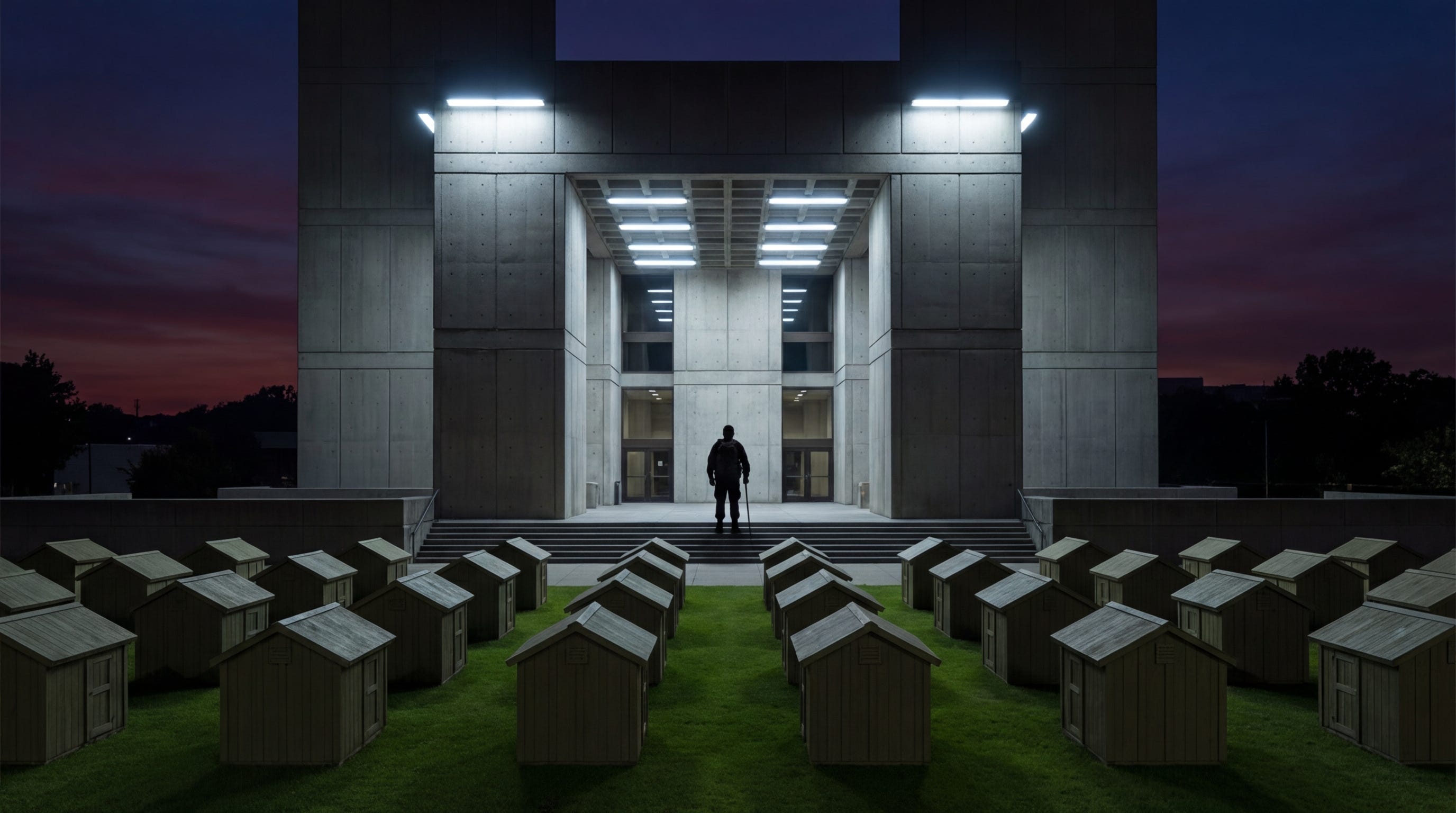
A follow-up to VA Bypassed Congress to Strip Veterans of Their Rights
THE GIST
Project Safe Harbor gives VA attorneys the power to pursue guardianship over homeless veterans — stripping their right to choose where they live
West LA is one of Safe Harbor’s five pilot sites
West LA already has VA-controlled housing on the ground: 64-square-foot sheds, no kitchen, no bathroom, not ADA-accessible — the same ones that burned in 2022. VA has not answered whether guardianized veterans can be placed there.
VA’s own internal documents show the program was designed to scale to veterans “experiencing unsheltered or sheltered homelessness” who are not enrolled in VA healthcare at all
VA’s own internal documents designate the Emergency Department as the primary screening point for the program — and the MOU gives VA attorneys the legal authority to initiate proceedings against any veteran screened there
The court ordered 1,800 permanent housing units. VA has no funding and no timeline for them
On February 18, VA and DOJ declared stripping veterans’ rights without a court order is unlawful. Twenty-one days later, they announced Safe Harbor
On March 25, the National Coalition for Homeless Veterans formally demanded the MOU be rescinded
Source Documents — Primary source documents for this investigation are available for independent review. Includes the VA internal IPT documents, hearing transcript, MOU, NCHV testimony, and video clips from the March 18 congressional hearing. A free Google account is required to access Safe Harbor — VA Bypasses Congress on NotebookLM.
1991. I was breaking down.
I was staying at a friend’s apartment. She wasn’t home. I’d been crying for days — the kind that doesn’t stop, that becomes its own weather system. I called the suicide hotline. They told me to call the VA. The VA psychiatrist said he’d send someone to bring me to the VA hospital. He said I’d be safe there.
Four cop cars showed up. Lights flashing. Angled like a crime scene.
They told me they couldn’t take me to the VA. Only to the state psychiatric hospital.
I didn’t agree to that. Nobody asked.
I ended up in a facility I’d never seen, hadn’t chosen, hadn’t consented to. A man strapped to a gurney rolled past me screaming. I didn’t catch the words. I caught the energy.
I ran.
I hid in a parking lot at 3 AM with no idea what street I was on. I used my last sixty dollars — my food money for the month — to cab back to the apartment.
The psychiatrist called the next morning. He promised no cops if I showed up at 8 AM.
I showed up.
Not because I trusted him. Because the alternative was worse.
That was 35 years ago. I know what it takes for a veteran to make that call. The pride you set aside. The fear you push through. The crisis you have to bottom out on before you’ll admit you need help.
I also know what happens when the system responds badly. How fast the door closes. How long it stays closed.
Here’s what’s different in 2026.
In 2026, a veteran who walks into a VA emergency room in crisis faces something new. The legal authority is now signed. The pilot program has been operational at five VA sites since at least early 2026. Under the March 11 MOU, VA attorneys can initiate state court guardianship proceedings against any veteran screened there — right now, today, at those five sites. The internal documents show the ER was designed as the primary entry point. The authority to act on what happens there is no longer pending. It’s live.
Guardianship means a court strips you of the right to make decisions about your own life. Where you live. What medical care you receive. Your finances.
The entity petitioning that court is the VA.
The same VA that sent four cop cars to a woman in crisis and called it help.
If you read my last piece on Project Safe Harbor, you know the full background. VA attorneys — under a memorandum of understanding announced March 11, 2026 with DOJ — are now authorized to petition state courts for guardianship over veterans without congressional authorization. Rep. Mark Takano put the internal documents proving that into the congressional record on March 18.
But there’s a piece of the story I didn’t fully pull on. I’ve been pulling on it since.
When You Lose Guardianship, Someone Else Picks Your Address
This is black letter law. Not an interpretation. Not a policy judgment.
When a court grants guardianship over a person, the guardian assumes decision-making authority over where that person lives. The veteran doesn’t choose. The guardian does.
Under the March 11 MOU, the entity authorized to initiate those guardianship proceedings is the VA.
The VA is also the entity that controls available housing at Pilot Site 5: VA Greater Los Angeles Healthcare System. West LA campus.
Same agency. Two roles. No firewall between them.
West LA Is Pilot Site 5. Here’s What’s Already There.
I published the West LA story in February. Here’s the short version for anyone coming to this fresh.
In 1888, 300 acres of prime West LA real estate were donated to the federal government for one purpose: house disabled veterans. A federal court ordered VA to build 1,800 permanent supportive housing units on that campus to fulfill that promise.
VA’s compliance plan, presented to Judge Carter in January 2026: up to 800 eight-by-eight-foot Pallet shelters.
Sixty-four square feet. No in-unit kitchen. No in-unit bathroom. Not ADA-accessible. Veterans using wheelchairs depend on communal facilities outside the shed. Emergency exits are floor-level flaps.
They already burned once. September 2022. Twelve units destroyed in minutes. Veterans lost medications, housing vouchers, CPAP machines. One grabbed his phone and wallet. Everything else was ash.
The VA announced safety improvements after the fire. They did not upgrade the shelters. They did not install sprinklers. They did not change the fire rating.
Now they want to build hundreds more.
And “temporary” stays are already stretching into years. Air Force veteran George Fleischman has been in one for over three years. He uses a wheelchair. He described it as living where you’d keep your lawn mower.
West LA is Pilot Site 5 for Safe Harbor. VA is simultaneously the entity initiating guardianship proceedings and the entity controlling housing at that campus. Can a guardian appointed through Safe Harbor place a veteran in VA-controlled housing at that site?
VA has not answered that question.
The Math Nobody at VA Wants to Do Out Loud
The 2025 Greater Los Angeles Homeless Count puts the homeless veteran population in LA County at approximately 3,050.
The executive order signed in May 2025 — EO 14296 — calls for housing up to 6,000 veterans on the West LA campus by January 2028.
That’s nearly twice the entire homeless veteran population of Los Angeles County.
California has approximately 11,000 homeless veterans statewide — the largest concentration in the country, about 31% of the national total.
Six thousand units. Three thousand fifty veterans in LA. Eleven thousand in the state.
The numbers don’t add up on their own.
Who fills the remaining beds? Where do they come from? Who decides they belong there?
VA hasn’t answered that publicly. But their own internal documents answered part of it.
What VA’s Internal Documents Actually Say
The VA told Congress that Safe Harbor targets approximately 700 veterans in acute inpatient beds — veterans with advanced Alzheimer’s, no next of kin, no one to authorize their discharge.
Their own internal documents say something different.
According to VA’s internal program architecture, entered into the congressional record by Rep. Takano on March 18, the program was designed to scale through defined “maturity levels.” At Level 4 — the program’s intended endpoint — Safe Harbor explicitly targets veterans “experiencing unsheltered or sheltered homelessness” who are “not currently enrolled in VA programming.”
Not inpatients. Not Alzheimer’s patients in acute care beds.
Veterans living on the street. Veterans outside the VA system entirely.
That’s their language. Not mine.
The same internal documents show the program was already operational well before the MOU was publicly announced. According to VA’s internal weekly summary dated November 3-14, 2025 — part of the documents entered into the congressional record by Rep. Takano — dedicated social workers had been funded at each pilot site, and a structured virtual planning session had taken place to coordinate implementation across all five locations. Data collection had begun. The MOU formalized the legal authority. The program itself was already running.
The internal documents also designated the VA Emergency Department as the primary screening point for the program. The VA’s own internal memo notes that “the Emergency Department is a common entry point for veterans experiencing homelessness.” So they built the ER into the program architecture as the front door of Safe Harbor.
Under the MOU, VA attorneys now have the legal authority to initiate guardianship proceedings against any veteran screened there. A veteran walks into an ER in crisis — a mental health episode, substance withdrawal, a bad night. The program is designed so that if he can’t demonstrate adequate decision-making capacity in that moment — under those conditions — he enters a pipeline that ends in a state court stripping his legal autonomy.
The man who built VA’s national homeless veteran outreach programs — Dr. O’Toole previously served as Director of the VA’s National Center on Homelessness Among Veterans — is now the executive sponsor of a program that uses the ER as a guardianship screening door.
And the entity petitioning that court is the same entity that controls housing at Pilot Site 5.
Twenty-One Days
On February 17-18, 2026, VA and DOJ issued a joint announcement declaring that stripping veterans’ rights without a judicial determination was unlawful. They restored gun rights to nearly 200,000 veterans assigned fiduciaries. VA Secretary Doug Collins called it correcting a “three-decade-old wrong.” AG Pam Bondi called it “unlawful and unacceptable” to threaten veterans’ constitutional rights.
Those are their words. On the record.
Twenty-one days later, the same VA and the same DOJ — with Bondi’s direct involvement — announced the Safe Harbor MOU authorizing VA attorneys to pursue guardianship over homeless veterans without congressional authorization.
One action restores rights. The other strips them.
Same department. Same attorney general. Three weeks apart.
I don’t know how you hold both positions simultaneously and call it a coherent legal philosophy. I know what it looks like from where I’m sitting.
The Permanent Housing Problem
The court ordered 1,800 permanent supportive housing units and 750 temporary units on the West LA campus.
VA has funding for the temporary housing — the sheds — through end of 2026.
VA does not have confirmed funding for the permanent units. No timeline. No construction schedule. Eight months after EO 14296 was signed, VA had missed its own 120-day deadline for an action plan.
So the current state is this: a court-ordered permanent housing mandate with no money behind it, a compliance plan built on sheds that already burned, and a legal mechanism now in place to move homeless veterans into VA-controlled housing without their consent.
Temporary, in this context, means until someone decides otherwise.
What the Veterans Community Is Saying
On March 25, 2026 — one week after Takano entered the internal documents into the congressional record — the National Coalition for Homeless Veterans submitted formal testimony to the House Veterans’ Affairs Subcommittee on Oversight and Investigations demanding that the VA and DOJ rescind the March 11 MOU entirely.
Their argument was direct: guardianship strips veterans of the right to vote, the right to marry, the right to choose where they live, and the right to make their own end-of-life decisions. Once imposed, guardianships are difficult — sometimes impossible — to terminate. A veteran who stabilizes, whose crisis passes, whose housing situation improves, still faces a legal mountain to reclaim their autonomy. A mountain they can’t afford to climb.
The NCHV also raised what may be the most practical consequence of this program: veterans will stop coming to the VA.
The relationship between unsheltered veterans and VA outreach workers is already fragile. The program is now designed so that walking into a VA emergency room in crisis can trigger a federal legal process to permanently strip your rights. When word spreads — and it will — veterans will avoid the ER. They’ll avoid the outreach worker. They’ll stay on the street before they risk losing everything.
The VA will have made itself the threat.
What Needs Answering
VA needs to answer these questions on the record:
What is the housing placement policy for veterans placed under guardianship through Safe Harbor? Who makes that decision? Who tracks it?
West LA is Pilot Site 5. West LA already has VA-controlled temporary housing on the ground — 800 Pallet shelters proposed as court compliance under Powers v. McDonough. Can a guardian appointed through Safe Harbor place a veteran in VA-controlled housing at that site? VA has not answered this question.
If the West LA campus is planned for 6,000 veterans and LA County has 3,050 homeless veterans, where does VA intend the remaining population to come from?
What oversight mechanism exists between the VA entity initiating guardianship proceedings and the VA entity controlling housing at the same pilot site?
When does “temporary” become permanent?
FOIA requests are warranted for Safe Harbor placement data by site, VA housing assignment protocols for guardianized veterans, and any interstate relocation planning documents connected to EO 14296.
The Through-Line
“Safe Harbor” sounds like rescue.
It’s a legal term that means protection from liability. In this context, it’s a program that strips a veteran of the right to make decisions about their own life — and hands that authority to the same agency that controls the housing.
The ER is designed to be the front door. Where the guardian sends them next — nobody at VA will say.
What’s missing is oversight. Transparency. A straight answer from VA about what happens to a veteran after the court says yes.
I’ve been documenting VA patterns for 29 years. The pattern here is familiar: build the infrastructure first. Answer the questions never.
Not this time.
This is a follow-up to VA Bypassed Congress to Strip Veterans of Their Rights, published March 26, 2026, and They Promised Housing. They Built Garden Sheds., published February 12, 2026.
⚡ TAKE ACTION
📞 House Veterans’ Affairs Committee: (202) 225-3527 “I’m calling about Project Safe Harbor. VA’s own internal documents show the program was designed to target homeless veterans outside the VA system — not just inpatients. West LA, one of the five pilot sites, already has VA-controlled housing on the ground. I want oversight hearings and I want the MOU rescinded.”
📞 Rep. Takano’s office: (202) 225-2305 “Thank you for entering the Safe Harbor documents into the record on March 18. I’m asking your office to request VA’s housing placement protocols for Safe Harbor participants — specifically whether guardianized veterans can be assigned to VA-controlled facilities at pilot sites.”
Sources
VA-DOJ Memorandum of Understanding, announced March 11, 2026 — DOJ press release: justice.gov/opa/pr/doj-va-sign-agreement-improve-care-nations-most-vulnerable-veterans
VA press release: news.va.gov/press-room/va-doj-sign-agreement-to-improve-care-for-nations-most-vulnerable-veterans
VA Internal IPT Organizational Chart and Program Documents — HHRG-119-VR00-20260318-SD010, entered into congressional record March 18, 2026 — docs.house.gov/meetings/VR/VR00/20260318/119040/HHRG-119-VR00-20260318-SD010.pdf
House Veterans’ Affairs Committee hearing transcript, March 18, 2026 — timestamps 1:55:43–2:02:24 — hadit.com/wp-content/uploads/2026-03-18_House-VAC-Legislative-Hearing-Transcript.pdf
National Coalition for Homeless Veterans, Statement for the Record, HVAC Subcommittee on Oversight and Investigations, March 25, 2026 — docs.house.gov/meetings/VR/VR08/20260325/119102/HHRG-119-VR08-20260325-SD005.pdf
VA press release: “VA Undoes Decades-Old Wrong and Protects Veterans’ Second Amendment Rights,” February 17-18, 2026 — news.va.gov/press-room/va-undoes-decades-old-wrong-and-protects-veterans-second-amendment-rights
Stars and Stripes, Linda F. Hersey, “VA moves to end gun restrictions on veterans who require money managers,” February 18, 2026 — stripes.com/veterans/2026-02-18/va-gun-restrictions-veterans-20793446.html
Powers v. McDonough, C.D. Cal. Case No. 2:22-cv-08357 — court proceedings, January 2026 — courthousenews.com/wp-content/uploads/2024/10/west-la-va-campus-decision.pdf
Ninth Circuit Court of Appeals ruling, December 2025
White House Executive Order 14296, May 9, 2025 — Federal Register 90 FR 20369 — federalregister.gov/documents/2025/05/14/2025-08683/keeping-promises-to-veterans-and-establishing-a-national-center-for-warrior-independence
2025 Greater Los Angeles Homeless Count — LAHSA — lahsa.org/news?article=1054-lahsa-va-mva-provide-unprecedented-picture-of-veteran-homelessness
HUD Annual Homeless Assessment Report, 2024
I use AI as a research and editing assistant — the same way I’d use a good reference book or a sharp editor. Every word published here is reviewed, verified, and approved by me. The perspective, accuracy, and editorial decisions are mine.
About Tbird’s Quiet Fight
Tbird’s Quiet Fight is independent investigative journalism covering VA policy, veteran benefits, and federal accountability. Published by the founder of HadIt.com (est. 1997), one of the oldest veteran-run VA claims communities online. Advisory Board Member, Veterans Healthcare Policy Institute (VHPI). Not affiliated with any political party, VSO, or commercial interest.
This is the third article in an ongoing investigation into Project Safe Harbor. Read the full series: VA Bypassed Congress to Strip Veterans of Their Rights | They Promised Housing. They Built Garden Sheds.
For Press and Advocates
Story tips or collaboration: Tbird (TQF / HadIt.com): ipersist@tbirdsquietfight.com
Congressional oversight contacts: House Veterans’ Affairs Committee: (202) 225-3527 | veterans.house.gov Senate Veterans’ Affairs Committee: (202) 224-9126 | veterans.senate.gov
Investigative journalists covering VA/veteran policy: Suzanne Gordon — American Prospect Linda F. Hersey — Stars and Stripes Leo Shane III — Military Times Quil Lawrence — NPR
Veteran advocacy organizations: Bazelon Center for Mental Health Law Disability Rights Education and Defense Fund (DREDF) Paralyzed Veterans of America National Coalition for Homeless Veterans National Veterans Legal Services Program