

WARRIOR ETHOS
VA POLICY INVESTIGATION

THE GIST
What’s happening: The administration has used the phrase “Warrior Ethos“ in at least four major policy documents — an executive order, the 2026 NDAA, the 2026 federal budget, and Pentagon directives under Defense Secretary Pete Hegseth. Each time the phrase appears, veterans receive less.
The pattern: “Warrior Ethos” is doing the same work the dependency narrative did a decade ago. The words are different. The math is the same.
The evidence: EO 14296 promised housing for up to 6,000 homeless veterans. The 120-day action plan it required was never submitted. The 2026 NDAA invoked “Warrior Ethos” while cutting IVF coverage for military families. The 2026 budget used the phrase while cutting the VA workforce and non-defense programs.
The bottom line: This administration wants veterans to be Spartans. Here’s what Sparta actually looked like.
Welcome to Sparta
When a child was born in Sparta, elders inspected it. If the infant appeared weak or deformed, it was taken to the mountains and left to die. The city-state decided, at birth, whether a person was worth investing in.
The children who survived were taken from their families at age seven and placed in the agoge — the Spartan training system. They were deliberately underfed so they would be motivated to steal. If they were caught stealing, they were beaten — not for the theft, but for getting caught. Competence, not morality, was the standard.
When a Spartan warrior grew old or was badly wounded, there was no pension. No care system. No obligation. He had served his purpose.
This administration is running a policy version of the same calculus.
If you can navigate the VA system after we fired 40,000 of its employees — you pass.
If you can call an 8-by-8-foot shed with no bathroom, no kitchen, and a Class C fire rating a home — you pass.
If you can get your claims processed after we gutted the staff — you pass.
If you can’t?
That’s not a government failure. That’s a lack of “Warrior Ethos.”
They even have a name for it.
Two Words. Plenty of Cover.
There is a phrase this administration keeps using.
It shows up in executive orders. It appears in congressional statements. It surfaces in budget documents and Pentagon decrees. It gets attached to programs that take things away from veterans while claiming to honor them.
The phrase is “Warrior Ethos.”
Language in policy documents is not decoration. It is argument. When the same phrase appears across multiple unrelated documents, across multiple agencies, deployed to justify decisions that have nothing in common except their outcome — that is a strategy.
The strategy isn’t new. It has a recent precedent.
In 2021, retired Army Lt. Col. Daniel Gade and journalist Daniel Huang published Wounding Warriors: How Bad Policy Is Making Veterans Sicker and Poorer. The book argued that VA disability ratings foster a costly and unhealthy culture of dependence among veterans — and that monthly checks from the VBA should be sharply restricted, not expanded. The argument could be distilled to one sentence: veterans are paid to be sick, and paid more the sicker they can show themselves to be.
The dependency narrative said: benefits make veterans dependent. The government’s obligation was being reframed as a personal failure by the veteran.
“Warrior Ethos” says: real warriors don’t need benefits. If you do, that’s on you.
Different words. Same result: spend less on veterans.
Now think about what that means for a veteran sitting down to file a disability claim. Filing a claim is not weakness. It is the legal exercise of a right earned through service — the contractual exchange in action. You served. You were harmed. The government owes you.
But under the “Warrior Ethos” frame, filing becomes evidence of failure. A real warrior doesn’t need the check. A real warrior figures it out. The veteran who files isn’t accessing what they’re owed — they’re admitting they can’t hack it on their own.
Nobody has to say that out loud. The phrase does the work for them.
EO 14296: “Restore Self-Sufficiency and the Warrior Ethos”
On May 9, 2025, President Trump signed Executive Order 14296, titled Keeping Promises to Veterans and Establishing a National Center for Warrior Independence. [Federal Register, 90 FR 20369]
The order directed VA Secretary Doug Collins to “work to restore self-sufficiency and the warrior ethos among homeless veterans through any guidance, requirements, or services needed to ensure that homeless veterans can access housing, receive substance abuse or addiction treatment, and return to productive work and community engagement.”
The language is worth sitting with. Restore self-sufficiency. The implication is that homeless veterans lack it. Not that the system failed them. Not that 3,000 veterans sleeping on the streets of Los Angeles represents a government breach of contract. The implication is that something was taken from these veterans — their “Warrior Ethos” — and that the right intervention is to give it back.
The order also directed the VA Secretary, within 120 days of signing, to “present an action plan to the President” to restore the capacity to house up to 6,000 homeless veterans at the National Center for Warrior Independence by January 1, 2028.
That 120-day deadline was September 6, 2025.
The action plan was never submitted. [See prior TQF reporting: “They Promised Housing. They Built Garden Sheds.”]
The LA homeless veteran population was approximately 3,000 as of 2024 — about half that number. The order explicitly directed the VA to arrange transportation for homeless veterans from outside the Los Angeles area to fill the gap. The plan was to relocate veterans from around the country to a single campus. The sheds were the down payment on that vision.
What was built: 8-by-8-foot sheds. No bathroom. No kitchen. Class C fire rating — the same category as a wood-frame outbuilding. The plan called them temporary transitional housing. Veterans on the ground called them what they were.
The “Warrior Ethos,” apparently, doesn’t require running water.
2026 NDAA: “Restoring the Warrior Ethos”
On December 8, 2025, House Speaker Mike Johnson released a statement praising the final text of the 2026 National Defense Authorization Act.
Johnson said the bill advances President Trump’s “America First” agenda by “ending woke ideology at the Pentagon, securing the border, revitalizing the defense industrial base, and restoring the ‘Warrior Ethos.’“
The bill simultaneously eliminated a provision covering IVF for military families.
Read that again. The Speaker used “restoring the ‘Warrior Ethos’” to describe a bill that cut fertility coverage for the people currently serving. The men and women who signed that contract. Who deployed. Who are still in.
A military family that can’t afford IVF isn’t failing the “Warrior Ethos.” They’re living the consequences of what Washington decided it was willing to pay for.
The “Warrior Ethos” doesn’t cover that, apparently.
2026 Federal Budget: “Revive the Warrior Ethos of America’s Armed Forces”
The Trump administration’s 2026 federal budget proposal, released in May 2025, stated directly that its defense priorities would “achieve peace through strength by providing the resources to rebuild America’s military, re-establish deterrence, and revive the ‘Warrior Ethos’ of America’s Armed Forces.”
The budget also called for cuts to non-defense programs of more than $163 billion — eliminating more than a fifth of non-military spending, excluding mandatory benefits programs.
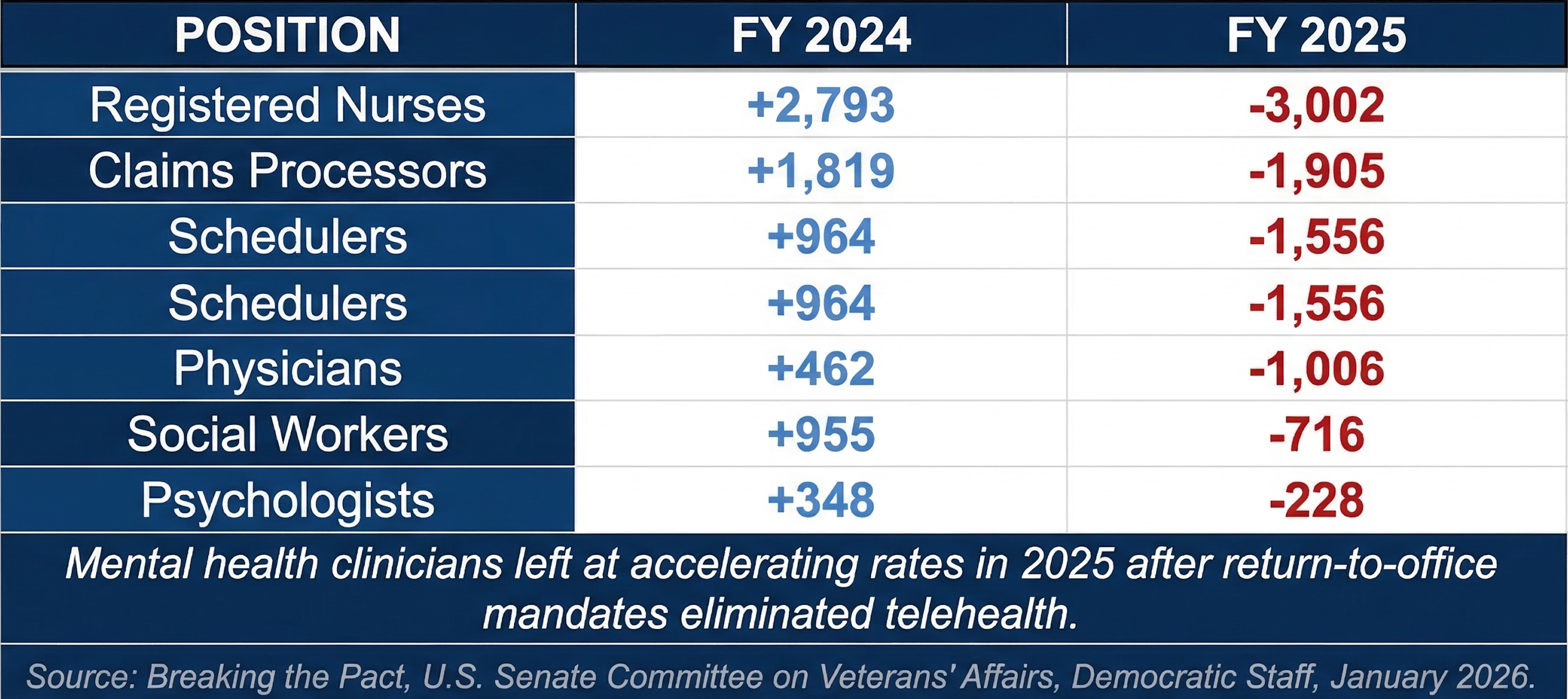
The VA workforce cuts rolled into that broader picture. Collins announced plans to eliminate 83,000 positions through mass layoffs. Veterans, VSOs, and bipartisan members of Congress pushed back — and he walked it back. Then the VA quietly lost more than 40,000 actual employees in a single fiscal year, the first net loss in the Department’s modern history. Eighty-eight percent were health care workers. The people who answer phones. The people who process claims. The people who schedule appointments. The ones who know where your file is and what form you need and what that code means on your rating decision.
Now the administration plans to permanently delete 26,000 to 35,000 vacant positions — welding the door shut so those jobs can never be filled again.
I know what it’s like to wait for that call.
In 1991 I was living 15 minutes at a time. I’d give myself 15 minutes, and if I still wanted to kill myself when the time was up, I could. Then I’d ask myself for just 15 more. I lived by the phone waiting for the VA to call with a mental health appointment. I pinned everything on it. That somebody could help me.
Can you imagine doing 15 minutes at a time for 17 days?
For 40 days?
For 121 days?
As of January 6, 2026, veterans waiting for a first mental health appointment faced waits exceeding 40 days in 15 states. The national mean had more than doubled — from 17 days in May 2024 to over 35 days. The VA’s own standard says 20 days is too long to wait. In 15 states, veterans are waiting more than double that threshold.
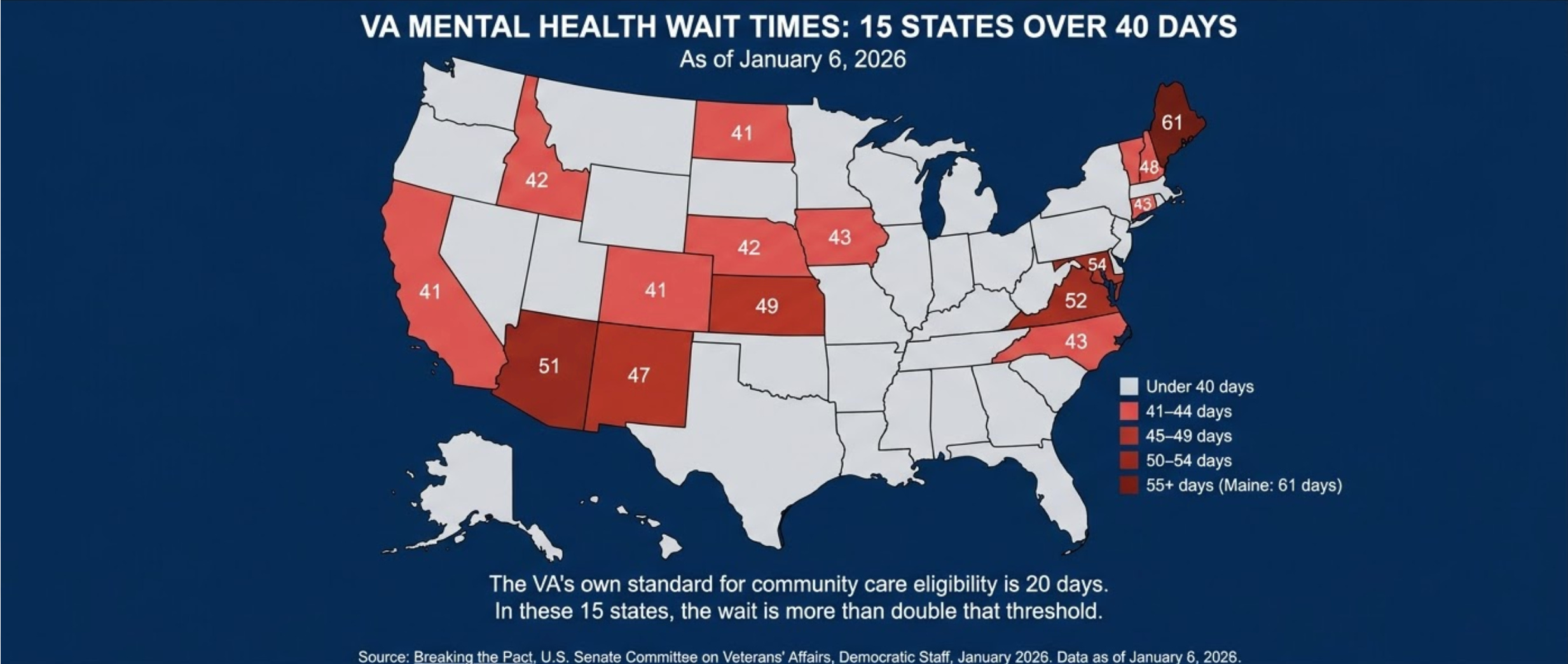
In Ventura, California, seven of twelve mental health providers quit over the return-to-office mandate. Wait times at that clinic hit 121 days.The average wait for a legacy appeal decision is now 3,541 days — nearly ten years. That is 952 days longer than it was in January 2025. Seventy-five thousand student veterans went without their education benefit payments in Fall 2025. The VA gave them no warning.
Fire them. Cut the positions. Delete the jobs. And then tell the veteran that he lacks the “Warrior Ethos” if he can’t figure it out on his own.
The phrase does its work quietly.
And this is before the veterans from OEF 2026 come home.
Hegseth’s Pentagon: The Decree
Defense Secretary Pete Hegseth brought the “Warrior Ethos” framework to the Pentagon as an operating principle. The department used it to justify purging diversity programs, targeting lawmakers who publicly dissented, and reinstating troops who had been discharged for refusing COVID-19 vaccination requirements.
The framing was consistent with the other three deployments of the phrase: the real warrior doesn’t ask for accommodation, doesn’t need protection, doesn’t require support. The warrior simply performs. If you needed the accommodations that are now gone — that’s a you problem.
This is not an argument about military readiness. It is an argument about obligation.
Specifically, about whether the government has one.
The Dependency Narrative, Rebranded
Daniel Gade argued that benefits make veterans dependent. He was working from a real problem — a VA disability system that is genuinely broken in ways that deserve scrutiny — and arriving at a conclusion that conveniently aligned with benefit cuts.
Former VA Secretary Robert Wilkie, from his new position at the Heritage Foundation, accused his former agency of being overly “focused on getting veterans checks and not getting them well and getting them back into society,” and claimed that veterans service organizations encourage former military personnel “to play disability.”
The Heritage Foundation. The same organization that drafts policy blueprints for Republican administrations.
The pipeline from Gade’s book to current executive language is not a coincidence. It is intellectual infrastructure. Build the argument that benefits create weakness, let it circulate in conservative policy circles for four years, and then deploy it in federal documents as the “Warrior Ethos” — a phrase that carries the emotional weight of military culture while doing the analytical work of entitlement reform.
Gade’s argument was uncomfortable because it came from a combat-wounded veteran. “Warrior Ethos” is more powerful because it doesn’t need a critic. It just needs to appear in the preamble of an executive order.
Once it’s there, the logic writes itself: We’re not cutting your benefits. We’re restoring your “Warrior Ethos.” The weak veteran needed the check. The real warrior doesn’t.
What the “Warrior Ethos” Actually Is
Ask a veteran what “Warrior Ethos” means to them.
Not a think tank fellow. Not a policy architect. Not a speaker at a House press conference.
Ask the infantry sergeant who came home with a TBI and spent three years trying to get a C&P exam. Ask the woman veteran who finally proved her MST-related PTSD after a decade of appeals. Ask the Vietnam veteran who found out at 75 that he qualifies for benefits he never knew existed because nobody told him.
They will not describe a philosophy that requires them to prove they don’t need help.
They will describe the person next to them in the foxhole. The one who didn’t leave. The one who kept watch when you couldn’t. The one who carried you when you went down.
The “Warrior Ethos” is about the obligation to the person beside you — not the requirement to perform self-sufficiency for a government that has already gotten what it paid for.
This country got what it paid for when that veteran signed the contract. The obligation runs the other direction now.
The Promise
You don’t restore the “Warrior Ethos” by housing a homeless veteran in a shed smaller than your garage.
You don’t restore it by cutting IVF from the people still serving.
You don’t restore it by firing the claims processors and then calling the backlog a character test.
You restore the “Warrior Ethos” by keeping the promise this country made when that veteran signed a contract giving up their life to defend it.
That promise was not conditional on the veteran’s ability to perform self-sufficiency in the ruins of a system the government deliberately dismantled.
It was a contract.
The warrior held up their end.
Take Action
The pattern is documented. Now it needs to be on the record.
Call Scripts
If you are a veteran:
“I’m calling to express concern about the use of ‘Warrior Ethos’ language in federal documents to justify cutting veteran benefits and VA staffing. The 120-day action plan required by Executive Order 14296 was never submitted. I want to know when my representative plans to demand accountability for that missing plan. My name is [name], I’m a constituent and a veteran, and I’m paying attention.”
If you are a citizen or advocate:
“I’m calling on behalf of veterans in this district who are watching their care system get dismantled while the administration frames it as philosophy. The 120-day plan from EO 14296 was never submitted. Workforce cuts at the VA are creating real backlogs. I want to know what my representative is doing about it.”
Committee Contacts
Senate Veterans’ Affairs Committee Chair: Sen. Jerry Moran (R-KS) — (202) 224-6521 Ranking Member: Sen. Richard Blumenthal (D-CT) — (202) 224-2823 Committee line: (202) 224-9126
House Veterans’ Affairs Committee Chair: Rep. Mike Bost (R-IL) — (202) 225-5661 Ranking Member: Rep. Mark Takano (D-CA) — (202) 225-2305
House Armed Services Committee (NDAA / IVF provision) Chair: Rep. Mike Rogers (R-AL) — (202) 225-3261
Verify current chairs before calling — committee leadership changes. Check congress.gov.
Journalists Covering This Beat
Leo Shane III — Military Times, veterans policy: @LeoShane
Quil Lawrence — NPR veterans correspondent
Rebecca Kheel — Defense and veterans policy reporter
Patricia Kime — Military.com senior reporter
Suzanne Gordon — The American Prospect, VA Champion Substack
Tip line for this investigation: ipersist@tbirdsquietfight.com
VSO Directory
If you need help navigating the VA system while the system is being dismantled:
DAV (Disabled American Veterans): dav.org — (877) 426-2838
VFW National Veterans Service: vfw.org/assistance
American Legion Benefits: legion.org/veteransbenefits
Veterans Service Organizations Directory (VA): va.gov/vso
VSO services are free. Claims agents who charge you money are not VSOs.
RELATED INVESTIGATION: Project Safe Harbor
The National Center for “Warrior Independence” plan relocates homeless veterans from around the country to a single campus in West Los Angeles — away from family, local advocates, and attorneys who know their cases.
A separate TQF investigation is tracking new federal guardianship rules that reduce the procedural protections standing between a vulnerable veteran and the appointment of a legal guardian who controls their housing, finances, and medical decisions.
The questions worth asking: Who benefits when you concentrate isolated veterans on a single campus and simultaneously weaken the guardrails on guardianship? Who ends up controlling their benefits?
If you have information about guardianship abuse targeting veterans, contact the tip line.
Tip line: ipersist@tbirdsquietfight.com
About Tbird’s Quiet Fight
Tbird’s Quiet Fight is an independent investigative publication covering VA policy, federal veteran benefits, and the political systems that shape them. Founded by Tbird, a U.S. Navy veteran and founder of HadIt.com (est. 1997). Not affiliated with any political party, VSO, or commercial interest.
For press and advocates: ipersist@tbirdsquietfight.com
I use AI as a research and editing assistant — the same way I’d use a good reference book or a sharp editor. Every word published here is reviewed, verified, and approved by me. The perspective, accuracy, and editorial decisions are mine.
SOURCES:
Executive Order 14296, Keeping Promises to Veterans and Establishing a National Center for Warrior Independence, May 9, 2025. [Federal Register, 90 FR 20369]
Speaker Mike Johnson statement on 2026 NDAA, December 8, 2025. Via Military.com
Trump 2026 Federal Budget Request, May 2025. Via VeteranLife.com | OMB Discretionary Budget Request PDF
Daniel Gade and Daniel Huang, Wounding Warriors: How Bad Policy Is Making Veterans Sicker and Poorer, Ballast Books, 2021.
Suzanne Gordon and Steve Early, “Trump Is Coming for Veterans’ Disability Benefits,” The American Prospect, December 8, 2025.
Breaking the Pact, U.S. Senate Committee on Veterans’ Affairs, Democratic Staff Minority Report, January 2026.
Prior TQF reporting: “They Promised Housing. They Built Garden Sheds.”